
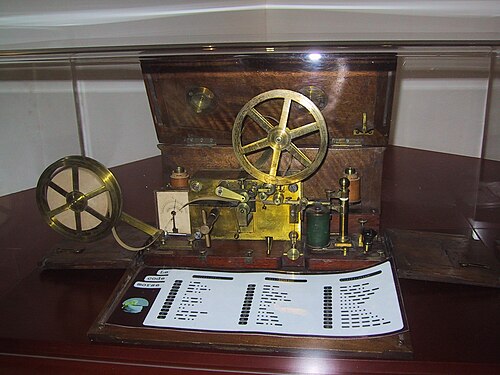
Morse code was developed by Samuel Morse and Alfred Vail in the 1830s. Morse came up with an early system that used numbers and a codebook, while Vail appears to have played an important role in developing the much simpler system that used different combinations of signals for individual letters. Exactly how much each man contributed is still debated, but it was Morse’s name that became attached to the code.
Before the invention of the telegraph, it was almost impossible to communicate quickly over long distances. Letters could be sent by horse, ship, or even bird, but it would take a while for the message to arrive and even longer for a reply to come back. If there was a line of sight, people could communicate using semaphore systems, with different positions representing different letters or symbols. Lamps and other visual signals could also be used, but distance, darkness, and bad weather could make communication difficult. The invention of the electric telegraph changed all of that. Suddenly, information could travel enormous distances almost instantly. Eventually, messages could even be sent across oceans. However, it wasn’t enough to have a telegraph line. People also needed a way to send information through it.
Samuel Morse is an interesting figure because he started out as a portrait painter but ended up becoming an inventor. He studied at Yale University before embarking on a career as an artist. He traveled to England to study art and was admitted to the Royal Academy of Arts. In 1832, he became professor of painting and sculpture at New York University, a position he would hold for many years.
That same year, Morse was traveling back to the United States by ship when he became involved in a conversation about recent discoveries in electromagnetism. This apparently gave him the idea that electrical signals could be used to communicate over long distances. Morse wasn’t the first person to think of an electric telegraph, and several inventors were working on different systems at around the same time, but he began developing his own version.
Some early telegraphs used several wires and a row of needles at the receiving end. One of the best-known examples was the five-needle telegraph developed in Britain by William Cooke and Charles Wheatstone. When electricity was sent through different wires, electromagnets caused two of the needles to move. The needles pointed towards each other and indicated a letter on a grid. It was a clever system because the receiver didn’t need to learn a code, but all of those wires made the system expensive to build and maintain.
Morse wanted a much simpler system that could send information using a single circuit. His early telegraph used a moving strip of paper at the receiving end. The operator at the sending end used a switch to turn the electrical current on and off. When the current arrived at the receiver, an electromagnet pulled a stylus against the paper. The paper was constantly being moved by a clockwork mechanism, so a short electrical signal made a short mark and a longer signal made a longer mark. When the electricity was switched off, a spring pulled the stylus away again.
Morse’s original idea was to use combinations of these marks to represent numbers. The person receiving the message would read the number and then look it up in a special codebook, where each number represented a word. It worked, but it wasn’t particularly convenient. Both the sender and receiver needed the codebook, and any word that wasn’t in it caused problems.
In 1837, an American inventor called Alfred Vail saw Morse demonstrate his telegraph and was fascinated by it. Vail agreed to help finance the project and became Morse’s partner. He was also a skilled mechanic and helped turn Morse’s early machine into a much more practical telegraph.
It was during their work together that Morse’s original numerical system was replaced by a much simpler alphabetic code. Instead of sending a number and then looking it up in a book, combinations of short and long electrical signals could represent individual letters. A message could therefore be spelled out directly. Vail appears to have played an important role in developing this system, although historians still disagree over exactly how much of the code was his work and how much was Morse’s.
The new system required telegraph operators to memorize the code, but once they had learned it, almost any message could be sent without needing a huge codebook. There was another unexpected improvement as well. The original machine was designed to record the dots and dashes on paper, but experienced telegraph operators realized that they could recognize the signals simply by listening to the clicks made by the receiving mechanism. Eventually, the paper wasn’t even necessary.
Morse became the public face of the telegraph and his name became attached to the code. Vail continued working with him for several years but left the telegraph business in 1848, frustrated in part by how little money he was making from it. He died in 1859 at the age of 51. Morse lived until 1872 and became wealthy and internationally famous. Exactly who deserves the most credit for inventing Morse code is still debated, but Vail’s contribution to turning Morse’s original idea into a practical communication system was enormous. And this is what I learned today.
Sources
https://science.howstuffworks.com/innovation/inventions/telegraph.htm
https://en.wikipedia.org/wiki/Morse_code
https://en.wikipedia.org/wiki/Alfred_Vail
https://en.wikipedia.org/wiki/Samuel_Morse
https://en.wikipedia.org/wiki/Electrical_telegraph#Morse_system
Image By (c) 2006 Zubro – image by myself, CC BY-SA 3.0, https://commons.wikimedia.org/w/index.php?curid=1336642