
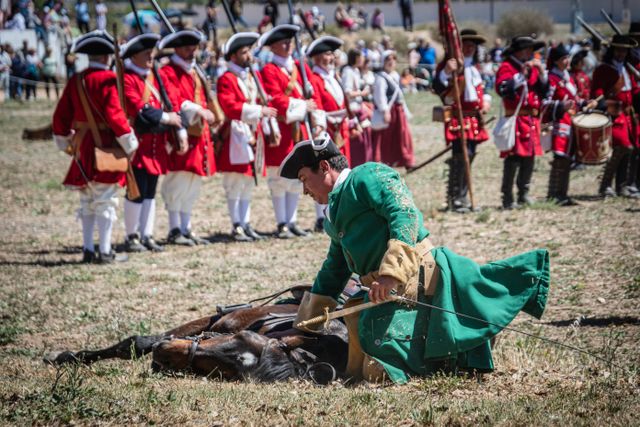
Why did armies use brightly colored uniforms? Armies used to use brightly colored uniforms so that the commanders could easily see their troops, prevent friendly fire, project national pride, instill fear in the enemy, and help to direct a battle. This stopped with the development of modern conventional weapons and tactics.
Warriors have worn one type of uniform or another for thousands of years. Even before people gathered in settlements, they wore different types of face paints or markings to differentiate themselves. This gave them a strong feeling of belong to one group and probably helped them to see the “other” group as different and an enemy. Ancient armies always used some kind of uniform. Roman soldiers were well-known for their uniform and appearance. They were easy to spot from a long way away and this often instilled fear in the enemy, which is one purpose of a uniform. In medieval times, there were not really national armies, but a collection of forces controlled by regional lords. These troops would have worn markings on their shields to identify them. Once national armies became a thing, it became necessary to dress them in a uniform. It needed to be recognizable. Let’s look at why.
The first reason is for the commanders of each army. Let’s take the British and the French armies as examples. The British army were dressed in red, and this earned them the nickname redcoats. Red was said to be the national color of England, but the main reason might have been that red dye was cheap and made the uniforms easy to mass produce. The French army were dressed in blue. When two armies went into battle, they usually formed squares and marched at each other until they were close enough to fight with swords or bayonets. By the 16th century, muskets were available, but they were not accurate and couldn’t fire very far. Forces still formed squares for safety. The only way for commanders to communicate with their troops was to send down riders who would carry messages to the leader of each division. The commanders had to be somewhere high where they could see the whole battle and they often viewed it from a nearby hill. Having a national uniform that was distinct and clearly visible, helped them to see the direction of the battle and where their troops were.
The second reason is similar to the first. The commanders needed to see where their troops were, but soldiers also needed to know where the other soldiers in their army where. In the heat of battle, it is difficult to think, so having an easily recognizable uniform helps. It also helped soldiers not kill each other. Muskets and canons release a lot of smoke, which made it difficult to see clearly on a battlefield. A bright red uniform is easy to see through the smoke and reduces the chances of friendly fire.
Having a single bright uniform also helped inspire the troops. Going into battle is a terrifying experience and being able to see a mass of people wearing the same color clothes as you would give a big boost in confidence. The mass of a unified color coming out of the mist can also instill fear into the enemy.
The tradition of wearing bright colors started to disappear in the 19th century and by the time World War I arrived, it had disappeared completely. The main reason for this was the power of the weapons that were available. Muskets produced a lot of smoke and bright uniforms made a soldier visible. The musket ball was also unlikely to do much damage. The invention of smokeless powder and rifles made it much easier to see on the battlefield. And through the 19th century rifles became much more accurate and able to fire over a much greater distance. It was very easy for soldiers to pick off brightly colored soldiers. This made traditional uniforms obsolete. Britain, for example, shifted to a khaki colored uniform for its forces in Indian in 1848. That made it harder to see them because they blended in with the surroundings. By World War I, all of the countries that participated had shifted to grey, green, or brown colors. And by the time World War II had arrived, camouflage materials were becoming common. The style of warfare had changed because of the weapons available. And this is what I learned today.
Sources
https://en.wikipedia.org/wiki/Military_uniform
https://kabinettskriege.blogspot.com/2018/04/how-impractical-were-eighteenth-century.html
https://iotserver4g.trumeter.com/iot/when-did-the-british-army-stop-wearing-red-coats-1tato3s
Photo by Jesús Esteban San José: https://www.pexels.com/photo/man-sitting-above-lying-horse-16563533/