
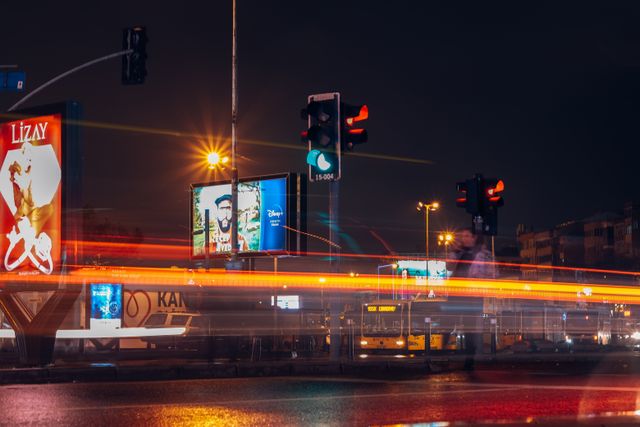
When did billboards become a thing? Billboards have been around for years, but the modern style was created in the early 19th century. Billboards really took off with the growth of modern transportation.
A board to post bills on has been around since people have been able to write on some kind of material, such as papyrus or parchment. You could even say that some of the writings chiseled into stone are bills. A bill is technically a written notice or document and the English word comes from the Medieval Latin billa, which meant a written document, list, or note. That word had evolved from the early Latin bulla, which meant the seal that was attached to an official document and which eventually became associated with the document itself. We still use the word “bill” in the same sense. A bill in Parliament. Bill of sale. A playbill. No bills posted here. By the 16th century in England, the word had become associated with an announcement or advertisement that was posted publicly.
Large advertisements had been displayed in towns for centuries, but printing large, complicated illustrations was difficult. Posters were often dominated by text, with illustrations produced using techniques such as woodcuts. That is fine, but an image obviously captures the attention more effectively than words do. Some adverts were hand drawn images, but it would take the artist a long time to produce even one. Books could be mass produced by using movable text and woodblock images, but you couldn’t use that for something as large as a poster. The first step on the journey to modern billboards was the invention of lithography by Alois Senefelder, a German author and actor. A lithograph uses the properties of grease and water to attract or repel oil based ink. An artist painted on a limestone plate with grease. The limestone slate was wiped with water and the places with grease repelled the water, leaving the non greasy parts wet. Then the slate was covered in an oil based ink. The ink stuck to the greasy areas and none stuck to the wet areas. This slate could then be stamped onto a piece of paper. By using different slates with different colors, a full color image could be built up on the poster. This system allowed for bigger posters to be printed much more quickly.
The new technology of lithography allowed for more complex and sophisticated posters. It also meant they could be bigger. An American called Jared Bell is often credited with producing some of the first large style posters to advertise his circus in the 1830s. He may have produced some of the first, but there is no way of knowing if he actually was the first.
Printing technology improved over the coming years and the number of billboards in cities increased. Mid 19th century cities probably looked a lot different to cities from half a century earlier. Advertising would have been very common. There were different sized billboards and they were displayed in a host of different places, often attached to the sides of buildings. Most outdoor advertising was concentrated wherever large numbers of people would see it — busy streets, town centers, entertainment districts and other heavily travelled places. The point of a billboard is to show a product to a potential customer and these customers were mostly in cities.
The first change to the location of billboards came with the invention of railways. Train stations offered a potential location that a lot of people would pass through. Train stations had advertising for the train company that owned the station, but they also rented out advertising space to normal businesses. The businesses had to pay money to the railway, but they soon realized that people looking out of train windows were a captive audience and they started to put up billboards along the railway lines. This is probably one of the biggest milestones in the evolution of billboards.
This means that when the automobile came along, the idea to put billboards up along a line of transport already existed. Early cars were mostly used in cities, but as they improved, they were able to travel further and further. It wasn’t long before there were highways and roads criss crossing the country. This gave advertisers a lot more area in which to place their billboards and the number of billboards rapidly increased throughout the 20th century. Now, they are everywhere.
Sources
https://en.wikipedia.org/wiki/Billboard
https://bigscreen.my/billboard-advertising
https://en.wikipedia.org/wiki/Lithography
Photo by Tahir Osman: https://www.pexels.com/photo/traffic-on-city-street-14780175/