
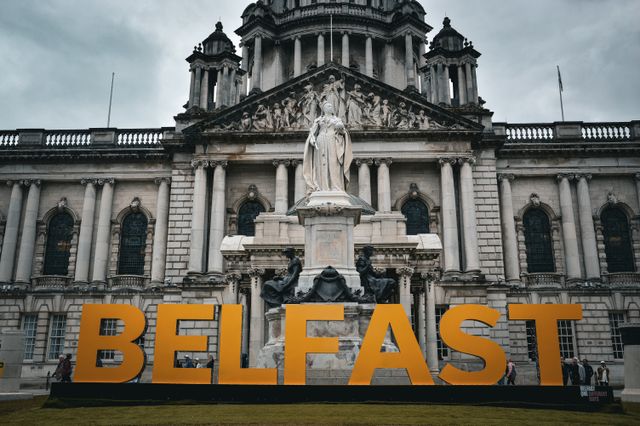
What caused “The Troubles” in Ireland? “The Troubles” in Ireland had many causes that spanned centuries. I am going to look at four of the main causes today. These are the centuries of religious and political division, the partition of Ireland in 1921, the civil rights protests of the 1960s, and the escalating violence.
The origin of “The Troubles” can be traced back to 1169, when Anglo-Norman forces began invading Ireland. King Henry II of England arrived in 1171 to establish his authority over the country. He sent forces to colonize it and they began to settle in the area around Dublin. The area that was controlled by England had a fence and a ditch around it and it was called the pale. The rest of Ireland was controlled by Gaelic tribes. Going beyond this boundary was dangerous and it is probably where the saying “beyond the pale” comes from. The colonization continued, but some parts of Ireland rebelled. One of these areas was Ulster and James I started sending more settlers across. He believed that if he could settle thousands of loyal English and Scottish people, it would stop the rebellions. To do this, he started to take Irish land and give it to the settlers. This started in 1609 and there were many reasons, but one of them was to decrease the number of Catholics in the area and increase the number of Protestants. This began the division of religion in the north of Ireland, and it is one of the causes of “The Troubles”. It led to religious and political discrimination against Catholics. They couldn’t get jobs and life was made difficult for them. Because many of the protestants had roots coming from England and the Catholics were already in Ireland, over time, the Protestants wanted to remain connected to Britain and the Catholics wanted to separate.
A second cause was the partition of Ireland in 1921. The whole of Ireland had become part of Britain in 1801. However, by the start of the twentieth century it was becoming very difficult to rule because of numerous uprisings. Britain decided to partition Ireland into two separate self-governing regions. Almost along the lines of modern day Ireland and Northern Ireland. Before then Ireland was made up of 32 counties and Britain decided to put 26 of them in Southern Ireland, governed from Dublin, and the other 6 in Northern Ireland, governed from Belfast. The problem was, the traditional province of Ulster had nine counties, but including all nine would have left unionists with only a narrow majority. Unionist leaders pushed for a six-county Northern Ireland, where they would have a much stronger majority, and the British government agreed. In 1922, the southern 26 counties became the Irish Free State. Northern Ireland was given the option of joining it, but its Protestant-dominated parliament chose to remain in the UK. This left a substantial Catholic minority living under a government they largely opposed.
The third cause is the civil rights protests. Because Northern Ireland was mostly Protestant controlled, there was a lot of discrimination against the Catholics. Catholics frequently faced discrimination in employment and public housing. Electoral boundaries and voting rules also made it difficult for them to gain fair political representation. These grievances led them to protest for their rights. In the 1960s, civil rights movements were spreading across the world, led by the African American marches in the United States. Campaigners in Northern Ireland started to organize demonstrations for equal rights. One of these demonstrations was brutally put down by the police in 1968 and the images spread through the media. This started to increase the tension and campaigners on both sides began to distrust each other even more. By August of 1969, there were serious riots and British soldiers were deployed to restore order.
The fourth reason is the cycle of violence. As each group’s distrust grew, they began to arm themselves. They began to attack each other, civilians, and the British forces. Republican paramilitary groups, particularly the Irish Republican Army (IRA), fought to remove British rule and reunite Ireland. Loyalist paramilitary groups fought to keep Northern Ireland in the UK. As the violence escalated, both sides carried out shootings and bombings, frequently killing civilians. British security forces also became heavily involved in the conflict. Each attack led to retaliations and the violence became self-perpetuating. Each reprisal had to be bigger and that led to reprisals in turn. “The Troubles” grew bigger and bigger and thousands were killed.
By the late 1990s, people on every side could see that violence wasn’t going to solve anything. The violence had been going on for over three decades and none of the three sides (Unionist, Republicans, and British) had changed their original view. It became obvious that the question was not who Northern Ireland belonged to, but how people with different national identities could govern together and live together. This led to the Good Friday Agreement in 1998 and a set of principles that all sides could be happy with. Northern Ireland would remain in the UK unless a majority voted to join Ireland. (An analysis of opinion polls published in October 2026 found that 48% of people in Northern Ireland wanted to remain in the UK, 35% supported reunification, and 17% were undecided.) Unionist and Nationalists would share government. People could identify as Irish, British, or both. New institutions would encourage cross-border cooperation. There would be commitments to disarmament, security changes, and prisoner releases. All concessions that every side could live with. And this is what I learned today.
Sources
https://en.wikipedia.org/wiki/The_Troubles
https://en.wikipedia.org/wiki/Plantation_of_Ulster
https://www.iwm.org.uk/history/cold-war/the-troubles
Photo by David Coleman: https://www.pexels.com/photo/belfast-city-hall-with-prominent-sculpture-34727214/