
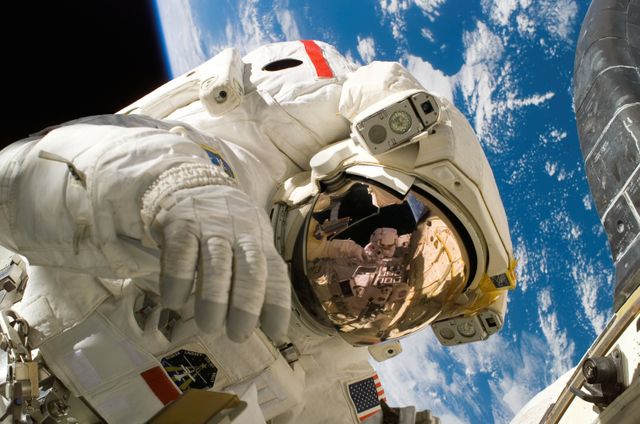
Why do spacesuits pick up so much static electricity on the Moon? Static electricity builds up on spacesuits for some of the same reasons it builds up on our clothes on Earth. As astronauts walk and move, their suits rub against other materials, allowing electrical charges to build up. However, conditions on the Moon make it much harder for those charges to dissipate. Spacesuits themselves also contribute to the problem because they contain layers of insulating materials. And there is another source of electrical charging on the Moon: the Sun. Even if you wore ordinary clothes, static electricity would still be a problem. However, if you walked on the Moon in jeans and a T-shirt, static electricity wouldn’t be your most pressing concern. It is worth noting that everything on the Moon builds up static electricity, not just spacesuits.
Static electricity on the Moon can cause two serious problems. The first is that astronauts can accumulate significant electrical charges. When they return to their spacecraft, these charges could produce sparks that might damage sensitive electronics or ignite combustible materials in an oxygen-rich environment. The second problem is lunar dust. Electrically charged spacesuits can attract enormous amounts of dust, which can interfere with their equipment and be carried back into the spacecraft.
So, why is static electricity such a problem on the Moon? Static electricity produced when two materials come into contact and separate is called triboelectric charging. Electrons can transfer from one material to another, leaving one positively charged and the other negatively charged. This happens on Earth as well. However, we have several ways for electrical charges to dissipate on Earth. Moisture in the air and on surfaces can help charge leak away, and contact with conductive materials can allow electricity to flow into the ground. We have looked before at why static electricity is more common in dry rooms than humid ones.
The Moon is different. It has virtually no atmosphere, no moisture, and a surface covered in extremely dry dust and broken rock called regolith. This regolith is a very poor electrical conductor. That means electrical charges cannot easily flow away through the ground. Spacesuits make the problem more complicated because they contain several layers of different materials, many of which are electrical insulators. Charges can accumulate on different parts of the suit without an easy way to remove them.
There is also another source of electrical charging: space itself. Unlike Earth, the Moon has no substantial atmosphere or global magnetic field to protect its surface from the Sun. Ultraviolet radiation can knock electrons out of lunar dust, leaving the dust positively charged. At the same time, the solar wind carries electrically charged particles that can deposit electrons on the surface. In areas without sunlight, the surface can become negatively charged. Astronauts and their equipment are exposed to this electrical environment as well.
All of this makes lunar dust an enormous problem. If you have ever tried to refill a beanbag with tiny polystyrene balls, you will know what happens. They stick to everything because of static electricity. Lunar dust behaves in a similar way, although static electricity isn’t the only reason it sticks. The particles are also extremely fine, sharp, and abrasive. During the Apollo missions, astronauts discovered that the dust was incredibly difficult to brush off their spacesuits. It could scratch surfaces, interfere with moving parts, and get inside the lunar module.
NASA is developing several ways to deal with this problem. One of them is called an Electrodynamic Dust Shield. This uses a series of electrodes to create changing electric fields that move dust particles across a surface and remove them. The technology could eventually be used on spacesuit visors, boots, and other equipment. In March 2025, NASA successfully demonstrated the technology on the Moon using a robotic lander. However, removing accumulated electrical charges from an entire spacesuit remains a difficult problem, and NASA is still looking for solutions. They need to find a way to bleed the static electricity from the astronaut before they touch the ladder to the lander or get into the airlock. It is such a tricky problem that they are offering a significant prize. And this is what I learned today.
Sources
https://www.universetoday.com/articles/static-electricity-in-space
https://ntrs.nasa.gov/api/citations/19700004167/downloads/19700004167.pdf
https://ttu-ir.tdl.org/server/api/core/bitstreams/3c3f160c-4b29-49a3-a6fc-6878d740ab64/content