
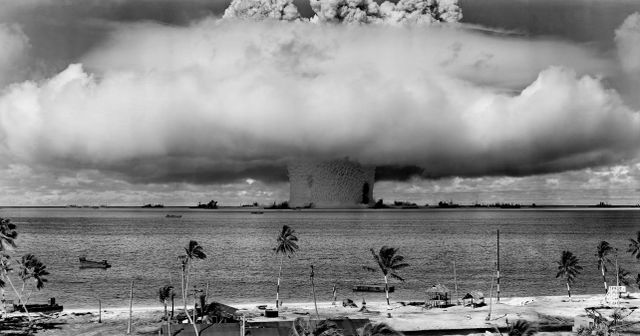
What causes nuclear winter? A nuclear winter is caused by soot, ash, and other particles being kicked up into the atmosphere by a nuclear war. These particles block out sunlight, and the temperature on the surface of Earth would be drastically reduced. A nuclear winter caused by nuclear weapons has thankfully never happened. We have had nuclear winters, but they have been caused by volcanoes and asteroid impacts. We’ll cover them at the end.
A nuclear winter happens when enormous quantities of soot and ash are lifted up into the stratosphere, the layer that is higher than most weather systems. The soot could be carried around the globe, and if there is enough soot, it can create a black layer over the Earth. The black soot absorbs sunlight, preventing much of it from reaching Earth’s surface. This causes the temperature at ground level to fall. Ironically, the upper atmosphere becomes hotter even as the surface cools. The soot absorbs solar radiation and heats the air around it, causing it to rise and potentially carrying the soot even higher. Because the stratosphere is above most weather systems, rain cannot easily wash the soot out, allowing it to remain there for years.
There are nine countries that we know of that have nuclear weapons. Between them, they have over 12,000 nuclear warheads. This is more than enough to destroy every city on Earth. And, so far, these countries have tested 2,056 nuclear weapons. These tests have been carefully controlled for obvious reasons. None of these tests have come close to causing a nuclear winter, and that is because it is not caused by the nuclear explosion itself.
A nuclear winter would be caused by the fires that nuclear weapons cause. When the nuclear bomb was dropped on Hiroshima, the initial explosion was devastating, but it was the fires caused by the tremendous heat that caused more damage and death. These burning cities produce huge clouds of black soot and ash. But one city wouldn’t produce enough. Nobody knows exactly how many nuclear explosions would be needed to produce a nuclear winter. Some studies suggest that even a regional nuclear war involving around 100 Hiroshima-sized weapons could cause significant global cooling. The important factor isn’t the number of bombs, but how much soot from the resulting fires reaches the stratosphere. The surface area of the Earth is big, and it would take a staggering amount of soot to completely cover it.
Nobody knows how much the temperature on the surface would drop, but one study thought that 150 million tons of soot in the stratosphere could equate to a drop of 16 degrees Celsius. To put that in perspective, the temperature difference between today and the last ice age was only a few degrees. And cooling before an ice age happens over thousands of years. A nuclear winter would happen in weeks.
The biggest problem with a nuclear winter is starvation. We have the technology to keep warm if temperatures drop that low, but we can’t heat all of the crops we grow. The lower temperature and lack of sunlight would decimate world crops. A study in 2022 estimated that the famine caused by a nuclear winter could kill five billion people.
Hopefully we will never experience a nuclear winter, but similar global cooling has happened before. In 1815, Mount Tambora erupted in Indonesia, releasing enormous quantities of ash and sulfur dioxide into the atmosphere. The sulfur dioxide formed tiny particles that reflected sunlight, cooling the Earth’s surface. The following year, 1816, became known as the Year Without a Summer because of the unusually cold weather and widespread crop failures.
One of the most devastating examples of a similar event happened 66 million years ago, when an asteroid approximately 10 kilometers wide struck Earth and contributed to the extinction of the dinosaurs. The impact blasted enormous quantities of rock and dust into the atmosphere and caused devastating tsunamis and fires. Scientists believe that dust, sulfur-containing particles, and soot blocked sunlight and caused an impact winter. Global temperatures fell dramatically, and plants struggled to grow without sufficient sunlight. This disrupted food chains around the world, contributing to the extinction of about 75% of Earth’s species, including all non-avian dinosaurs. And this is what I learned today.
Sources
https://en.wikipedia.org/wiki/Nuclear_winter
https://www.ebsco.com/research-starters/science/nuclear-winter
https://en.wikipedia.org/wiki/Chicxulub_crater
Photo by Pixabay: https://www.pexels.com/photo/grayscale-photo-of-explosion-on-the-beach-73909/