
Where did Halloween come from? Halloween is the shortened form of All Hallows’ Eve, and it probably originated with the Irish Gaelic harvest festival called Samhain. The traditions of Samhain and All Hallows Eve were carried across to the United States by Irish and Scottish immigrants.
Modern Halloween probably has roots in the Irish harvest festival, Samhain, but also the Christian celebration of Allhallowtide. However, different elements were brought by different cultures, and modern Halloween is a mix of things. By modern Halloween, I am talking about the famous one celebrated in the United States.
There isn’t much written information about how Samhain was originally celebrated. Although the ancient Irish had a writing system called Ogham, most surviving inscriptions are very short. Much of what we know about Samhain comes from medieval manuscripts written by Christian monks, centuries after the festival began. However, we do know that it was a harvest festival celebrated on the day that roughly equals November 1st today. The Irish and Scottish word for November is Samhain. The Celtic day began and ended at sunset, so celebrations would have started in the evening of October 31st. It marked the end of the harvest, and the line between the light of the summer and the dark of the winter. So, what parts of Samhain have been carried over into modern Halloween?
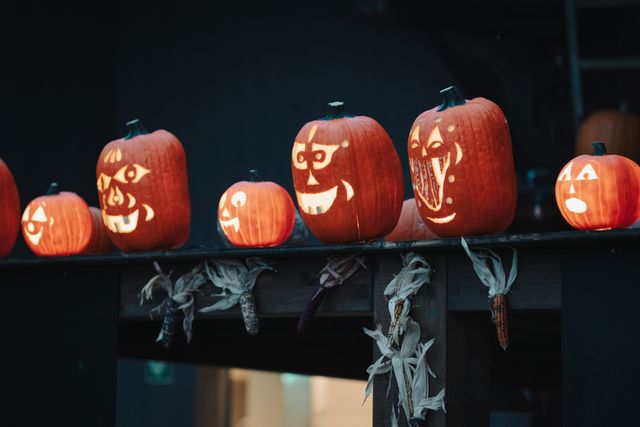
It was said to be a time when the doorway to the Otherworld opened, letting supernatural beings and the souls of the dead enter our world. It was said to be a dangerous time when the barrier between our world and the Otherworld could be easily crossed. Later Halloween traditions in Ireland and Scotland included guising, where people dressed in costumes and visited houses, sometimes singing songs or performing in exchange for food. This tradition may have contributed to modern trick-or-treating, although we don’t know whether it existed during the original pre-Christian Samhain celebrations. If they weren’t welcomed or given food, they would perform mischief. The idea of ghosts, monsters, and spirits, represented by costumes and displays, and the tradition of trick-or-treating could have come from here. People often had a large bonfire on the hilltops, which is a custom that hasn’t continued in the USA. People also carved faces out of turnips and put candles inside them, making turnip lanterns called Sean na Gealai. When the Irish immigrants took this tradition across to the United States, pumpkins were more available than turnips, so they switched to those.
Allhallowtide is a Christian celebration that was brought to Britain and intermingled with the celebration of Samhain. Allhallowtide is three days that are to celebrate the death of Christian martyrs, saints, and the faithful departed. The words mean all (every) hallow (holy) tide (time). In the early days of Christianity, Christians were heavily persecuted, and there were a lot of martyrs. Martyrs were individually given a day to be celebrated on, but soon there were too many martyrs, so they were all lumped together.
Allhallowtide consists of three days. Some of the customs are similar to Samhain. Some people think this was intentional to help convert Celtic people to Christianity. Some people think it is just a coincidence. October 31st is All Hallows’ Eve, shortened to Halloween. It is a day when the line between the material world and the afterlife thins. People sometimes wear masks so that they are not recognized by a soul from the afterlife. The costume and mask tradition could have come from here. November 1st is All Hallows’ Day, and it is the main feast day for the church. It is a day to commemorate all of the martyrs and saints. Many Christians visit graveyards to place flowers and candles on the graves of their family. It is a holy day of obligation, so people are supposed to attend church. And the third day is All Souls’ Day, which is the day to remember all souls that have departed. In some countries, on this day, children and poor people go around houses to beg for apples, money, or cakes. This is called souling. If they weren’t received well, they could perform mischief, which might be another source of trick-or-treating.
Many of the festivities that we see in the modern Halloween can be traced back to either Samhain in Ireland or All Hallows’ Eve. However, many of them are modern inventions. The enormous commercialization of Halloween is certainly something that is modern. The idea behind trick or treat might come from thousands of years ago, but the words “trick or treat” were only used beginning in the 20th century. And this is what I learned today.
Sources
https://en.wikipedia.org/wiki/Halloween
https://en.wikipedia.org/wiki/Allhallowtide
https://en.wikipedia.org/wiki/Samhain
https://www.britannica.com/topic/Where-did-Halloween-come-from
https://www.bbc.co.uk/news/articles/cj4d40rwwyjo
Photo by Sergio Zhukov: https://www.pexels.com/photo/halloween-jack-o-lanterns-display-at-night-40398542/