
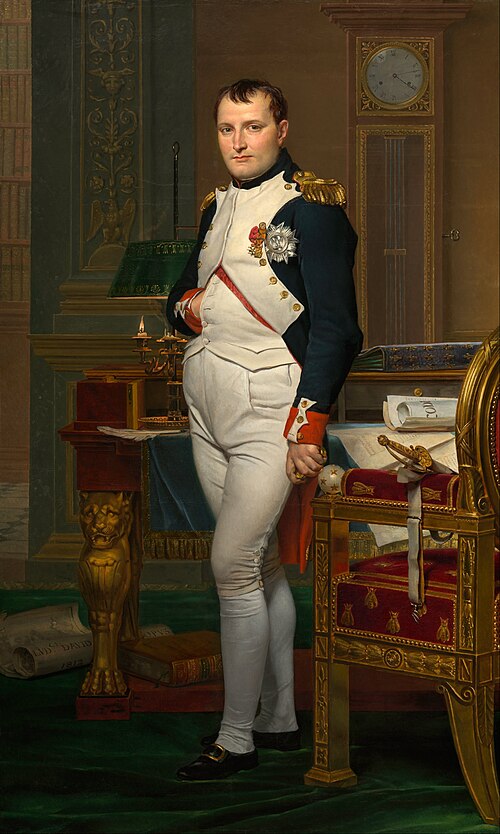
Did arsenic poisoning really kill Napoleon? No, Napoleon was not killed by arsenic poisoning.
Napoleon died on 5 May 1821. He was 51 years old, which was a relatively young age to die in 1821. We have an image that everybody died young in the 19th century, but that is not true. The average life expectancy was only about 35, but that average was very heavily skewed by the number of infants and children who died. People who lived past their childhood had a very good chance of living into their 60s. Obviously, their level of wealth would have had an impact on how long they lived, which would mean that Napoleon should have lived into his 60s at least. He was wealthy, had access to good doctors, and was protected on the Island of Saint Helena, where he was imprisoned. So, when he died at such a young age, it sparked theories that he had been poisoned. In fact, Napoleon himself possibly believed he had been poisoned. Three weeks before he died, he wrote in his will, “I die before my time, murdered by the English oligarchy and its assassin.”
There were generally two branches to the poison theory. The first is that he was intentionally poisoned, and the second is that he was accidentally poisoned. Let’s look at both of them and then look at what modern research has uncovered.
Napoleon was born in 1769. He joined the army in 1785, and his rise was meteoric. By the age of 24, he was a brigadier general, and by 29 he seized power in France, becoming the First Consul. He crowned himself Emperor in 1804 at the age of 35. He led these armies across Europe, conquering Italy, Spain, Austria, and attempting to conquer Russia. He was finally defeated in 1814 and exiled to the Mediterranean island of Elba. He escapes in early 1815 and regains power in France again. He was defeated at the Battle of Waterloo in June of 1815 and exiled again. This time to the island of Saint Helena, a British island. This was chosen over Elba because he had escaped from Elba relatively easily. Saint Helena was in the middle of the South Atlantic, had steep cliffs all around it, 3,000 soldiers guarding it, and Royal Navy ships patrolling its waters. The British even occupied the nearby Ascension Island so it couldn’t be used as a base to launch a rescue attempt. Despite that, there was an attempt to rescue him using a submarine, but it was unsuccessful. Napoleon died on the island of Saint Helena six years later.
Now, if anybody wanted to assassinate him, there was no shortage of suspects. Britain and all of its allies could have been worried that Napoleon would escape and try to regain power again. However, escape was very unlikely. The European powers were united in keeping him on Saint Helena. And, even if he had managed to escape, the monarchy had been restored in France, and he wouldn’t have been able to take power easily. His supporters in France were also being repressed. He did have supporters, but taking power again was very unlikely. And the Allies knew this. Poisoning him would have made him a martyr and achieved less than keeping him imprisoned on the island.
The second theory is that he was accidentally poisoned by the green wallpaper in his bedroom. The theory is that the pigment used to color the green wallpaper used in Napoleon’s bedroom, and many other bedrooms was copper arsenite, which produced arsenic dust. But Napoleon wasn’t the only person to have this kind of wallpaper in his room. Since the introduction of oil lamps in the 1850s, rooms became brighter, and there was a change in interior decorating. People started to choose darker colors because they could still see, thanks to the oil lamps. In fact, tests have been run on Napoleon’s hair, and they showed that he had 100 times more arsenic in his body than people today. However, hair tested from Napoleon in his youth and other people alive at the time showed that this was a relatively normal amount of arsenic to have in the body. Less was known about it at the time, and far more things produced arsenic than we use today. If Napoleon’s later hair had shown a greater concentration of arsenic, the theory could have had legs, but it didn’t.
At the time, the cause of death was given as stomach cancer. Many people didn’t believe it, and the two theories I have outlined became popular. However, analysis of his hair and a study by eight international gastrointestinal pathologists concluded that he had definitely died of stomach cancer. They studied the case in 2021 to mark the 200th anniversary of his death. The researchers concluded that the extensive damage described in his stomach, together with his worsening health and symptoms before death, provided strong evidence that cancer was responsible. A perfectly normal and not suspicious death. And this is what I learned today.
Sources
https://cerncourier.com/a/particle-physics-proves-that-arsenic-didnt-kill-napoleon
https://www.amnh.org/explore/news-blogs/was-napoleon-poisoned
https://en.wikipedia.org/wiki/Death_of_Napoleon
https://link.springer.com/article/10.1007/s00428-021-03061-1