
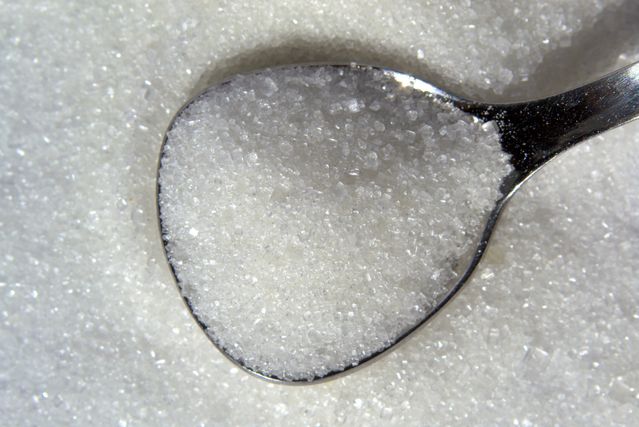
Why does sugar dissolve in water but sand doesn’t? Sugar dissolves in water while sand doesn’t because the internal structures of their crystals are very different.
If you put a sugar cube into your cup of coffee, it will slowly lose the corners, then get smaller and smaller until it has completely disintegrated. However, when you drink that cup of coffee, it will still taste sweet. That means even though the sugar has disappeared, it is still in the coffee. So, what has happened?
When sugar dissolves in water, it doesn’t disappear. A sugar cube is made up of roughly 20,000 sugar crystals. However, when we go down to the individual crystal level, we can see that a single sugar crystal is made up of many sugar molecules. A typical table sugar crystal contains roughly 600 quadrillion sucrose molecules. That is a 6 followed by 17 zeroes. It is a lot. One sugar molecule is made up of 12 carbon atoms, 22 hydrogen atoms, and 11 oxygen atoms. The atoms are strongly held together in the molecule by covalent bonds, but each sugar molecule is held to another sugar molecule by a hydrogen bond. In any molecule with oxygen and hydrogen, the oxygen attracts electrons more strongly than the hydrogen does. This makes the oxygen slightly negative and the hydrogen slightly positive. A hydrogen bond is where the slightly positively charged hydrogen atoms in one molecule are attracted to the slightly negatively charged oxygen atoms in another molecule. It is not a very strong bond, but it is strong enough to hold quadrillions of sugar molecules together in a sugar crystal.
When we put sugar in our coffee, there are always sugar molecules on the outside of the crystal that are exposed to the water. Molecules inside are surrounded by sugar, but on the outside, they are only in contact with other sugar molecules on one side. Water also contains hydrogen and oxygen and water also creates hydrogen bonds. Water molecules are constantly moving, while the sugar molecules in the crystal are vibrating. When water molecules come into contact with the surface of the crystal, they form hydrogen bonds with the exposed sugar molecules. Sometimes, molecular motion allows a sugar molecule to leave the crystal. Water molecules then surround it and form new hydrogen bonds with it, helping it remain dissolved. This leaves another sugar molecule exposed, and it continues until all of the molecules from the crystal have been pulled away and are suspended in the water. However, the molecules are still intact, which is why the coffee tastes sweet. And if you were to evaporate all of the water in that coffee, you would be left with the sugar.
So, why doesn’t the same thing happen to sand? Sand doesn’t readily dissolve in water because its atoms are joined together in a completely different way from the molecules in a sugar crystal. Most ordinary sand contains a lot of quartz, which is made up of silicon atoms and oxygen atoms. Each silicon atom is bonded to four oxygen atoms. They are bonded with covalent bonds, which is when atoms share a pair of electrons. It is a very strong bond. In sand, the silicon atoms and oxygen atoms bond with other silicon and oxygen atoms, creating an enormous, continuous, three-dimensional network. Water can interact with the surface of sand in just the same way it interacts with the surface of sugar crystals, but the water cannot break off individual quartz molecules because there aren’t any. They are connected in one lattice.
It is possible to dissolve sand, but it requires a chemical process that can disrupt the bonds between the atoms. Quartz can be attacked by certain chemicals, such as hydrofluoric acid, which reacts with the silicon–oxygen network and breaks it down. Water can actually dissolve a small amount of sand, but it takes a very long time. There are chemical changes at the surface of the quartz crystals, but it takes so long that we are talking geological timescales. However, these interactions are an important part of weathering and they can change the shape of rocks.
So, if you put sugar in your coffee, you will have sweet coffee. If you put sand in your coffee, you will be left with a mouthful of sand at the end. And this is what I learned today.
Sources
https://iopscience.iop.org/article/10.1088/1757-899X/858/1/012047
https://en.wikipedia.org/wiki/Covalent_bond
https://chemistry.stackexchange.com/questions/18363/why-is-sand-that-insoluble
https://www.bbc.co.uk/bitesize/articles/zs9sp4j#zndvf82
Photo by Irma Sjachlan: https://www.pexels.com/photo/close-up-of-sugar-crystals-in-metal-spoon-37105892/