
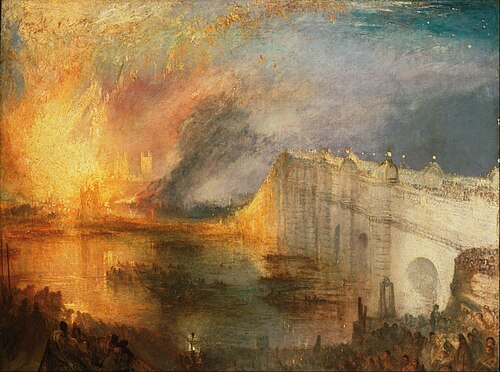
How did tally sticks burn down the Houses of Parliament? In 1834, the furnace in the Houses of Parliament was overloaded by the burning of tally sticks, and the resultant fire destroyed most of the building.
A tally stick started out literally as a stick with a mark on it used to tally or count something. Archeologists have found ancient bones with marks on them dating back to about 35,000 years ago. The Lebombo bone is the oldest of these, and it is the fibula of a baboon. It has been dated to roughly 44,000 years ago. It has marks on it which may be the first ever evidence of mathematics. Once civilizations formed, tally sticks were an easy way of recording counts and saving them.
In Medieval Europe, a system called the split tally developed. It was necessary to collect taxes, lend money, and make promises of payment, but the majority of people could not read or write. The easiest way to remember what was owed was to make notches on a stick and then split it in half. Both halves would contain the exact same notches. One half would be kept by the debtor and one half by the creditor. And the grain in the wood made them unique so they could not be forged. When the debt was repaid, the two pieces were put back together again. People still tried to tamper with them, so the system was improved upon. The two halves of the stick were made different lengths. The longer part was called the “stock” and was given to the person who had put up the money or the goods. This is where the word “stock” in stocks and shares comes from. The shorter part was called the “foil” and was given to the person who had borrowed the money or received the goods. Splitting them in this way meant that not only was the grain unique, but the part where they had split was also unique. And if one person tried to add more notches, the other half wouldn’t have the notches. And it would not be possible to remove the notches. It was a remarkably effective system.
The word stock came to mean the “stock” in stocks and shares because it was possible to buy someone else’s debt. If you owe me 100 pounds and I have my tally stick to prove that, I can sell the tally stick to someone else and they now own your debt. Or if it is a promise to buy something or to pay for something, I can sell that too. The price of the item might go up or down, and the person who holds the stock stick could make or lose money.
Tallies spread across Europe and were occasionally even used as a form of currency. If your tally stick is worth 100 pounds but you don’t have the coins, you could use the tally stick in place of the money. In England, they were very common, and the government used them as a way to record and collect taxes and manage accounts from the 12th century onwards. The number of tally sticks rapidly increased from the end of the 17th century. King William III was engaged in a very expensive war with France, and he needed more money. The monarchy was not well known for repaying debts, and it was difficult to borrow money. A Scottish merchant called William Paterson suggested creating a central bank that could raise money for the government. This would become the Bank of England. The Bank of England was established in 1694 when investors raised £1.2 million to lend to the government. In 1697, investors were allowed to exchange government debts recorded on tally sticks for shares in the bank. The bank would be able to collect that debt, but it also meant the bank had to store a large number of tally sticks.
This brings us to the fire of 1834. The system of tally sticks had finally been abolished in 1826 and a lot of tally sticks were stored in the Palace or Westminster, which is where the government sat. When a debt was repaid, the sticks were put back together and then stored. On 16th October 1834, 2 workmen were told to dispose of two cartloads of tally sticks. They were Joshua Cross and Patrick Furlong. They threw the tally sticks into the furnace. The quantity of wood made the furnaces burn hotter than they usually did, melting the copper lining of the flues and starting a chimney fire. The fire then spread to the wooden parts of the House of Lords. The two workmen said they never put more than about ten centimeters of tallies in at once, but other witnesses say they threw piles in at once. They continued to burn the tallies and the floor got hotter. People reported smelling smoke, but nobody put out the furnaces. Late in the evening, somebody raised an alarm that there was a fire. Once it was spotted, the fire spread rapidly through the old building and very shortly the whole palace was on fire. The fire was huge and could be seen from 35 km away. Apparently, it was possible to read a newspaper by the light of the fire from a kilometer away.
By late evening, they realized that the fire could not be controlled. The Palace of Westminster at the time had been built in the 11th century and had thick stone walls with wooden roofs and floors. Luckily, the stone walls contained the fire from spreading to other buildings, but all of the wood was lost. Fortunately, the wind direction changed, and the largely wooden Westminster Hall was spared. Firefighters continued extinguishing the remaining fires for five days. Most of the Palace was destroyed, although Westminster Hall and a handful of other historic structures survived. The building was rebuilt into the Houses of Parliament that are famous today. All because of tallies. The famous artist Turner was among the thousands of people who watched Parliament burn, and he created two famous paintings of the disaster. His paintings are now among the best-known artistic records of the event. And this is what I learned today.
Sources
https://en.wikipedia.org/wiki/Tally_stick
https://en.wikipedia.org/wiki/Burning_of_Parliament
https://heritagecollections.parliament.uk/stories/the-fire-of-1834
https://www.socratica.com/pages/tally-sticks
By J. M. W. Turner – UwEixmBDiZjk7A at Google Cultural Institute maximum zoom level, Public Domain, https://commons.wikimedia.org/wiki/Special:Redirect/page/21886524