
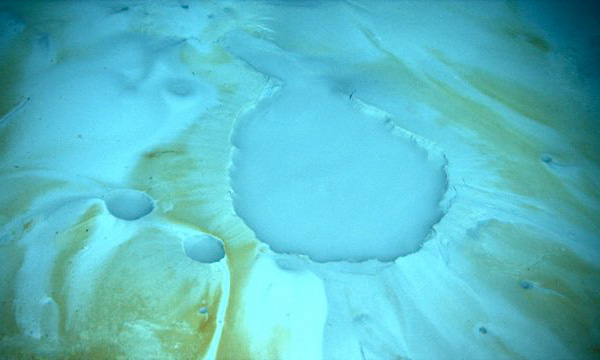
Why are there pools of extremely salty water on the seafloor? The salt comes from ancient salt deposits or hydrothermal activity. Once the area has become saltier than the surrounding area, the density creates an area that won’t mix.
Seawater is about 3.5% salt. That means in every liter, there are 35 g of salt. That makes it 70 times saltier than regular drinking water. That is an average because some seas are much saltier. The Dead Sea, for example, is very salty because the water evaporates rapidly, concentrating the salt. However, on average, the saltiness of the sea is fairly uniform. The salt comes from two places. It is washed from the land by rivers, or it comes out of the seafloor. Rain that falls on land is slightly acidic, and it slowly dissolves rocks. These rocks release ions that are carried away by streams and rivers before they end up in the sea. A lot of them are used by organisms that live in the sea, but more are added than are used, so they slowly build up. Salts also come from hydrothermal vents in the seafloor. Seawater enters cracks in the seafloor, comes into contact with magma, is superheated, and that causes a chemical reaction where the water picks up salts from the seafloor, carrying them back up into the ocean.
However, there are some places in the ocean that have a far higher concentration of salt than anywhere else. These are called brine pools, and they are very rare. Only a few have been found, and they are located in the Gulf of Mexico, the Mediterranean Sea, and the Red Sea. They are always at the bottom of the ocean, and they form in depressions on the seabed. They are undersea lakes that don’t mix with the rest of the ocean and are three to eight times saltier than the normal seawater. They are so dense that they actually have a visible surface, even though they are underwater. The surface is milky white, and it ripples with very slow waves. It actually looks like a lake within the sea, and that is how they can be spotted.
So, what causes them? There are three ways. The first is that they are made from the salt left over from ancient seas. Before the seas we have today, there were other seas, and the tectonic plates were in different places. Ancient seas on ancient plates might have evaporated or flowed away and left their salt behind. This salt could have soaked into the ground and made a very large salt deposit. When the new sea forms above this salt deposit, the salt dissolves into the water. However, because there is so much salt, it is dense and doesn’t mix any further than the nearby water. The salt can also come from hydrothermal vents. Extremely hot water circulates through rocks and underground salt deposits, dissolving minerals and producing concentrated brine. Once the water becomes extremely salty, it is much denser than the surrounding seawater, so it sinks into depressions on the seabed and remains there in one of these undersea salt lakes.
The interesting thing is that despite being so incredibly salty, there are organisms that live next to these salt lakes. The salt lakes themselves are so dense that there is no oxygen. Many brine pools contain methane and other chemicals, some of which are toxic to most marine animals, but a lot of microbes live on their edge, feeding off the methane. Then there are other creatures that feed off the microbes. There are also several creatures that have learned to use the brine pools to get food. Some shrimp live next to the brine lake and wait for unsuspecting sea life to wander into it. When they do, the brine instantly stuns them, and the shrimp pounce on the stunned creature. Hagfish do something similar, Hagfish release a strong, flexible, and biodegradable slime when they are attacked. This can immobilize many predators. The slime coats the hagfish’s skin as well, and this allows it to tolerate short contact with the toxic brine. They can dash in to retrieve other animals that have been stunned or killed by the brine. And this is what I learned today.
Sources
https://oceanx.org/blog/brine-pools-the-deep-sea-s-most-mysterious-ecosystems
https://oceanservice.noaa.gov/facts/whysalty.html
Image By Lophelia II 2010 Expedition, NOAA-OER/BOEMRENational Oceanic and Atmospheric Administration – Ocean Exploration and Research / Bureau of Ocean Energy Management, Regulation and Enforcement – http://oceanexplorer.noaa.gov/explorations/10lophelia/logs/oct19/media/seep.html http://oceanexplorer.noaa.gov/explorations/10lophelia/logs/oct19/media/seep_600.jpg, Public Domain, https://commons.wikimedia.org/wiki/Special:Redirect/page/11943281