
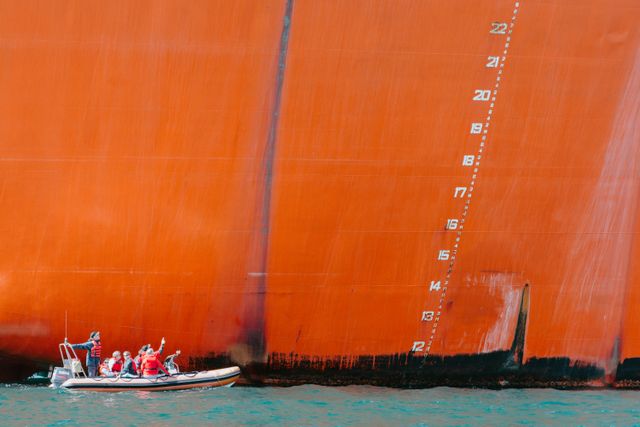
What is the Plimsoll line and why is it called that? The Plimsoll line is a line painted on a ship that shows its legal loading limit. It was named after Samuel Plimsoll. A Plimsoll line is generally required only on commercial cargo, merchant ships, and large passenger carrying ships. Smaller vessels and naval ships don’t usually need one.
The Plimsoll line is painted on the hull of the ship. It is painted at such a height that if the ship were loaded to its maximum weight, the Plimsoll line would be at the water level. If the Plimsoll line is underwater, the ship is overloaded. It is a very quick and easy way to see how much weight the ship is carrying. However, different types of water have a different density, so there need to be different Plimsoll lines. This is usually indicated with letters. These will be TF, F, T, S, W, WNA. TF is Tropical Freshwater, F is Freshwater, T is Tropical Seawater, S is Summer Temperate Seawater, W is Winter Temperate Seawater, and WNA is Winter North Atlantic Seawater. Let’s break these down.
The height a ship floats at depends on the density of the water. A ship floats by displacing water that equals the weight of the ship. The salt in seawater increases its density. That means the ship doesn’t have to displace as much seawater to float as it does freshwater, which means the same weight of ship will float higher in seawater. The temperature of the water also affects its density. Cold water is more dense than warm water, so a ship will float higher in the winter than it will in the summer. A ship in cold seawater will float much higher than a ship in warm freshwater. The different painted lines reflect this. However, the seasonal lines are mainly there because of different weather conditions. In winter, particularly in the North Atlantic, ships are more likely to encounter powerful storms and large waves, so they must carry less cargo to leave more of the hull above the water.
When a new ship is built, the exact location of the Plimsoll line is calculated by a classification society and its position the hull is then verified and a certificate is issued. The Chief Officer of the ship is responsible for the safe loading of the cargo and they need to consider all of the different types of water and weather the ship might pass through when they calculate how much weight they can take.
These marks were only called Plimsoll lines in the 19th century, but they did exist before that. The first case of load lines being painted on ships was in Venice in the 12th century. Before that, different civilizations had different ways of judging if a ship was overloaded. The Romans, for example, labelled their ships by the amount of grain they could carry. They used a unit of volume called the modii and they had ships that could carry 10,000 or 50,000 modii. However, they didn’t have a legal limit and they used experience to know if a ship was carrying too much.
The Venetians began requiring ships to paint a cross on the hull of their ships at its loading limit. In the beginning they only insisted, but in 1375, it became law. Genoa and then the Hanseatic League also began requiring the mark.
The line we have today is largely because of Samuel Plimsoll. Lloyd’s of London first tried to implement a line in 1835, but it wasn’t taken up. Plimsoll was a British politician and social reformer. He didn’t invent the line, but he did campaign hard to have it as standard on all ships. He became a Member of Parliament in 1867, and he was very concerned with the lives of sailors. He was particularly concerned with coffin ships. These were old, unseaworthy, and overloaded ships that were heavily insured. They were often riddled with shipworm and then painted over to disguise the holes. Some owners overloaded them to make more money from each voyage, even though they knew the vessels could sink. There were also accusations that unscrupulous owners deliberately sent unseaworthy ships to sea because they could recover money through insurance. They often sank.
Plimsoll started campaigning in 1870, and the bill was finally passed in 1876. It was called the Merchant Shipping Act. It didn’t really go far enough and was fixed with a new act in 1894. Lloyd’s produced tables to help people calculate the line depending on the shape of the hull and the type of water. In 1906, the law was applied to foreign ships entering British ports and by 1966, it became an international law. And this is what I learned today.
Sources
https://heritage.lrfoundation.org.uk/what-is-the-plimsoll-line
https://oceanservice.noaa.gov/facts/plimsoll-line.html
https://en.wikipedia.org/wiki/Load_line_(watercraft)
https://en.wikipedia.org/wiki/Samuel_Plimsoll
https://en.wikipedia.org/wiki/Coffin_ship_(insurance)
https://en.wikipedia.org/wiki/Merchant_Shipping_Act
https://www.virtuemarine.nl/post/how-water-salinity-shapes-buoyancy-the-salty-side-of-ships
Photo by Gordon Plant: https://www.pexels.com/photo/people-on-boat-against-cargo-ship-14744203/