
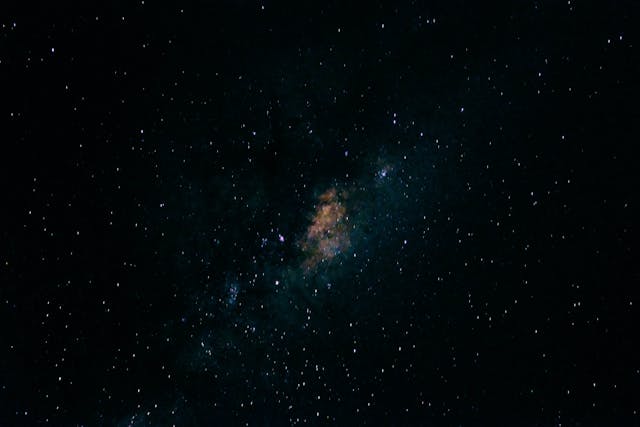
What is the cosmic microwave background radiation? The cosmic microwave background radiation is the heat leftover from the Big Bang.
In the early 20th century, Edwin Hubble proved that the universe was expanding. He looked at the red and blue shift of distant galaxies to prove this. If the source of a wave is heading towards you, the frequency of the waves rapidly increases because new waves don’t take as long to reach you. Conversely, if the source of a wave is heading away from you, the frequency of the waves decreases because each new wave takes longer to reach you. We can see this ourselves on Earth with sound waves. The common example is an ambulance driving towards you and then going past. The pitch of its siren goes down after it passes you because of the changing length of the sound waves. Edwin Hubble realized that this worked with the light from distant galaxies. As the frequency of the light wave from a distant galaxy increases, because the galaxy is moving towards us, the visible light becomes more blue, and when the frequency of a light wave decreases, because the galaxy is moving away from us, the visible light becomes more red. The redder the light is, the faster the galaxy is moving away. He realized that the universe was expanding everywhere.
Logically, if the universe were expanding, there must have been a point where it was much smaller, hotter, and denser everywhere. This became known as the Big Bang. People theorized that, if it were that hot, we should still be able to see signs of it. It happened at the start of the universe, but, because light has a finite speed, there would be some light that is only just reaching us. If we look at stars that are a million light-years away, the light from them has taken a million years to reach us, and we are therefore looking a million years into the past. The same should be possible with the Big Bang. The problem was that nobody could find this light. If the light from the Big Bang didn’t exist, was the Big Bang the correct theory?
It turns out that the light does exist, and we can see it, but it was not the light we expected to see. And it took an accident to find it. In 1964, Arno Penzias and Robert Wilson built a very sensitive horn antenna to study radio astronomy and satellite communications for NASA. When they switched it on, there was a low-level hum that they could not get rid of, no matter how hard they tried. This background static was present from every angle in the sky. They even cleaned the antenna, thinking it might be caused by pigeon droppings. After doing some research, they discovered that what they had found might be the leftover heat from the Big Bang. They won the Nobel Prize for this in 1978.
What they had found was the Cosmic Microwave Background radiation (CMB). You can hear it yourself if you have an old style TV or radio and you tune it to a point between two stations. A small part of that static is the CMB. It was formed about 400,000 years after the Big Bang. The Big Bang produced a lot of light energy, but, at the very start of the universe, everything was so hot (roughly 273,000,000℃), that atoms couldn’t form. The universe was a hot plasma full of free electrons and protons. Light could not travel freely because photons constantly bounced off the free electrons, like trying to see through thick fog. As the universe expanded, it cooled, and after about 400,000 years, it became cool enough for electrons to stay attached to protons, forming neutral hydrogen. Once most electrons were locked into atoms, the universe suddenly became transparent, and the light that had been trapped could finally stream through space. That light has been travelling ever since, but it has cooled down significantly to just above absolute zero (-270.42℃), and its wavelength has stretched as it has cooled. As the wavelength of light stretches, it becomes microwave radiation, which is what was detected. The CMB comes from every direction in the universe, showing that the Big Bang was not a single point, but happened everywhere at once. The CMB comes from everywhere, but it is not uniform. There are areas that have slightly lower levels of CMB, which could be because of the density differences of the early universe. These are called gravity potential wells. However, the difference in temperature between the areas is minuscule. The temperature fluctuations in the CMB could also be evidence of dark matter. And this is what I learned today.
Sources
https://www.scientificamerican.com/article/smart-luck-how-the-big-bang-was-found-by-accident
https://en.wikipedia.org/wiki/Cosmic_microwave_background
https://www.space.com/33892-cosmic-microwave-background.html
https://www.scientificamerican.com/article/what-is-the-cosmic-microw
https://cmb.physics.wisc.edu/pub/tutorial/cmb.html
https://fiveable.me/cosmology/unit-5/discovery-properties-cmb/study-guide/Za6ID8XuIGZ76dGY
Photo by Adrien Olichon: https://www.pexels.com/photo/galaxy-wallpaper-2538107/