
Why did it take so long for papermaking to reach Europe? It took so long for papermaking to reach Europe because they had materials that they thought were superior, they were resistant to Islamic influence, not many people could read or write, and the world was not as small then as it is now.
Writing developed in roughly 3400 BC and once people can write, they need something to write on. Different cultures had different materials, such as papyrus in Egypt, clay tablets in Mesopotamia, and vellum in Europe. All of these materials can be written on, but none of them have as many advantages as paper does. Paper is easy to make, lightweight, and reusable. It is the curse of hindsight, but one might wonder why it wasn’t invented sooner than it was, or in more places than it was.
Paper was invented in China. It is often credited to an imperial eunuch called Cai Lun in roughly 105 AD, but archaeological discoveries have shown that paper existed three centuries before that. He may not have invented paper, but he did start added tree bark pulp and hemp into it, which made it stronger and easier to mass produce. Paper became widely available in China and a culture of reading and writing developed. They had more books in more libraries than any other country for centuries.
As with many Chinese inventions, it spread down into Asia. It reached Vietnam by the 3rd century, Korea by the 4th century, Japan by the 5th century, and it was in India by the 7th century. Taking 100 years to spread from one country to another might seem like a long time, but it is not that surprising. There would have been trade between the two countries, but the traders may not necessarily have carried paper with them. And, if they did, people in other countries might not have been that interested. It takes a while for cultures to spread.
By the 8th century, there is evidence that papermaking was in the Middle East. Legend has it that paper was introduced by Chinese prisoners, but the methods the Islamic papermakers used were slightly different to those of the Chinese. So, papermaking spread from China down through Asia and into the Middle East in roughly 800 years. The oldest paper document found in Europe was made of Islamic paper and papermaking didn’t reach Europe until 1085 in Toledo, Spain. It then took another 400 years to spread through France, Germany, Holland, and reach England. The first papermill in England was opened in 1488. Why did it take so long?
The first reason is the geographical distance. Because of the Internet and the passenger jet, we see the world as much smaller than it actually is. In the world papermaking was spreading into, it took months to travel from one country to another, and the majority of people would be born and die in the same place. For technology to not only go from one country to another but to be adopted would naturally take a very long time.
The second reason is that Europe already had materials to write on. Vellum and parchment were the most widely used writing materials in Europe. Parchment was made from the cured skin of a sheep or a goat. Vellum was made from the skin of a calf and was generally considered to be higher quality. The skin was soaked in lime, stretched on a frame, scraped, and dried. Vellum and parchment are very durable can can last for centuries. Because of this, the paper that did reach Europe was seen as inferior. There was not much desire to use it.
The third reason was that there was not a lot of call for a new material to write on because not that many people could read or write. Literacy levels were probably higher in Asia, India, and the Middle East than they were in Europe at that time. Parchment and vellum were more expensive, but it didn’t matter if not many people were using them.
The fourth reason is probably the most important reason why papermaking took so long to reach Europe. Despite it being a Chinese invention, paper was seen as a very Islamic thing. Europe was a heavily Christian area and they tended to see anything Islamic with suspicion. This was only made worse during the Crusades and it even went as far as the Holy Roman Emperor Frederick II declaring all documents written on paper as being invalid in the 13th century. People couldn’t use paper even if they wanted to.
Papermaking only spread all the way into Europe as literacy rates increased and with the invention of the printing press. Paper was far easier to make and print on than parchment. This overcame all of people’s problems with paper and it spread. Even then, it took a long time because papermaking also depended on a supply chain Europe did not yet have. Early European paper was made mainly from linen and hemp rags, not from wood pulp. That meant papermills needed a steady supply of old cloth, plus clean water, plus skilled labor, and then networks to sell the paper. At first, those networks were stronger in places already connected to Islamic trade and administration, such as Spain and parts of Italy. Once European cities grew, trade intensified, and cloth production increased, rags became easier to gather in bulk, and papermaking became cheaper and more reliable. And this is what I learned today.
Sources
https://en.wikipedia.org/wiki/History_of_paper
https://en.wikipedia.org/wiki/Cai_Lun
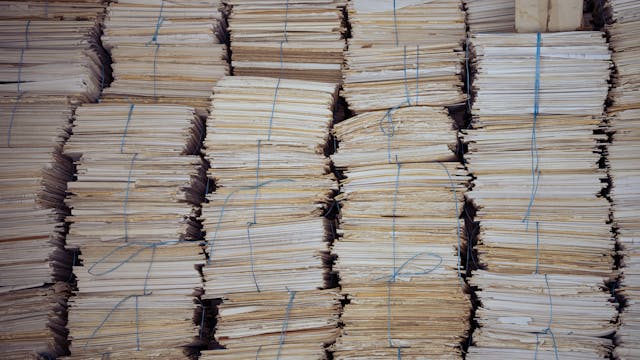
Photo by Božo Gunjajević: https://www.pexels.com/photo/organized-stacks-of-paper-bound-with-string-34568328/