
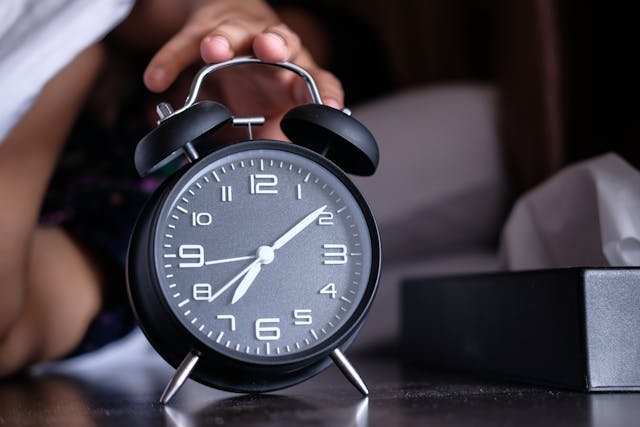
How did people wake up before alarm clocks? Before alarm clocks, people woke up naturally or were woken by outside noises. In cities, they might have used candle clocks, been woken by church bells, or paid a professional knocker-upper.
The idea of needing to be awakened by an alarm clock is a relatively recent problem. For the majority of human existence, people woke naturally, just as animals do. Without candles or electric lighting, the only real choice when it got dark was to go to sleep, and when it got light people tended to wake up. Our natural circadian rhythm is tied to the light-dark cycle. Once people shifted to agriculture, they still went to sleep when it got dark and woke with the sun, but they were often woken by the sounds of their animals as well. Animals too sleep and rise with the sun, though, so there was usually not much problem with that.
The peasants who worked the land did have access to candles, but they were generally expensive and were used sparingly. It seems that many people slept naturally and that their sleep was broken into two blocks. The first sleep was deep and lasted about four hours. Then they would wake for a couple of hours. In this time they might fix tools, talk, pray, feed animals, or do other tasks. Then they slept again until dawn in their second sleep.
The need to wake up early only really came about with the Industrial Revolution. For the first time in human history, large numbers of people were working shifts in factories. They needed to get up at a certain time to be in the factory by a certain time and work for a set number of hours before going home again. They had to concentrate their sleep into one solid block, and they needed to be able to wake up reliably. Artificial gas lighting was also introduced to homes, which meant that people could stay up later. People began to restrict their sleep. So, without alarm clocks, which were invented in 1847, how did people wake up? Let us look at a few of the methods used in cities.
Church bells were a common way to wake people up, but they were usually only used on Sundays. It was necessary to wake people for church, and church bells are loud and can be rung consistently for a long time. They are very effective at waking people up, even today, if a person lives near a church. Factories also tried using steam whistles to wake their workers, but a steam whistle could not be sounded endlessly and did not always wake people up.
People with enough money for candles could use the nails-in-a-candle idea. A candle burns at a set speed depending on its size and the material it is made of. The owner would work out how much of the candle would burn down through the night and then stick nails into that part of the candle. When it burned down to that point, the nails would fall out into a metal dish and the person would be woken by the sound. Water alarms were common as well. Water would pour into a bowl at a set rate. When the water reached the top of the bowl, at a predetermined time, it would flow over the edge and make a bell ring.
One common way of waking up during the Industrial Revolution was to hire a knocker-upper. These were people who were paid to go to houses in the morning and bang on windows with a long stick until the sleepers woke up. They would keep banging until they were given some signal that the person inside was awake. Some of them used peashooters to fire peas at the window. One knocker-upper would make the rounds of several houses. It might be wondered how the knocker-uppers managed to wake up themselves. They solved that problem by staying awake all night and sleeping through the day.
By the late 19th century, alarm clocks became cheaper and more common. The profession of knocker-upper gradually died out. Today, most of us have several clocks in each room and more than one way to wake up. However, thanks to phones, which are also the same devices used to wake us up, many of us restrict our sleep far more than at any other time in history. And this is what I learned today.
Sources
https://www.history.com/articles/human-sleep-cycle-origins
https://www.bbc.com/future/article/20260306-the-wake-up-tricks-people-used-before-alarm-clocks
https://www.bbc.com/future/article/20260306-the-wake-up-tricks-people-used-before-alarm-clocks
Photo by Towfiqu barbhuiya: https://www.pexels.com/photo/a-black-alarm-clock-11344545/