
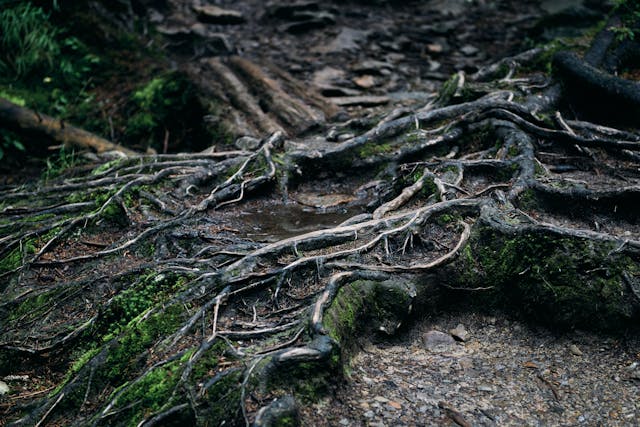
How do plant roots know where water is? Plant roots find water through a process called hydrotropism, which is where they can sense the moisture content of the soil.
Not all plants have roots, but the majority do. Mosses and liverworts don’t have roots. They have tiny hairs that they use to hold themselves in place. For plants, roots perform a number of jobs. One of them is to anchor the plant in place. Generally, the larger the plant, the larger and more spread out its root network will be. Giant redwoods, the tallest trees on Earth, have roots that spread out for more than 30 meters to hold them in place and to give them stability so that the tall trees can withstand strong winds. The root systems of neighboring trees also lock together to give them even more stability. The second job that roots do is to take up nutrients for the plant. Things like nitrogen are taken out of the soil by the roots. The third job, and perhaps one of the most important, is to take up water for the plant. And the fourth job is to communicate with other plants. Plant roots intermingle, and they can communicate with each other by sending chemical signals. These can warn other plants of danger, or ask for help when one plant doesn’t have enough water or nutrients. A fifth reason to have roots is for storage. A lot of trees store nutrients and sugars in their roots over winter. When they lose their leaves in the autumn, they reabsorb all of the sugars, and they send them down to their roots so they can stay safely out of harm’s way, ready to be used again when the spring comes.
Because one of the main jobs of roots is to transport water into the plant, they have to be able to find the water. Obviously, the plants don’t know where the water is to start with, so they have to send out roots in every direction. They have the main roots, and then numerous roots branch out from these. Once they find moisture, the root branches on that side start to grow more, and the roots on the side with less moisture stop growing. This is very much in the same way that ants find food. Thousands of ants head out in random directions. When one of them finds food, they lay down a scent trail to the food, and more and more ants start to congregate on the food source.
Plants find water through a process known as hydrotropism. When the plant starts to grow, the roots naturally push downwards, and the stem of the plant naturally pushes upwards. The tips of the roots have receptors that react to the amount of moisture in the soil. If there is more moisture, it triggers the receptors, and they signal the growth response in the plant. The cells on the side that has detected water will continue to grow, while those in other areas won’t. This process is so strong that roots will grow in any direction if they discover water.
The ability to be able to find water is vital for plants, especially those in drought conditions. They will continue to grow until they find moisture. Trees such as the camel thorn, shepherd’s tree, and the mesquite have roots that stretch down to between 50 and 70 meters deep. They all grow in hot deserts, and the water table is often far below the surface. If they hadn’t evolved this ability to find deep water, they could not survive.
There is even a process called negative hydrotropism. This is where roots will grow away from an area that is waterlogged and has more water than the plant can cope with. The reverse happens, and the plants find an area that has less moisture, slowly growing towards an environment they can use.
Plants take up water from the soil by using tiny hairs on their roots and osmosis. Water passes from the soil into the roots, and it carries nutrients with it as well. The water then gets passed up the plant or tree through capillary action. Some plants suck water out of the soil by evaporating water from small pores in their leaves. This creates a pressure difference that draws water up into the roots.
Sources
https://academic.oup.com/jxb/article/69/11/2759/4910007
https://en.wikipedia.org/wiki/Hydrotropism
https://en.wikipedia.org/wiki/Sequoiadendron_giganteum
https://www.nationalgeographic.com/science/article/plants-can-talk-yes-really-heres-how
https://www.rutgers.edu/news/deep-roots-plants-driven-soil-hydrology
https://www.rhs.org.uk/advice/understanding-plants/how-plants-absorb-water
https://www.sciencedaily.com/releases/2020/02/200212104735.htm
Photo by Yevhenii Deshko: https://www.pexels.com/photo/close-up-of-tree-roots-and-moss-14057803/