
How did hinges evolve? The very first hinges were probably simple wooden or stone pivots, and they slowly evolved from there.
We probably don’t pay much attention to hinges, but we use them multiple times every day. Doors, cupboards, car doors, garage doors, and even the arms of glasses and sunglasses all have hinges. They are everywhere, but we rarely think about them. All of these are human-made hinges, but there are natural hinges as well. Many of the joints in the human body work like hinges. The wings of many insects move on hinge-like joints. Bivalves such as clams and mussels open and close their shells with a hinge. Even some proteins and other molecules have hinge-like sections that allow them to move.
The earliest places humans lived in were probably caves or simple structures made from branches, leaves, animal skins, and other natural materials. The entrance might have been covered with a hanging animal skin. There is no need for a hinge on something like that, but an animal skin is not very strong and is not going to keep much out. If people wanted more protection in a doorway, they needed to use something sturdier. That meant either carrying the barrier out of the way every time they wanted to go in and out, or finding a way to make it swing open and closed. That is where the hinge comes in.
The earliest hinges probably came from civilizations such as Egypt, Mesopotamia, and other early building cultures. They were not hinges in the modern sense. They were basically stone or wooden pivots. Instead of having a door that opened from one side, as is common today, the door could turn around a fixed point. The hinge was the pivot. A bowl-shaped socket could be carved into the floor, or placed where the pivot needed to be. The door had a peg or extension at the bottom that fit into the socket. When someone pushed the door, it rotated around this point.
This kind of pivot hinge could be used for heavy wooden or stone doors, but it had disadvantages. The two surfaces rubbed against each other every time the door moved, so friction slowly wore them down. Doors could also be pivoted from the edge. A socket at the bottom and another at the top, close to the wall, could hold the door in place and allow it to spin. Pivot doors still exist, but modern versions use much smoother materials and bearings, so they do not simply grind two rough surfaces together. The enormous bronze doors of the Pantheon in Rome are about 7.5 meters tall and still use a pivot system, although exactly how old every part of them is has been debated.
Another early form of hinge was the strap hinge. A simple version could be made from leather or another flexible material, and it could be used to hang a light door, gate, lid, or cover. When someone opened the door, the strap would bend and allow it to swing. This was easy to make, but it was not very strong, and it was not suitable for a heavy or secure door. The stronger version was the metal strap hinge. Metal straps could be fixed to the door and the frame, allowing the door to swing while also spreading the weight across a wider area.
The earliest metal hinges we know of were made in the ancient world, including bronze hinges from Egypt. They were much more durable than wood, stone, or leather, but they were also expensive. Metal had to be mined, smelted, shaped, and fitted by skilled workers. For ordinary people, a metal hinge was not a small thing. This is one reason hinges were used unevenly for a long time. Important buildings, temples, wealthy homes, and strong gates could have metal hinges, while poorer buildings often used simpler methods.
The Romans greatly improved hinge design and helped make hinges more common. At first, Roman builders often used pivot systems, especially for large doors. However, Roman metalworkers also made hinges that fastened to the door and the frame and used interlocking metal parts with a central pin. These are the earliest hinges that start to look like the hinges we use today. The Romans used them on doors, but they also used them on cupboards, cabinets, boxes, shutters, and even armor. Hinges were so important to Roman life that they even had a goddess connected with hinges and doorways: Cardea. Her name is linked to the Latin word cardo, meaning hinge or pivot.
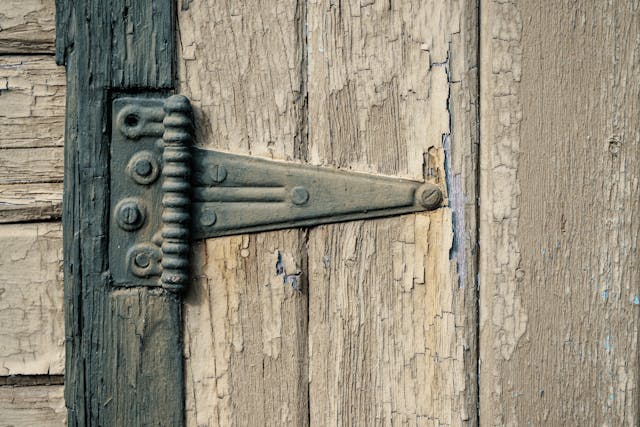
The next major development came in the Middle Ages. Heavy doors on castles, churches, and cathedrals needed strong hinges, and the main material for those was iron, especially wrought iron. Medieval hinges were often long, flat straps that stretched far across the door. This was not only decorative. It also helped spread the weight of the door and stop the wood from warping or pulling away from the frame. On castles and churches, these hinges could be enormous. They were sometimes shaped into branches, scrolls, or other patterns, so the hinge became both a mechanical part and a piece of decoration.
The biggest change in the world of hinges came with the Industrial Revolution. Before that, hinges had to be made by hand, which made them slow and expensive to produce. Once factories could mass-produce metal parts, hinges became cheaper, more accurate, and more widely available. Cast iron and later steel hinges could be made in large numbers. It also became common to use three hinges on a door instead of two because this spread the weight more evenly and reduced the strain on each hinge.
Since then, the materials and designs have continued to change. Hinges can now be made from steel, stainless steel, brass, aluminum, plastic, or specialized alloys. Some are designed to be hidden inside furniture. Some close automatically. Some allow a door to open both ways. Some are built for tiny objects like glasses, and others are built for huge industrial doors, aircraft, ships, and bridges. The basic idea, though, has not changed very much. A hinge is still a way of connecting two things while allowing one of them to move in a controlled way. It is such a simple idea that nature invented versions of it long before humans did. We just copied the principle, improved the materials, and used it everywhere. And this is what I learned today.
Sources
https://www.traditionalbuilding.com/product-report/hinge-history
https://www.fritsjurgens.com/inspiration/blog/what-is-a-pivot-door
https://www.linkedin.com/pulse/evolution-hinges-from-basic-fasteners-advanced-engineering-k1gjc
https://www.kronakoblenz.com/en/product-school/door-hinge-history
https://en.wikipedia.org/wiki/Hinge
Photo by Brett Sayles: https://www.pexels.com/photo/close-up-of-hinge-on-wooden-planks-17503605/