
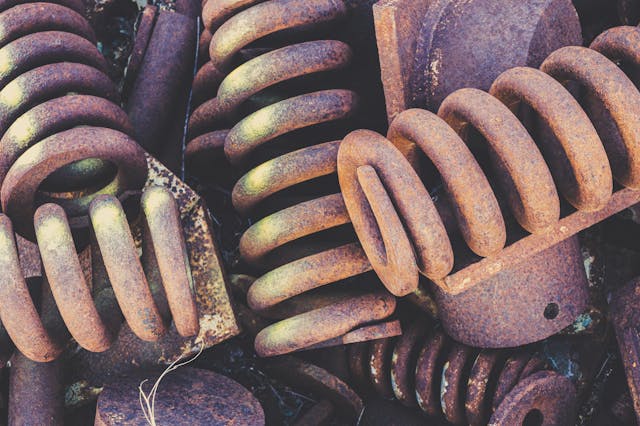
How does a spring work? A spring works by storing mechanical energy when it is deformed and then releasing that energy when it returns to its original shape. Springs don’t have to be metal, but in human-made springs, metal is probably the most common material. There are natural springs as well. The tendons in a kangaroo’s legs work like natural springs because they stretch and recoil as the animal jumps.
Springs work by storing energy and then releasing it. There are generally three types of springs. There are springs that are compressed and then release the energy as they return to their original form. These are the types of springs you find in the suspension system of a car. Then there are springs that are stretched and release energy as they return to their original shape. These are the type of springs you will find on a trampoline, between the material and the frame. And then there are torsion springs, which are springs that are twisted or wound and then release energy as they try to return to their original shape. These are the type of springs you will find in many mechanical watches, clips, and wind-up mechanisms. The similarity between all of these springs is that they store energy when their shape is changed and then release that energy when they are allowed to return.
When you use a spring, you either pull it, compress it, or twist it, and you have to use energy to do this. If you pull a spring between your two hands, you can feel the force required to keep it in that position. The spring wants to return to its original shape. It is not really “wanting” anything, of course, but the forces inside the material are trying to pull everything back into balance.
When you stretch an extension spring, the wire in the spring is deformed. In a coiled spring, this does not simply mean that every atom is pulled straight away from every other atom. The wire is also bending and twisting slightly. However, at the atomic level, the basic idea is the same. The atoms in the metal are moved slightly away from their most comfortable positions. Metal atoms are held in place by strong electromagnetic forces. When the spring is stretched, those forces resist the change. The energy that was used to stretch the spring is stored in the strained arrangement of the atoms and their bonds. When the spring is released, those forces pull the atoms back toward their original arrangement, and the stored energy is released.
A compression spring works in a similar way, but in the opposite direction. When you compress the spring, the wire is deformed and the atoms are again shifted slightly away from their normal positions. Some parts of the structure are pushed into a slightly higher-energy arrangement. It takes energy to do that. When the spring is released, the electromagnetic forces in the material push and pull the atoms back toward their normal arrangement, and the spring returns to its original shape.
Springs are made of elastic materials, but any material has a point where it cannot return to its original position. You can try this with a spring that isn’t very strong. If you pull a weak spring between your two hands and keep pulling, you will pass the elastic limit of the spring, and it will stretch out of shape. At this point, the layers of atoms in the metal have slipped into a new arrangement. The spring is now permanently longer and weaker. If you keep pulling, the spring might snap because the structure has been damaged too much.
No matter the type of spring, it needs to be made of a material that resists being changed from its natural shape. It also needs to have a high elastic limit. This is how far the spring can be deformed before it won’t return properly. It needs to resist fatigue because it may be stretched, compressed, or twisted thousands or millions of times. Metals fit most of these conditions, but not all metals are good for springs. Copper and lead, for example, are too soft and deform too easily. Steel tends to be a very good spring material because it can be strong, elastic, and resistant to repeated stress when it is made and treated properly.
Springs weren’t invented by one person. They evolved over the centuries. The string in a bow and arrow acts like a type of extension spring, and bows have been used for tens of thousands of years. Many civilizations used different types of spring-like devices over the millennia. Ancient Egyptian chariots appear to have had suspension systems that absorbed shocks, and Roman vehicles also used spring-like suspension. However, these were not modern coiled springs. Coiled springs appeared much later, in medieval and early modern Europe, in devices such as locks, clocks, and weapons.
The scientific law behind many springs is called Hooke’s law. Robert Hooke first stated the idea in 1676 and published it more clearly in 1678. The law says that, within the elastic limit of a spring, the force needed to stretch or compress it is proportional to how far it is stretched or compressed. In simpler terms, the more you pull a spring, the harder it pulls back. The modern coiled spring was developed gradually, but Richard Tredwell patented an important coiled spring design for carriages in 1763. It was a revolutionary step that helped improve vehicles and machines. Springs are so simple that it is easy to overlook them, but we couldn’t live without them today. And this is what I learned today.
Sources
https://en.wikipedia.org/wiki/Robert_Hooke
https://www.explainthatstuff.com/how-springs-work.html
https://en.wikipedia.org/wiki/Spring_(device)
Photo by Brett Sayles: https://www.pexels.com/photo/close-up-shot-of-metal-pipes-11942508/