
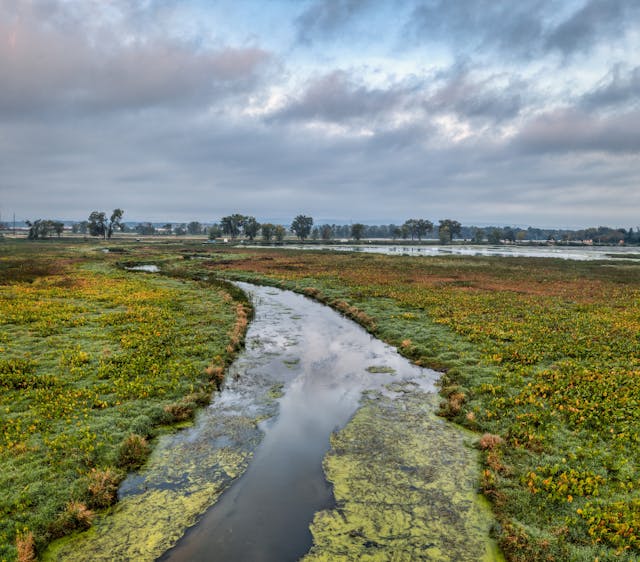
What is the watershed? A watershed is a turning point or a dividing point between two times or events, although the word originally comes from geography. In geography, a watershed is an area of land that drains water to a specific point.
Another word for a watershed is a drainage basin. It is basically the area of land where all of the water drains to the same place. If you are from the UK, you probably know the word more as the time when family TV shifts into adult TV. In the UK, the watershed is at 21:00. Family programming slowly transitions into adult programming after that time. Almost every country has some kind of system like this, but they don’t usually call it the watershed. The US generally sets it at 22:00, but it doesn’t have the same common word for it. The system in the UK first started with a 1964 Act, but the word watershed was used more as a nickname than an official name.
So, what really is a watershed? A watershed is a land area that channels rainfall and snowmelt into a common body of water. That body of water might be a river, a lake, or the ocean. Because of gravity, water always flows downhill. Rivers are fed by rainwater and snowmelt. When rain falls on mountains, or when snow melts on mountains, the water runs down and forms channels, which carry it to the base of the mountain. From the mountains or the high ground, the land slopes downward, and this is where the water flows.
However, the land is not completely flat. There are ridges and areas of high ground that separate lower areas into large basins. These ridges form the boundaries of each watershed. Rainwater or snowmelt running down a mountain could hit one side of a ridge and go in one direction, while water on the other side could go in a completely different direction. Two drops of rain could fall only a few meters apart and end up in different rivers, or even different oceans.
The rainwater and snowmelt in the basin begin to form streams. These streams flow into larger streams, then rivers, then lakes or the sea. The system gets bigger and bigger as more water joins it. The literal meaning of the word is an area where water is shed. Watersheds can range from fairly small areas to huge systems that cover a large percentage of a country. The Mississippi River watershed covers almost 3 million square kilometers, which makes it bigger than many countries. Water from 31 US states and two Canadian provinces drains into it. The final destination for all of this water is the ocean.
Because watersheds are networks of connected waterways, pollution can wreak havoc in one area. Pollution can get into a watershed from many different sources. It might be washed out of the sky by rain. It might have been frozen in snow or glaciers that have started to melt. It could be a byproduct of a factory that is released into the wild. One of the most common types of pollution in waterways is runoff from farms. Fertilizers and pesticides that are spread on fields can very easily get washed out of the soil and carried into streams. All of these pollutants can spread through a watershed, and the problem can build as smaller streams join larger rivers. People and animals living farther down the watershed may have to deal with pollution that started a long way away.
Damage higher up in the watershed can also lead to problems such as flooding farther down. In a healthy watershed, forests, wetlands, and soil all slow the movement of water. Trees catch some of the rain. Soil absorbs water. Wetlands act like sponges and release water slowly. However, if forests are cut down, wetlands are filled in, or large areas are covered with concrete, the water cannot be held back in the same way. Instead, it rushes into streams and rivers all at once. That can cause flooding and damage farther down the watershed. The silt and soil carried by the excess water can also become a problem because it can block rivers, damage habitats, and make the water harder to clean.
And this is why the metaphor of a watershed moment makes sense. You can’t always see the barrier between two watersheds, but it is there. One drop of rain falls on one side and begins one journey. Another drop falls on the other side and begins a completely different journey. With us, a watershed moment separates the flow of things that came before from the flow of things that will come after. And, just like a real watershed, what happens near the beginning can have huge and lasting impacts downstream. And this is what I learned today.
Sources
https://oceanservice.noaa.gov/facts/watershed.html
https://education.nationalgeographic.org/resource/watershed
https://en.wikipedia.org/wiki/Watershed_(broadcasting)
https://www.etymonline.com/word/watershed
Photo by Tom Fisk: https://www.pexels.com/photo/scenic-wetlands-landscape-in-alma-wisconsin-34305559/