
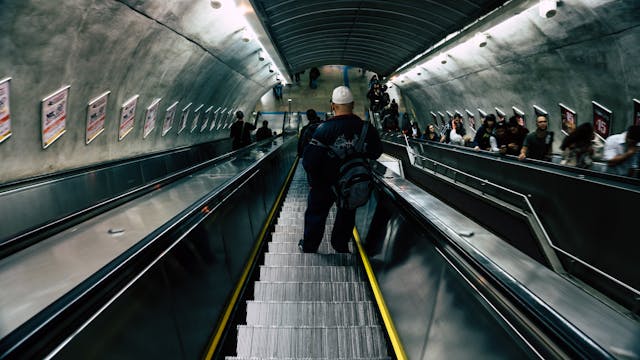
How do escalators move at almost the same speed when they are empty and when they are fully loaded? Escalators can move at almost the same speed no matter how much weight is on them because their motors are designed to run at a steady speed and produce more torque when the load increases. Chairlifts and some other conveyor systems use the same general idea. Modern escalators can also use electronic controls that make the whole system even smoother and more efficient.
An escalator is basically a conveyor belt with stairs. It has a motor, usually near the top, and a chain that loops down to the bottom of the escalator and back up. The chain is attached to the steps, which are pulled around the escalator by the motor. Each step has wheels attached to it, and those wheels run along tracks inside the escalator. The tracks keep the steps level during the steep part of the escalator. When the steps get to the top or bottom, the tracks move closer together, which makes the steps flatten out before they go under the floor and travel back down the inside of the escalator. The handrail is also driven by the same system so that it moves at the same speed as the steps.
Different companies and countries have different rules, but escalators generally travel at about 30 to 45 meters per minute. That is about 0.5 to 0.75 meters per second. One of the longest single-span escalators in the world is at Wheaton Station, on the Washington Metro system. It is about 70 meters long and takes roughly two minutes and forty-five seconds to ride.
An escalator has to carry its own weight, plus the weight of any passengers who step on it, along with their belongings. Obviously, the weight of the escalator is known, but the passenger weight can vary greatly throughout the day. If the motor was only strong enough to move the empty escalator, then it would slow down whenever a large number of people stepped on it. That doesn’t happen, so why not?
Traditional escalators use a constant-speed drive system. The motor has two important properties: the speed it runs at and the amount of torque it can produce. Torque is turning force. The speed of an AC induction motor is mainly set by the frequency of the electric current and by the way the motor is built. For example, electricity running at 50 Hz does not make the motor rotate 50,000 times a second. It means the current cycles 50 times a second. The motor uses that alternating current to create a rotating magnetic field. Depending on the number of magnetic poles inside the motor, that rotating magnetic field might make the motor turn at 1,500 revolutions per minute, or another related speed. The gearbox then reduces that speed and transfers the turning force to the escalator chain.
The torque of the motor is connected to the current it draws. Current is basically the amount of electricity flowing into the motor. More current lets the motor create a stronger magnetic force, and that gives it more torque. This does not mean the motor becomes faster. It means it becomes stronger.
Inside an induction motor, the rotating magnetic field pulls the rotor around. However, the rotor always lags very slightly behind the rotating field. That lag is called slip. When the escalator is empty, it is only carrying its own weight, so the load is fairly steady and the slip is small. When more people get on an upward-moving escalator, the motor has to do more work. The rotor slows down by a tiny amount, the slip increases, and the motor draws more current. That extra current creates more torque, and the escalator keeps moving at almost the same speed. The slip does not vanish. It simply settles at the level needed to produce enough torque for the load. When people get off, the load falls, the slip falls, the current falls, and the motor uses less power again.
Down escalators have to cope with a different problem. They don’t have to lift the passengers. Instead, they have to stop the weight of the passengers from making the escalator run too fast. In that situation, the motor and braking system can act more like a brake. Older systems may lose much of that extra energy as heat. Some modern systems can use regenerative braking, which turns some of that motion back into electricity and saves power.
Modern escalators are more high-tech than older ones. Many use variable-frequency drives, which can change the frequency sent to the motor and control the speed more precisely. They can also run slowly when nobody is using them, or stop completely until a sensor detects a person approaching. Once passengers step on, the escalator smoothly returns to normal speed. Modern controllers can also monitor the load by watching how much current the motor needs, rather than simply guessing how many people are on the steps. Along with regenerative braking, these methods make modern escalators much more efficient than older constant-speed systems that ran at full speed all day.
The first working escalator was invented by Jesse Wilford Reno. He called it an inclined elevator. Charles Seeberger later worked on a flat-step version, using ideas from earlier patents, and helped create the form that became the modern escalator. He also coined the word escalator from the Latin scala, meaning steps or stairs, with an ending that made it sound like a machine. Originally, Seeberger intended the word to be pronounced es-CAL-ator, but people soon started saying ES-ca-lator instead. And this is what I learned today.
Sources
https://science.howstuffworks.com/transport/engines-equipment/escalator.htm
https://en.wikipedia.org/wiki/Wheaton_station_(Washington_Metro)
https://en.wikipedia.org/wiki/Escalator
Photo by Kaique Rocha: https://www.pexels.com/photo/man-in-black-leather-jacket-on-escalator-108149/