
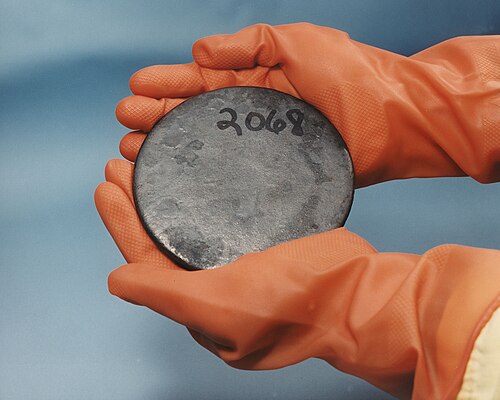
What is highly enriched uranium? It is uranium that contains 20% or more uranium-235, which is the type of uranium most useful for a sustained nuclear chain reaction.
Uranium is a fairly common element that can be found in rocks, soil, and water. It is not as rare as many people probably imagine. There is about as much uranium in the Earth’s crust as there is tin, and it is far more common than gold. Traces of uranium occur almost everywhere, and vast amounts of it are dissolved in the oceans, although in very low concentrations. It is possible to extract uranium from seawater, but it is difficult and expensive because so much seawater would need to be processed. Mining uranium from rock is much more practical.
Natural uranium on Earth is mostly uranium-238, with only a small amount of uranium-235. About 99.3% of natural uranium is uranium-238, and about 0.7% is uranium-235. The difference between the two is the number of neutrons they have. All uranium atoms have 92 protons. That is what makes them uranium. Uranium-238 has 146 neutrons, while uranium-235 has 143 neutrons. They are the same element, but they are different isotopes.
Uranium-235 is important because it can split more easily than uranium-238. This is partly because uranium-235 has an odd number of neutrons. Neutrons tend to be more stable when they are paired. When a uranium-235 nucleus is struck by a slow neutron, it can absorb that neutron. The new neutron pairs with the unpaired neutron, and this releases extra binding energy inside the nucleus. For a tiny fraction of a second, the uranium-235 has become excited uranium-236. That excited nucleus is unstable, so it can split apart.
When it splits, it splits into two smaller atoms, called fission products, and it also releases two or three neutrons and a large amount of energy. The two new atoms are usually radioactive and are much smaller than the original uranium atom. The total mass after the split is slightly less than the mass before the split, and that missing mass has been converted into energy. E=mc2. This is the basic idea behind nuclear power and nuclear weapons.
The released neutrons are the key. If those neutrons hit other uranium-235 atoms, they can make those atoms split as well. Those atoms then release more neutrons, which can split more uranium-235 atoms. This is called a chain reaction. In a nuclear reactor, the chain reaction is carefully controlled so that it releases heat steadily. In a nuclear weapon, the chain reaction is designed to happen extremely quickly.
Natural uranium dug out of the ground does not usually sustain a chain reaction by itself because there is not enough uranium-235 in it. A uranium-235 atom might absorb a neutron and split, but the neutrons it releases are unlikely to hit another uranium-235 atom before they escape or are absorbed by uranium-238. There needs to be enough uranium-235 close together for the reaction to continue. This is where enrichment comes in.
Enrichment does not change uranium into a different element. It changes the mixture of isotopes. Natural uranium contains about 0.7% uranium-235. Enriched uranium contains a higher percentage of uranium-235. The more uranium-235 there is, the easier it is for neutrons to find another uranium-235 atom and continue the chain reaction.
There are several ways to enrich uranium, but the most common method today uses gas centrifuges. Uranium itself is a heavy metal, so it is not easy to separate the isotopes as a solid. First, the uranium is chemically changed into uranium hexafluoride. This is a compound made of one uranium atom and six fluorine atoms. When uranium hexafluoride is heated, it becomes a gas. That gas can then be fed into centrifuges.
A centrifuge spins extremely quickly. The uranium hexafluoride molecules that contain uranium-238 are slightly heavier than the ones that contain uranium-235. Because of that tiny difference, the heavier molecules move a little more toward the outside, while the lighter ones stay a little closer to the center. The separation in one centrifuge is very small, so many centrifuges have to be connected together. Each stage makes the uranium slightly richer in uranium-235. Over many stages, the percentage can be raised.
There are different names for different levels of enrichment. Ordinary low-enriched uranium is below 20% uranium-235, but most of the fuel used in today’s commercial nuclear power reactors is only enriched to about 3% to 5%. High-assay low-enriched uranium, or HALEU, is usually between 5% and 20% uranium-235. It may be used in some advanced reactors because it can make fuel last longer and produce more energy from a smaller amount of material. Uranium enriched to 20% or more is called highly enriched uranium.
Highly enriched uranium is sensitive because it is much closer to material that could be used in nuclear weapons. That does not mean all highly enriched uranium is used for weapons. Some research reactors, naval reactors, and special uses have used highly enriched uranium. However, once uranium is enriched beyond 20%, it becomes much more worrying from a security point of view. Ordinary reactor fuel is usually far below that level. Weapons material is generally enriched much more highly.
That is why the phrase “highly enriched uranium” matters so much. It does not mean the uranium is more radioactive in a simple way, or that it has become a new element. It means the mixture contains a much higher percentage of uranium-235. Uranium-235 is the isotope that can most easily keep a chain reaction going and with enough of it in the right conditions, the reaction can be sustained. With much higher concentrations, the material becomes dangerous for a completely different reason. Countries with highly enriched uranium might not be making weapons, but they could. And this is what I learned today.
Sources
https://www.energy.gov/ne/articles/uranium-enrichment-explained
https://en.wikipedia.org/wiki/Enriched_uranium
https://www.nrc.gov/reading-rm/basic-ref/glossary/high-enriched-uranium
https://www.iaea.org/newscenter/news/what-is-uranium
https://en.wikipedia.org/wiki/Uranium_hexafluoride
Image By Unspecified – https://web.archive.org/web/20050829231403/http://web.em.doe.gov/takstock/phochp3a.html, Public Domain, https://commons.wikimedia.org/w/index.php?curid=2287275