
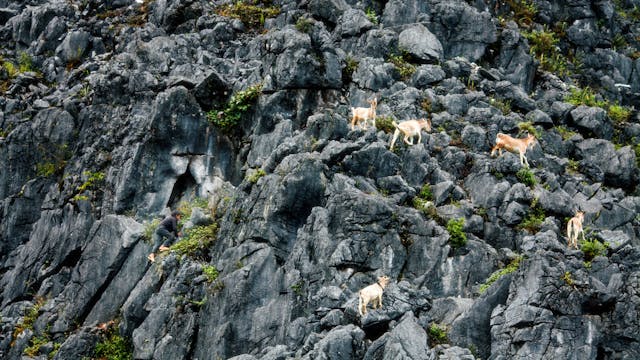
How do animals migrate up and down mountains? A lot of animals do migrate up and down mountains. This is called altitudinal migration. It is a kind of vertical migration, although the term vertical migration is also used for animals that move up and down through the ocean every day.
Animals migrate over many different distances, but they often do it for similar reasons. Usually, something about the place where they live changes, and it can no longer provide what they need. It might become too cold, too dry, too snowy, or too dangerous. However, food is often one of the biggest reasons. Birds, for example, often feed on insects. In winter, many insects disappear because the adults have died, or because they are surviving as eggs, larvae, or pupae hidden away from birds. To cope with this, many birds fly to warmer places where food is still available. When the weather changes and their food source returns, they fly back.
Different animals have different migration triggers. For some, it might be temperature. For others, it might be the amount of daylight. Some animals have an internal biological clock that tells them when to start moving, while others migrate when food, water, or safe shelter becomes scarce.
Some animals don’t migrate very far. They just go far enough to find more food or better conditions. Other animals migrate enormous distances. The gray whale migrates thousands of kilometers between cold feeding waters and warmer breeding waters. The Arctic tern migrates from the Arctic to the Antarctic and back again. Monarch butterflies can travel thousands of kilometers between North America and Mexico, although their full yearly migration is spread across several generations. These animals move mostly across the surface of the Earth, but some animals move vertically instead.
Animals that migrate vertically up and down mountains move with the seasons. This is more common than people might think, and it happens in many parts of the world. Birds are probably the best-known examples, but mammals, insects, and bats can do it as well. Some animals move higher up the mountain when the weather is warm and food is available there. Then, when winter comes and the upper slopes become cold or snowy, they move back down.
Food is one major reason for altitudinal migration. Plants grow, flower, and fruit at different times depending on altitude. As elevation increases, temperatures usually drop. A common average is about 0.65°C for every 100 meters, although the exact amount depends on the weather and the moisture in the air. This temperature difference means that spring arrives later higher up a mountain. Flowers bloom later, leaves grow later, and fruit ripens later. An animal that eats fruit, nectar, leaves, or insects can take advantage of this by moving gradually up the mountain as food becomes available.
The reason higher places are colder is not simply that they are farther from the sun. The sun’s energy passes through the atmosphere and warms the ground. The ground then warms the air above it. As warm air rises, the air pressure drops and the air expands. When air expands, it cools. That is why mountain air is usually colder than air near sea level, even though the mountaintop is slightly closer to the sun.
This creates a moving food supply. At the bottom of a mountain, fruit might ripen early in the season. Higher up, the same kind of fruit might ripen weeks later. A bird or mammal that follows that pattern can extend its feeding season. Instead of waiting in one place for food to disappear, it moves upward with the season. Later, when the upper slopes become too cold or covered in snow, it moves back down again.
Mountain goats and other mountain animals may also move vertically for reasons besides food. They may go higher to avoid predators, reach mineral licks, escape insects, or find safer places to give birth. In winter, they may move lower because snow is deep and food is easier to reach at lower elevations. Altitudinal migration is usually much shorter than flying across continents, but it can still be very important for survival.
There is another type of vertical migration, but it is not up a mountain, at least not a mountain above sea level. Every night in the oceans, trillions of zooplankton, lanternfish, squid, jellyfish, krill, and other marine creatures move from deeper water toward the surface to feed. In the morning, many of them sink back down again. This is called diel vertical migration. “Diel” means that it happens over a 24-hour cycle.
This happens in all the world’s oceans, and it also happens in deep lakes. The animals rise as night falls, feed near the surface through the night, and then move back down at dawn. They do this because the surface waters contain more food, but they are also more dangerous. Most predators use their eyes to hunt. At night, it is harder for predators to see, so small animals can feed near the surface with less risk. When daylight returns, they move back down into darker water.
It is a good system, but it is not perfect. Many predators have evolved to follow the migration. Fish, squid, whales, and other animals can feed on the creatures as they rise and fall. If a whale finds a dense patch of migrating animals, it can swim through and take in huge numbers of small creatures at once. This daily rise and fall is sometimes called the largest migration on Earth, even though most of the animals involved are tiny.
Migration does not always mean crossing a continent. Sometimes it means moving from the bottom of a mountain to the top. Sometimes it means rising from the dark ocean to the surface and sinking back again before sunrise. Animals are constantly following food, safety, temperature, and opportunity. Some move north and south. Some move up and down. And this is what I learned today.
Sources
https://en.wikipedia.org/wiki/Altitudinal_migration
https://en.wikipedia.org/wiki/Animal_migration
https://kids.frontiersin.org/articles/10.3389/frym.2020.00044
Photo by Thành Peter: https://www.pexels.com/photo/chamois-in-mountains-15826933/