
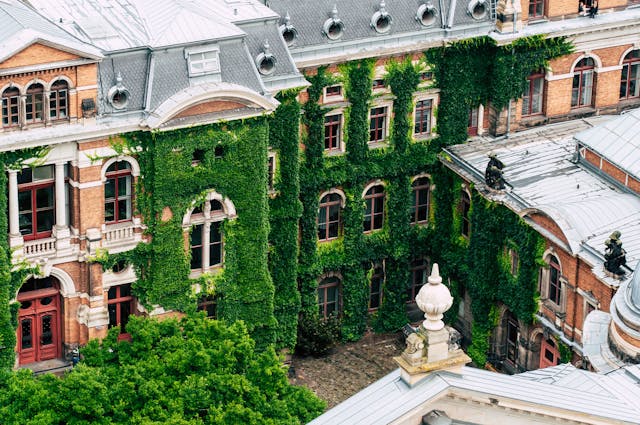
How does ivy grip walls? Ivy grips walls by using special roots that grow out from its stems. These are called aerial roots or adventitious roots, and they work like tiny natural anchors.
There are many different types of plants that grow up walls, but ivy is probably one of the most well-known. Ivy climbs because it is trying to reach more sunlight. It can grow along the ground, but if it stays under other plants, trees, or buildings, it may not get enough light. By climbing a wall, rock face, or tree trunk, ivy can spread its leaves over a much larger area and reach brighter conditions.
The majority of plants have roots at the bottom, a stem in the middle, and leaves at the top. Ivy is a little different from that. Ivy does have normal roots in the ground. These roots anchor the plant and take in water and nutrients. These underground roots can spread a long way, which is one reason ivy can cover the ground so quickly. However, ivy also has another kind of root. When the plant is in its climbing stage, it grows tiny aerial roots from its stems.
Ivy does not climb like a pea plant or a grapevine. It does not wrap tendrils around a support. It does not twist its stem around a pole. Instead, it creeps along until it finds something solid to climb, such as a tree, a wall, a fence, or a rock. Once the stem is touching a suitable surface, it produces clusters of tiny aerial roots. These roots do not work like normal roots in soil. Their job is not mainly to collect water and minerals. Their job is to hold on.
The way these aerial roots hold on is fascinating. The roots grow many microscopic hairs. These hairs fit into tiny cracks, holes, bumps, and rough places on the surface. Even a wall that looks smooth to our eyes has many tiny spaces and uneven areas. The root hairs push into these spaces and then secrete a sticky glue-like substance. This helps fasten the root hairs to the surface.
That alone would give ivy a good grip, but ivy has another trick. As the root hairs dry out, they shrink and change shape. Some curl or twist as they lose water. This pulls the root more tightly against the surface and wedges the tiny hairs into the rough spaces of the wall or bark. So ivy does not hold on with glue alone. It uses glue, shape, and mechanical grip together. It is a very strong attachment system.
This is why ivy can climb so well. It can attach to tree bark, brick, stone, mortar, and many other textured surfaces. It has a much harder time attaching to very smooth surfaces, such as clean glass, because there are fewer tiny cracks and bumps for the root hairs to grip. Ivy is not really boring into a wall like a drill. It is gripping the outside and using any cracks or rough places that are already there.
People often think ivy is bad for buildings, and sometimes it can be. If a wall is old, cracked, or already damaged, ivy can grow into the cracks and make them worse. The roots and glue can hold very tightly, and when ivy is pulled off, bits of weak mortar or damaged surface can come away with it. Ivy can also grow into gutters, around windows, and under roof tiles if it is not controlled. It can become heavy as well, especially when wet, and that extra weight can be a problem for weak structures.
However, ivy is not always bad. On a sound wall, it may not cause much damage at all. It can even have benefits. Ivy can shield a wall from heavy rain, wind, and sudden temperature changes. It can reduce the effects of frost and help keep the wall cooler in summer. It can also act as a layer of insulation. On top of that, ivy creates a small ecosystem. Birds, insects, and other small animals can live in it, shelter in it, or feed from it.
So ivy grips walls with tiny aerial roots that act like natural holdfasts. The roots grow hairs into small cracks and rough places, secrete a sticky glue, and then shrink and curl as they dry, pulling the plant tightly against the surface. Ivy is not just leaning on the wall. It is fastening itself to it with thousands of microscopic anchors. And this is what I learned today.
Sources
https://www.rhs.org.uk/prevention-protection/ivy-on-buildings
https://historicengland.org.uk/advice/technical-advice/monuments-and-sites/ivy-on-walls
https://alextokolyi.com/2020/05/26/diversity-of-common-ivy.html
Photo by wal_ 172619: https://www.pexels.com/photo/historic-building-with-ivy-covered-facade-37545717/