
How did people make the first scales accurate? They made them accurate by using simple physics, careful craftsmanship, and agreed standard weights.
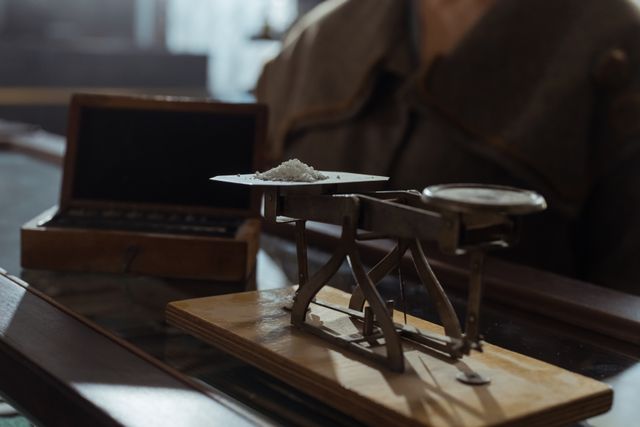
Weighing scales are incredibly simple when they are looked at from the outside. At their simplest, there are two dishes hanging from either end of a bar. In the center of the bar there is a pivot point called a fulcrum. If the fulcrum is exactly in the middle, the bar is the same on both sides, the two dishes hang the same distance from the center, and the dishes weigh the same amount, the bar will balance. If one side is heavier, it will go down. If both sides are equal, the bar will stay level. That is the basic physics behind a balance scale.
Weighing scales have existed for thousands of years. The earliest evidence we have comes from the ancient world, especially Egypt and Mesopotamia, but the idea was probably older than the surviving evidence. Most early scales would have been made from wood, cord, fiber, or other materials that do not usually survive for thousands of years. So, determining exactly when the first weighing scales were invented is probably impossible.
It is easier to think about when weighing scales became necessary. For simple trade, people did not always need to weigh things. If one person wanted to trade one sheep for ten bags of barley, both people could simply agree to the exchange. Nobody needed to know the exact weight of the sheep or the barley. But once people started trading precious metals, spices, medicines, and other valuable goods, weight became much more important. A small difference in weight could mean a large difference in value.
This was especially true when people started using gold and silver as payment. A lump of gold does not have a fixed value unless its weight can be measured. If two pieces of gold look similar but one is heavier, the heavier one is worth more. That means traders needed a way to compare one amount of metal with another. A balance scale was perfect for this because it did not need to know the weight of anything in modern units. It only needed to show whether the two sides were equal.
This is the key point. The first scales did not have to measure in grams. They only had to compare. If a trader placed a piece of silver on one side and goods on the other, the scale could show whether the exchange was balanced. If a buyer and seller agreed that a certain small stone was the correct weight for payment, that stone could be used again and again. Accuracy came from comparison.
The hard part was making sure everyone trusted the weights. A scale can be physically balanced, but if the weights are wrong, the trade will still be unfair. Today, weights are calibrated against official standards. In the ancient world, people had to create local standards and keep them consistent. They could do this by making stones, pieces of metal, or shaped objects that had agreed values. These weights could be checked against other weights and copied carefully.
Some early weights may have been connected to natural objects, such as seeds. Seeds are useful because many of them are small, easy to carry, and reasonably similar in size. There is a famous story that carob seeds were used as weights because they were all close to the same mass. The word carat, used for weighing gemstones, is connected to the carob seed. The modern metric carat is 0.2 grams.
However, the carob seed story should be treated carefully. Carob seeds are not perfectly uniform, and they do not all weigh exactly 0.2 grams. They vary like other seeds. What may have made them useful is that people could reject the seeds that looked too large or too small and keep a group that averaged out fairly well. That would not be accurate enough for a modern laboratory, but it could be useful for trade before official weights existed.
Once people had a rough natural standard, the next logical step was to make more durable weights. Seeds dry out, break, get lost, or vary too much. Stones and metal weights last longer. A trader could make a small stone that weighed the same as a certain number of seeds. Later, metal weights could be made more carefully and marked. These weights would be far more reliable than seeds because they would not change as easily.
Of course, this system depended on trust. A dishonest trader could shave a little metal off a weight, use a hollow weight, or adjust the scale itself. That is why societies eventually needed official weights, inspectors, laws, and punishments. Fair trade depends on everyone believing that the weights are honest. In many ancient societies, accurate weights were not just a technical matter. They were a social and legal matter as well.
So, the first scales were accurate in two different ways. The scale itself was accurate because it used a balanced beam and a central fulcrum. The weights were accurate because people gradually created standard objects that everyone agreed to use. At first, those standards may have come from natural things such as seeds. Later, they became carefully made stone and metal weights. The genius of the balance scale is that it turns weight into comparison. Once both sides balance, the answer is visible. And this is what I learned today.
Sources
https://en.wikipedia.org/wiki/Weighing_scale
https://www.precisa.com/article/the-history-of-the-weighing-scales
https://www.royalmint.com/invest/discover/gold-news/a-brief-history-of-gold
Photo by cottonbro studio: https://www.pexels.com/photo/powder-on-a-platform-balance-8667532/