
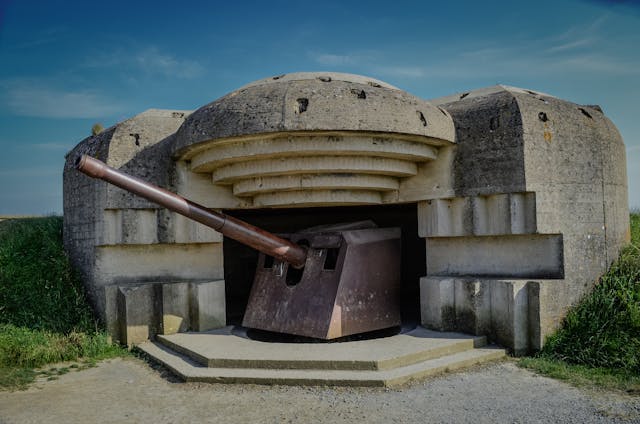
Was there anything the Germans could have done after D-Day? Not to win the war. Short of producing a working nuclear bomb, and probably not even then, there was no realistic way for Germany to secure victory after the Allies entered Europe on D-Day. What they could have done was make the Allied advance slower, make it more expensive, or possibly surrender earlier and save millions of lives.
The Allies landed in Normandy on June 6th, 1944. They had originally planned to land on June 5th, but bad weather pushed the invasion back by one day. About 160,000 troops crossed the Channel on the first day, and by the end of August, more than 2 million Allied troops had landed in France. The Germans could probably have made Allied casualties worse on D-Day if they had known exactly where the invasion was coming. If they had moved their armored reserves faster, and if Hitler had allowed his commanders more freedom, the fighting on the beaches and inland could have been even bloodier. However, there was probably no way for Germany to stop an Allied invasion of Europe forever. There was too much coastline to defend, and the Allies had too much control of the air and sea.
With hindsight, it is pretty safe to say that Germany’s chance of winning the war disappeared long before D-Day. One possible turning point was December 1941. Japan attacked Pearl Harbor on December 7th, and a few days later Hitler declared war on the United States. At first, Hitler was pleased because he thought the USA would have to split its strength between Europe and Asia. He also believed Japan’s attack would give Germany more time to win in the Soviet Union. However, he seriously underestimated the economic power of the United States.
After the USA entered the war, it had to arm almost from zero. That took time, but once American industry switched to a war footing, it produced weapons, tanks, planes, ships, trucks, ammunition, and supplies on a scale Germany could not match. Germany was also already fighting the Soviet Union, and that war was eating up enormous numbers of soldiers, tanks, aircraft, and fuel. Germany might be able to replace one plane or tank for every several it lost, while the USA and the Soviet Union could keep producing more. So, once the Western Allies invaded France, Germany was being squeezed from both sides. What options did it have?
The option Hitler chose was to keep fighting in the hope that something would happen to turn the tide. This could be called the “head in the sand” option, although that is easier to say with hindsight. Some Germans may have believed that new weapons, a political split between the Allies, or exhaustion in Britain and America could still save them. Germany had developed the Me 262, one of the first jet fighters, and it was much faster than Allied aircraft. However, it arrived too late, there were not enough of them, fuel was short, pilots were short, and Allied bombing made production difficult. It could have made the air war more dangerous, but it could not have changed the outcome by itself. The same is true of Germany’s other “wonder weapons.” They were frightening, but they were not enough.
Germany could also have retreated more sensibly. After D-Day, German forces fought hard in Normandy, but Hitler repeatedly refused to allow proper withdrawals. A tactical retreat to a more defensible line, such as the Seine, might have saved more German soldiers, tanks, and equipment. It might also have slowed the Allied advance. However, it would not have solved Germany’s main problem. The Allies had air superiority, huge supplies, and more men arriving all the time. At the same time, the Soviet army was advancing from the east. A better retreat might have prolonged the war, but it probably would not have saved Germany.
Another option would have been to overthrow Hitler and try to negotiate. Some German officers did try to kill Hitler on July 20th, 1944, but the attempt failed. If Hitler had been removed and handed over, a new German government might have tried to make peace with Britain and America. However, that would have been extremely difficult. The Allies had already agreed to demand unconditional surrender, and the Soviet Union had suffered so much that Stalin was unlikely to accept a gentle peace. Germany had also committed crimes on such a huge scale that it is hard to imagine the Allies simply allowing it to keep conquered land. Still, a successful coup might have ended the war earlier and saved lives.
Probably the best option Germany had after D-Day, and certainly after the failure of the Ardennes Offensive in December 1944, was to surrender as soon as possible. This is not something Hitler would ever have considered, and it is said with hindsight, but an early surrender would have saved a huge number of people. The Allies would not have had to fight across the rest of France, Belgium, the Netherlands, and Germany. Many German cities would not have been destroyed. Many soldiers and civilians on all sides would have lived. Germany may or may not have received better terms, but fewer people would have died.
Once D-Day had succeeded, Germany was almost certainly defeated. It could still choose how long to keep fighting, where to retreat, and how many lives to waste, but it had very little realistic chance of victory. The best thing Germany could have done after D-Day was not to find a way to win. It was to find a way to stop. And this is what I learned today.
Sources
https://nationalinterest.org/blog/reboot/could-german-army-have-stopped-allied-victory-d-day-189012
https://www.iwm.org.uk/history/second-world-war/d-day/the-german-response-to-d-day
https://forum.paradoxplaza.com/forum/threads/could-have-germany-won-d-day.210629
Photo by Hub JACQU: https://www.pexels.com/photo/historic-normandy-bunker-with-artillery-cannon-29008792/