
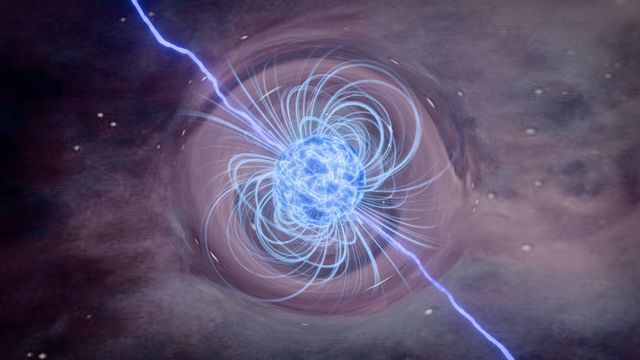
What is a magnetar? A magnetar is a neutron star that is the size of a city but is one of the strongest magnetic objects in the universe.
Many planets and stars have a magnetic field. Our Earth has a magnetic field that is produced by the spinning liquid metal in the outer core. The swirling liquid metal produces electrical currents, which in turn produce a magnetic field. Our magnetic field extends tens of thousands of kilometers into space and protects us from charged particles that fly off the sun. Without the magnetic field, our atmosphere would have been stripped off long ago. The magnetic field protects us but, as far as magnets go, it is not very strong. It measures about 0.000065 Tesla at the surface. A fridge magnet is about 0.01 Tesla. The strongest magnet ever made on Earth was 48.7 Tesla. By comparison, the magnetic field of a magnetar is roughly 100,000,000,000 Tesla. If you got within 1,000 km of a magnetar, the magnetic field would rip all the electrons from your atoms in a nanosecond. You would die. So, what are magnetars?
A magnetar is a type of neutron star. And neutron stars are the collapsed cores of massive stars that have shrunk down to the size of a city. Not any star can become a neutron star. They need to be a minimum of 8 times bigger than our sun. Stars are hot because they are converting fuel from one element to another. Our sun is converting hydrogen into helium. When our star runs out of hydrogen, that will be it, but if a star is massive enough, the pressure of its gravity will make it hot enough to turn the helium into heavier elements. This will keep going with heavier and heavier elements until the star gets to iron. When a massive star builds up an iron core, fusion can no longer release enough energy to support the star. Stars exist in a battle between the weight of the star pulling it in on itself and the energy it produces pushing it out. So long as these balance, the star remains whole. When the energy disappears, the core collapses under gravity. Protons and electrons are forced together to form neutrons and neutrinos. The core becomes incredibly dense and may survive as a neutron star, while the outer layers of the star are blasted into space in a supernova.
Neutron stars usually have magnetic fields, but magnetars have fields far stronger than ordinary neutron stars. Astronomers are not completely sure how they form, although they do have some ideas. It does depend on whether the original star had a magnetic field or not. If it did, when the star collapses into a neutron star, the magnetic field compresses with it, become far more powerful. However, this alone isn’t enough to account for the stupendous power of a magnetar’s field.
Another theory is that they behave like a dynamo. A dynamo works when a loop of wire rotates inside a magnetic field. This creates an electric current. The inside of a neutron star is mostly neutrons, with some protons and electrons, and possibly more exotic states of matter deeper inside that behave like a superconducting fluid. The neutron star itself might be rotating at about 500 times a second. This spin is so fast that it can increase the power of the magnetic field it had exponentially. Magnetars are so powerful that a giant flare of gamma rays and X-rays from the magnetar SGR 1806-20, about 50,000 light years away, disrupted Earth’s ionosphere.
The star that collapsed to form the neutron star and then the magnetar was probably burning for billions of years. It only took a few seconds for it to collapse down into a neutron star. Once it is a magnetar, it won’t last for long. The magnetic field around the magnetar starts to decay after about 10,000 years and it will end up as just a normal neutron star. From there, unless it collides with something else, the neutron star will just slowly lose heat over a trillion years until it becomes a sphere of cold neutronium. No one has ever seen neutronium, because a trillion years is 76 times longer than the universe has already existed. And this is what I learned today.
Sources
https://science.howstuffworks.com/magnetars.htm
https://en.wikipedia.org/wiki/Magnetar
https://en.wikipedia.org/wiki/Earth%27s_magnetic_field
https://en.wikipedia.org/wiki/Neutronium
Photo by Nicola Narracci: https://www.pexels.com/photo/illustration-of-a-neutron-star-s-magnetic-field-38039151/