
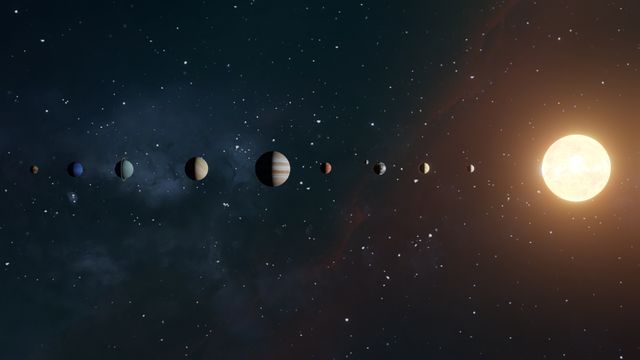
Why do all the planets orbit in the same plane? All of the planets orbit in the same plane because they were all formed out of the same spinning cloud of gas, and because any planets that orbited at a different angle would have been less stable and could have been destroyed in collisions.
The planets don’t spin in exactly the same plane, but they are extremely close. The planets all orbit in almost the same plane. Most are within about 2 degrees of the Solar System’s average plane, although Mercury is tilted by about 6 degrees. Jupiter is the largest, carrying 70% of the mass of all the planets, and sets the orbit that all the other planets follow.
The sun and all of the planets in our solar system were created from the same cloud of gas. About 4.5 billion years ago, a massive cloud of gas began to clump together because of gravity. When the cloud is hot, the particles are moving too much, but as it cools, it starts to gather together. This cloud was enormous, but some areas were denser than other and those were where stars and planets form.
As the gravity increased, the cloud of gas began to spin. It started to spin very slowly, but as it spun, it slowly contracted, and as it contracted, it spun faster. This is due to the conservation of angular momentum. Imagine a spinning figure skater. When she spreads her arms out, she slows down, and when she pulls her arms in again, she speeds up. A spinning object will naturally keep spinning unless it is stopped by another force, such as friction. The speed at which a spinning object spins is a ratio between its moment of inertia, which is how its mass is distributed from its center, and its angular velocity, which is its speed. If you reduce one, you increase the other. If you reduce the moment of inertia by bringing the mass closer to the center, you increase the angular velocity. As the cloud of gas rotated and grew more compact, it spun faster.
Then, because the cloud is spinning, it started to flatten out into a disk. The cloud is spinning around a central plane. Particles along that plane are pulled down towards the center by gravity, but they also have a lot of sideways speed, which means they miss the center and start orbiting. Gas above and below the plane loses energy through collisions and gradually settles into the rotating disk. Gradually, all of the particles join the orbiting disk.
As the disk spins, most of the mass is pulled into the center and clumps together to form the sun. Most of the mass goes to the center in the same way most of the water in your bath is pulled down to the plughole. The gas that is left over clumps together in different places and forms planets as well. These new planets orbit in the same direction and on the same plane as the spinning disk of gas from which they were made.
It is possible that some planets formed out of gas that wasn’t in the rotating disk, but they were probably destroyed through collisions. Any planet that was rotating on a different plane would have a very high probability of impacting one of the other planets. Perhaps that was what happened to the early Earth, creating the moon. The fact that there are no other planets orbiting outside this plane means they were either all destroyed or never created in the first place.
Interestingly, the planets don’t orbit exactly around the sun’s equator, and nobody knows exactly why. All of the planets are between 5 and 7 degrees of the sun’s equator. There are three possible reasons for this. The first is that the original disk wasn’t completely flat and had waves in it. That seems unlikely, because gravity would have ironed them out, but it is not impossible. A second reason is that the planets started in a disk around the equator, but something like a star moved past our young solar system, close enough for its gravity to pull the planets ever so slightly off their perfect plane. This is possible, but you would think that the sun would have been affected as well. The third reason is that the sun moved. The sun has a very strong magnetic field, and the interaction between that field and the rotating cloud of gas could have gradually tilted the sun’s rotation while the gas stayed unchanged. Nobody knows for sure. And this is what I learned today.
Sources
https://en.wikipedia.org/wiki/Angular_momentum
Photo by Zelch Csaba: https://www.pexels.com/photo/a-solar-system-graphic-12491599/