
How can a bicycle freewheel? A bicycle can freewheel because of a ratchet and spring-loaded catches inside the gear hub.
When you cycle on a bicycle, you use the pedals to apply energy to the chain, which transfers the energy to the wheels and makes you move forwards. You want that when you are on the flat or going uphill. However, when you are coming down a steep hill, you don’t need to keep supplying energy because gravity can supply the energy that you need. In fact, pedaling might even be a problem because you won’t be able to pedal as fast as the wheels are turning. In these situations, you need a bike that can unlock the wheel from the pedaling mechanism and freewheel.
The whole system works because of a ratchet mechanism inside the hub attached to the back wheel. The pedals connect to a crankset that might have one or two different-sized cogs on it. The chain attaches to one of those cogs and loops back to the cassette attached to the back wheel, which may also have different-sized cogs. When you apply force to the pedals, the force is transferred to the crankset, then to the front cog, through the chain to the rear cassette, and from there to the freehub, which drives the back wheel forwards.
The freehub contains spring-loaded pawls and a ring of ratchet teeth. The springs keep the pawls pushed out so that they engage with the steep faces of the ratchet teeth. When you pedal, the chain turns the cassette and freehub, causing the pawls to lock against the ratchet teeth and drive the rear wheel forwards. When you stop pedaling, or when the rear wheel spins faster than you are pedaling, the wheel turns faster than the cassette. The sloping faces of the ratchet teeth push the pawls back against their springs, allowing them to slide over the teeth with the familiar clicking sound. This lets the rear wheel continue spinning while the pedals remain still. As soon as you start pedaling again, the pawls spring back into place and lock onto the ratchet teeth once more.
The freewheel system was invented in 1869 by an American inventor called William Van Anden. It took a while to be taken up because cyclists thought it would make the bicycle too complicated. When they finally realized its advantages, it became commonplace. There were several inventions in the world of bicycles at the end of the 19th century that made them far safer and far more popular. With hindsight, we might wonder how people rode bicycles without these safety features, but that is always the way with hindsight.
Before the 1880s, bicycles were made of metal, and they had wooden wheels. They had no gears and, more surprisingly, they didn’t have very good brakes. The rubber tire and then the inflatable rubber tire were invented by John Boyd Dunlop in 1887. Before then, bicycles had no suspension and, for good reason, were called “bone shakers”. They also had very little grip and were not fun to ride.
Penny farthings had been the most common until the safety bicycle was invented in 1885. This made the front and back wheels the same size and placed the chain on the back wheel, pushing the bicycle rather than pulling. The reason a penny farthing had such a big front wheel was that the pedals were attached directly to it, and a big wheel meant more distance and more speed for one pedal revolution. The rear chain drive allowed for much smaller wheels. This made balancing easier but it also reduced accidents because on a penny farthing, you could only stop by bracing the pedals, which were attached to the front wheel, which meant a lot of people went over the handlebars. Safety bicycles also had a system of braking that hadn’t been present before. The only way to stop an old bike was to push a block on the wheel, brace the pedals, or jump off.
The safety bicycle was hugely popular and started a societal revolution. Cycling clubs appeared and a lot of women cycled. People could easily get out of the town for a day and see the countryside. Women took to the bicycles more than men because it gave them a freedom that they were not normally allowed. Their lives were controlled by men, but bicycles gave them a way to travel and get around on their own. Bicycles could be said to have been one of the pushes that led to the rise of the suffragette movement. Susan B. Anthony famously said the bicycle had “done more to emancipate women than anything else.” And this is what I learned today.
Sources
https://en.wikipedia.org/wiki/Freewheel
https://en.wikipedia.org/wiki/Safety_bicycle
https://www.kalkhoff-bikes.com/en_sk/advice/technology/freewheel
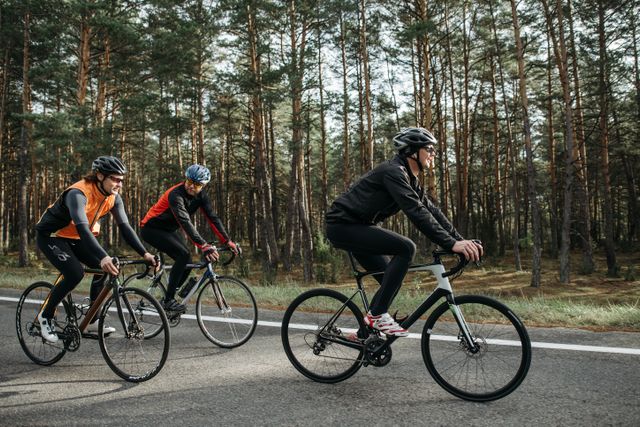
Photo by Pavel Danilyuk: https://www.pexels.com/photo/men-riding-bicycle-on-road-5807687/