
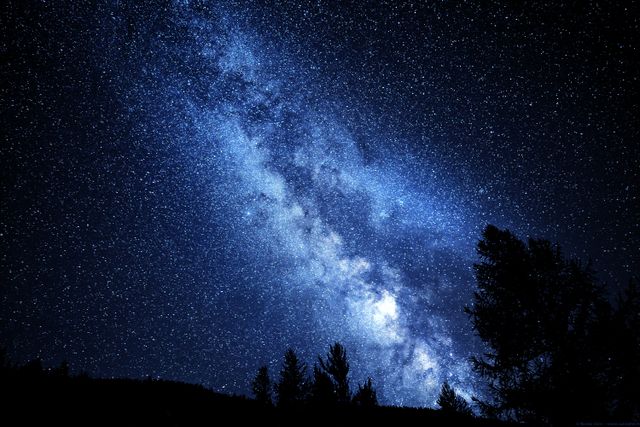
What is Olbers’ Paradox? Olbers’ Paradox says that if the universe is infinite, eternal, static, and the same in every direction, the night sky should be completely illuminated and very bright, all the time.
The Olbers behind Olbers’ Paradox was a German astronomer called Heinrich Olbers. In 1823, he was thinking about the size of the universe, and he hit upon a conundrum. If the universe were infinite and the same in every direction, there would be an infinite number of stars. That would mean that in every direction you looked, you would see the light coming from stars. There would be no dark in the night sky. The whole sky would be bright. Think of it as though you are standing in a forest. The trees close to you are huge, and the trees far away look tiny, but wherever you look, eventually your line of sight lands on a tree. The light of stars that are further away from us is not as bright as close stars, so the light reaching us would be fainter, but as you get further away from the Earth, you have more stars. If you think of layers around the Earth, every time you go out a layer, the brightness of the stars in that layer drops, but the surface area increases, so you end up with more stars and an overall total brightness that is unchanged. With infinite stars and infinite layers, you would have the same brightness anywhere you looked in the sky. The closest stars would still be bright points, but the space between them would be filled by light, and not dark as it is. To Olbers, the sky obviously wasn’t bright, and there was dark between the points of light, which meant that we couldn’t see all of the stars. And that was the paradox.
We know that this is not a paradox because of several discoveries that were made in the late 19th and early 20th centuries. Firstly, the observable universe has a finite age of about 13.8 billion years. Light from more distant regions has simply not had enough time to reach us. Secondly, the universe was discovered to be expanding. As galaxies get further away and move faster, the light from them gets stretched into infrared, microwave, and radio wavelengths that we can’t see. If you looked at the night sky with an infrared camera or listened for radio waves, it would be a lot brighter than just looking through a telescope. And, thirdly, stars don’t live forever. Our Sun will spend about 10 billion years on the main sequence, and that is a little bit longer than the average star. The light from the stars won’t reach us at the same time because stars are born and die at different times.
Most of the reasons why this paradox isn’t a paradox are clear to most of us. Possibly more interesting is why this is called Olbers’ Paradox. Olbers wasn’t the first person to think this, and it was a common problem in astronomy at the time. Apparently, Thomas Digges, an English mathematician and astronomer, was the first person to come up with the idea in the late 16th century. He argued that the universe was infinite and filled with stars, but he thought that the distant stars were probably too faint to see. In 1610, Johannes Kepler approached the problem, and he concluded that the fact that the sky is not completely bright proves that the universe is not infinite. Then, in 1744, a French astronomer called Jean-Philippe de Cheseaux approached the problem. He concluded that there could easily be enough stars to make the whole sky bright, but interstellar dust must be absorbing the light and preventing it from reaching us. Then, in 1823, Heinrich Olbers said exactly the same thing as Cheseaux. Olbers was more famous than Cheseaux, and his paper reached a much wider audience. His name started to stick with it. He didn’t discover it, he didn’t provide a solution, and his theory about interstellar dust absorbing the light was wrong because the dust would heat up and glow anyway. So, Olbers’ Paradox is not really a paradox, but why Olbers’ Paradox is Olbers’ Paradox and not Cheseaux’s Paradox is a paradox. And this is what I learned today.
Sources
https://en.wikipedia.org/wiki/Olbers%27_paradox
https://en.wikipedia.org/wiki/Thomas_Digges
https://www.skyatnightmagazine.com/space-science/olbers-paradox
https://lambda.gsfc.nasa.gov/product/suborbit/POLAR/cmb.physics.wisc.edu/tutorial/olbers.html
Photo by Nicolas Outin: https://www.pexels.com/photo/silhouette-of-trees-under-starry-night-sky-13444721/