
How did we work out the age of the Earth? The age of the Earth has been calculated by looking at the oldest minerals here on Earth, rocks on the moon, and meteorite rocks.
The Earth formed roughly 4.54 billion years ago. However, that is a date people have only known with certainty since 1953, when it was calculated by a geochemist called Clair Patterson. Before then, it was difficult to successfully age the Earth because it is not an easy problem.
People have always known that the Earth is old because we all have ancestors going back far further than we can remember. As to how old, nobody really knew. In the Middle Ages, people tried to work out the age of the Earth by working out how many generations there had been. In 1650, an Irish Archbishop called James Ussher made the calculation by counting how many generations were named in the Bible. He came up with the answer that the Earth, all the planets, and all the stars were formed on Sunday, October 23rd, 4004 BC. Making it slightly over 6,000 years old. A lot of religious groups still believe this calculation and use 6,000 years as the age of the Earth. They weren’t to know it at the time, but there are several buildings built before 4004 BC that are still standing, and many artefacts that are much older than that have been found.
In 1670, an English natural historian called John Ray saw a bed of sand 30 meters thick on top of cockleshells. He realized that if he could measure how long it took sand to build up, he could work out how long that 30-meter sand bed had been here. He worked out that it must have taken at least 10,000 years, which was much longer than the Bible said.
In the 1680s, Isaac Newton began to think about the problem in a different way. It was generally accepted that the Earth had been molten at one point. He wondered how long it would take for a molten globe the size of the Earth to cool down to the temperature it had reached. He calculated that even given 50,000 years, the Earth would still be far hotter than it is today. The Comte de Buffon tried it himself in 1779. He built a scale replica of the Earth using iron, heated it until it was molten, and then timed how long it took to cool. He then extrapolated from this and calculated that the Earth was 74,832 years old. In 1862, Lord Kelvin made his own calculations and decided that the Earth was between 20 million and 400 million years old.
In the early 19th century, the study of geology was taking off. Many geologists who studied the rocks and the mountains realized that for layers of rock to build up, and for the cycles of erosion, subsidence, and uplift that mountains underwent, 400 million years was probably not long enough.
Then, in 1953, an American geochemist called Clair Cameron Patterson was able to tell that the Earth is 4.55 billion years old. How did he do it? He did it using radiometric dating on meteorites. Radiometric dating is where scientists look at the amount certain elements have decayed. Elements such as uranium decay at a predictable rate. Over a certain amount of time, half of the uranium atoms will lose energy and turn into lead. Scientists know how long this takes, so they can look at how much uranium has turned into lead in the rock or whatever they are testing, and calculate how much time has passed. The problem with using this method on Earth is that, because we have tectonic plates, all the rocks are constantly being remade and they are not as old as the planet itself.
So, there are three ways to calculate the age of the Earth. Firstly, there are some minerals which are almost as old as the planet. They are called zircon crystals, and they formed 4.404 billion years ago. They are the oldest known mineral on Earth. Radiometric dating of these doesn’t give the age of Earth, but it’s close. The second method is to look at moon rocks. The moon was formed at roughly the same time the Earth was, but, unlike Earth, the moon doesn’t have plate tectonics. The rocks that are on the moon now are the same rocks that were there when it was formed. If we analyze those rocks, we can get a pretty good idea of how old Earth is. And the third way, which is how Clair Cameron Patterson dated the Earth, is by looking at meteorites. They were some of the earliest things to form as the early planets were clumping together. Aging those gives a rough idea of the Earth as well. The Earth is 4.54 billion years old (± 50 million years). And this is what I learned today.
Sources
https://en.wikipedia.org/wiki/Radiometric_dating
https://www.teachastronomy.com/textbook/The-Earth-Moon-System/Early-Estimates-of-Earths-Age
https://www.sciencefocus.com/planet-earth/how-old-is-the-earth
https://en.wikipedia.org/wiki/Age_of_Earth
https://education.nationalgeographic.org/resource/how-did-scientists-calculate-age-earth
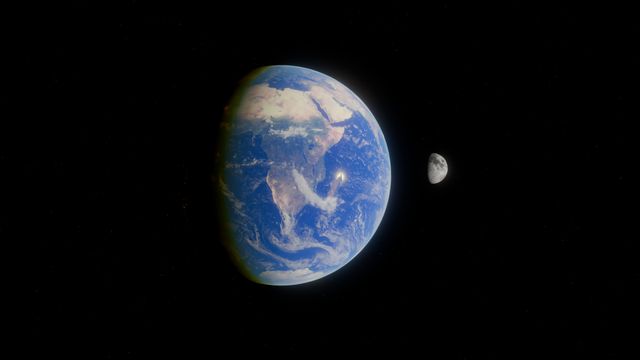
Photo by Zelch Csaba: https://www.pexels.com/photo/stunning-earth-and-moon-in-space-photography-30596303/