
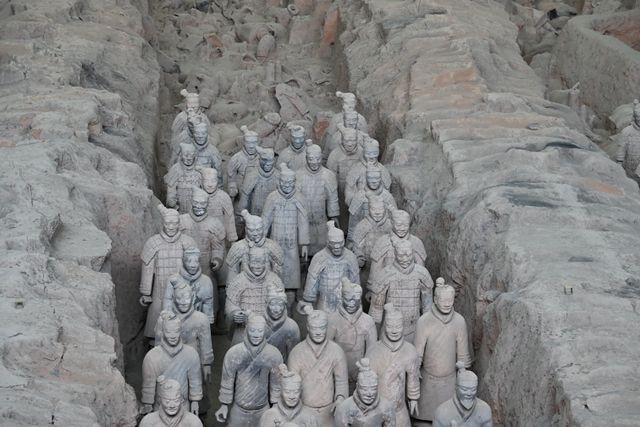
How were the Terracotta Warriors found? The Terracotta Warriors were found accidentally by farmers digging a well.
The Terracotta Army was buried in 221 BC and it wasn’t uncovered again until it was found by farmers in 1974. There was a bad drought in the area, and Yang Zhifa and his five brothers were desperate for water for their crops. They dug a well into the ground and had reached a depth of 5 meters without finding any water. However, they did discover pieces of pottery, along with life-sized heads and bronze arrowheads. From the quantity, they realized that something must be buried there and word spread. It quickly reached an archaeologist called Zhao Kangmin, who went to investigate. He started to excavate the area and realized that there was a lot more there than they had first thought.
Yang Zhifa was given a reward of a year’s salary and land in a neighboring village. He had to leave his hometown because of the excavation work. The site became so large that many people had to move. After a while, a museum was built on top of the site. Yang Zhifa was given a job in the museum, signing books for tourists. He made more money there than he ever would have as a farmer.
The Terracotta Army is located in Xi’an, China. It consists of four pits dug around a central mausoleum. The fourth pit is empty, but each of the other three pits contains a total of 8,000 soldiers, 130 chariots with horses, and 520 cavalry horses. A lot of it is still buried. Analysis of the faces of the soldiers shows that no two faces appear to be exactly alike. They vary in height, build, facial features, and expressions. At the center is the mausoleum of the first Chinese emperor of the Qin dynasty, Qin Shi Huang. The Terracotta Army surrounds this mausoleum to follow him in the afterlife.
Emperor Qin was the first person to unite China and technically the first emperor of China. He ruled from 221 to 210 BC. He was a huge force in the history of China because of all the things he did. He obviously united several warring states to make the country of China. It is thought that the name for China comes from Qin, pronounced Chin. The word for China is similar in different languages, lending strength to this theory. It is Cina in Sanskrit, Cin in Persian, and China in Portuguese. He standardized the writing system in China because the original nations that he unified had different systems. He standardized weights and measures. He introduced a common currency. He built an enormous road network. He built a giant canal network. He centralized the government. And, of course, he linked existing walls to start the Great Wall of China.
A lot of the Terracotta Warriors have been uncovered, but a large part of the site remains unexcavated. We think of them as just being clay colored, but they were actually painted in brilliant colors. Within minutes of being exposed to the air, the lacquer dries and the paint begins to flake away. The mausoleum has also been left untouched. Many archaeologists believe the unopened tomb may be even more impressive than the Terracotta Army itself. It is the size of a palace and appears as a pyramid hill. Legend has it that there are traps set in the tunnels that lead to the tomb and the emperor was buried with rivers of mercury. Soil analysis has revealed a high level of mercury, but it is unknown whether the high mercury levels come from rivers of mercury described by ancient historians or from natural geological sources and modern contamination. General consensus is that the technology to excavate the tomb safely without damaging anything doesn’t yet exist, so it is to be left as it is.
The tomb was written about by historians just after the time of Emperor Qin. It was said that it took 38 years to build the tomb and all of the terracotta warriors. That means work must have started as soon as he became emperor and carried on up to his death. One theory is that work stopped after the emperor died, leaving the fourth pit unfinished. Legend also says that the tomb is sealed and protected by traps and mercury, which is a reason why it hasn’t been looted. Nearly all of the tombs in Egypt were broken into and looted, but that hasn’t happened to this one. I would love to see what is inside it. And this is what I learned today.
Sources
https://education.nationalgeographic.org/resource/terra-cotta-warriors-found
https://en.wikipedia.org/wiki/Yang_Zhifa
https://en.wikipedia.org/wiki/Qin_Shi_Huang
https://en.wikipedia.org/wiki/Qin_dynasty
https://en.wikipedia.org/wiki/Mausoleum_of_Qin_Shi_Huang
https://en.wikipedia.org/wiki/Terracotta_Army
Photo by INDU BIKASH SARKER: https://www.pexels.com/photo/terracotta-warriors-in-xi-an-china-38115188/