
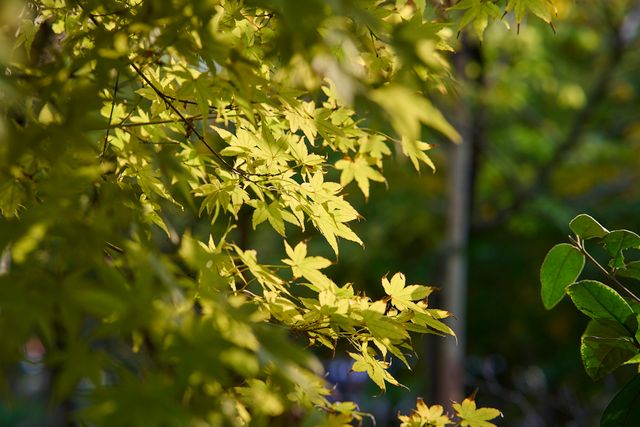
Why are leaves different shapes? Leaves are different shapes because of the conditions they have evolved to survive in. That might be for catching more sunlight, for saving water, to not be eaten by predators, or for staying cool.
Leaves on a plant or a tree are a constant tradeoff. The main purpose of a leaf is to photosynthesize. They are green because they contain chlorophyll. They absorb sunlight and use that energy to convert carbon dioxide into sugar and oxygen. And this is the tradeoff. The bigger the leaf is, the more it can photosynthesize. Plants also have stomata in their leaves, which allow carbon dioxide into the leaf. The bigger the leaf is, the more stomata it can have and the more carbon dioxide it can take in. However, the bigger the leaf is, the more water it will lose to evaporation. Bigger leaves can risk absorbing too much radiation and being damaged as well. Big leaves with a lot of water in them are also more vulnerable to frost damage at night if the temperature drops. Plants in the desert need to cope with both high daytime temperatures and very low nighttime temperatures. The balance between being large enough to photosynthesize and absorb enough carbon dioxide but small enough to retain water, not freeze, and not get damaged, has generally been arrived at through evolution. Replacing leaves costs the tree energy, which makes them expensive. It is better for the tree to have a type of leaf that isn’t lost easily.
Different trees have different shaped leaves, but often, the same species of tree has different shaped leaves depending on where it is growing. This is good evidence that the shape of a tree’s leaves has a lot to do with the environment it is growing in.
There are obviously exceptions to every rule, but trees that grow in shaded areas, or in forests with a lot of other trees, tend to have large leaves. Their goal is to receive as much sunlight as they possibly can. However, another problem with large leaves is wind or rain damage. Places that have less sunlight might also have more rain or wind. To cope with this, a lot of plants have evolved leaflets. This is where, instead of having one large leaf, they have the same surface area but broken up into leaflets. These are small leaflets connected to the same leaf stem. They are small, so if one of them is hit by wind or rain, it won’t rip the whole leaf off. They are also good when it comes to parasites or diseases. Instead of killing the whole leaf, they will only damage one small part of it.
A lot of trees have evolved leaves that have pointed tips. This is found all over the world where there is a lot of rain. They are called drip tips, and their function is to funnel rainwater down the tree. If rainwater builds up on the leaves, it can allow fungi, algae, and bacteria can grow. They can also become heavier, which brings the risk of them being pulled off.
Many trees have also evolved to have lobed leaves, such as oak and maple trees. Scientists don’t know the exact reason for this, but it is thought that it is to allow the wind to pass through the tree without ripping the leaves off. This shape of leaf also helps sunlight reach down to the lower leaves.
Both heat and cold can cause trees to have small leaves. Many evergreen trees that grow in cold climates have very thin, needle-like leaves. This is because larger leaves will freeze in the cold conditions that they grow in, and also because snow will build up on the branches and larger leaves would be pulled off. Needle leaves and flexible branches allow the snow to fall off. They make up for having tiny leaves by having a huge number of them. Cactuses, on the other hand, have tiny needle leaves because of the heat. The spikes on a cactus are actually leaves. They need to be small because the heat in the desert would evaporate too much water through their stomata. They can afford to be small because they receive more sunlight than a larger leaf in a more northern location would. Also, the stem of the cactus can photosynthesize as well.
It is not always to do with the shape, but some leaves also evolve to keep predators away. The leaflets we looked at earlier are a good survival mechanism. An animal might eat half of a leaflet, while they would have eaten all of a larger leaf. Some leaves also evolve to have spikes on them. Cactus leaves are spikes. Holly is another example of this. They have evolved to be hard leaves with sharp spines. This is a good idea, but the animals that eat them have evolved to have strong teeth and thick tongues and gums, which are not bothered by the spines. Some leaves have also evolved toxins to keep animals and insects away. Poison ivy is a good example of this. This toxin is contained in an oil called urushiol. However, just like holly, animals have evolved to be able to eat it. Poison ivy is harmful to primates and can make us very sick, but deer and goats can eat it without any effects. In fact, goats love it and will happily eat the entire plant. And this is what I learned today.
Sources
https://www.sciencefocus.com/nature/why-do-different-plants-evolve-different-shaped-leaves
https://www.treehugger.com/leaves-different-shapes-sizes-4864228
https://link.springer.com/article/10.1186/2041-9139-5-47#Bib1
Photo by 开 心: https://www.pexels.com/photo/sunlit-green-leaves-in-springtime-forest-34799514/