
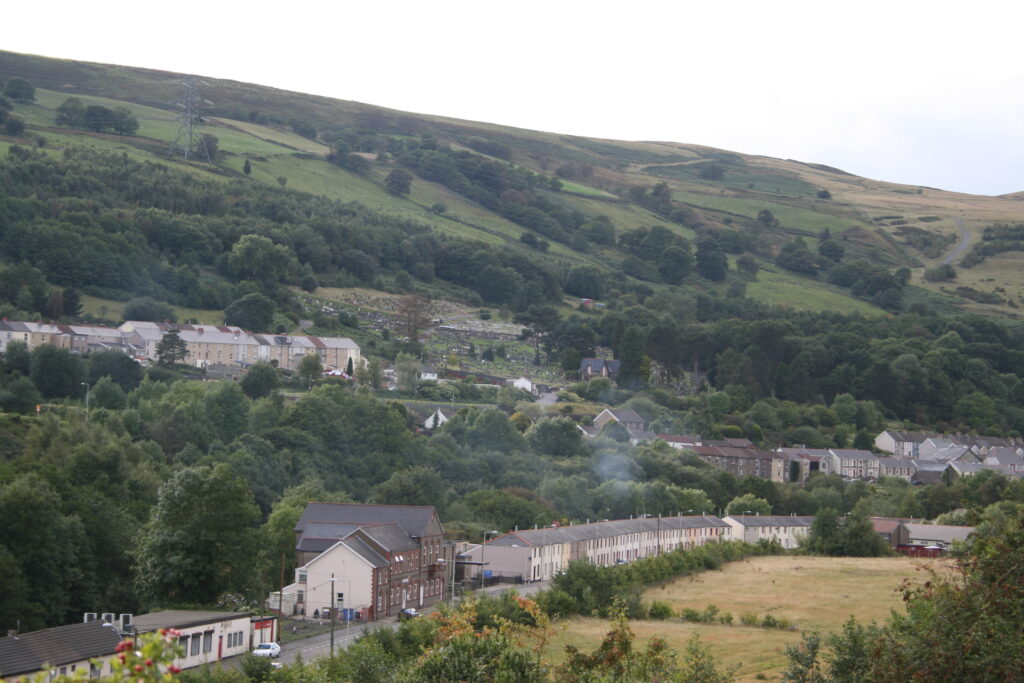
What was the Aberfan disaster? The Aberfan disaster was a terrible coal-waste landslide in 1966 that hit a school and killed 116 children and 28 adults.
Aberfan is a small village in the area of Merthyr Vale in Wales, UK. The village was mostly a tiny hamlet until the Merthyr Vale Coal Mine was opened in 1869. The Industrial Revolution was in full swing, and coal was a desperately needed resource. Britain has quite a few areas that have a lot of coal. These tend to be the hilly areas of South Wales, North England, and Central Scotland. In the early years of the Industrial Revolution, firewood had been used to produce steam, but there were nowhere near enough trees in the whole of the UK to sustain that practice. It was quickly realized that coal contained a lot more energy per kilogram and coal mining increased. Merthyr Vale Colliery was opened by a mining engineer called John Nixon and it went into production in 1869. Coal mining was labor-intensive and the hamlets around the mine began to grow. Aberfan reached a population of 5,000 by the time the disaster happened.
When miners dig up coal, it is impossible to only remove the coal. They take up all of the earth, including rocks, soil, shale, slate, sandstone, and mud, and the coal is removed on the surface. The waste material can’t be put back into the ground because the miners need to constantly move forward to find more coal. The problem of where to put this waste is a problem that every mine has. The general way of doing things was to just pile it up next to the mine. These piles of waste were called spoil tips. The mine at Merthyr Vale had been going for almost one hundred years by the time the disaster happened. In the early days of the mine, they had piled the spoil up at the base of the hill, but as they started to bring up more coal, they ran out of space. In the 1910s, they began to pile the spoil up on the sides of the hill. They grew into conical piles and by 1966 they had accumulated seven of these spoil tips.
Spoil tip number 7 was started in 1958 and by the time of the disaster, 21 October 1966, it had grown to 34 meters high. The problem wasn’t just the height; the tip was built upon a hill that had a natural spring coming out of it. The other spoil tips were also built on springs and streams that were known about, but the management at the mine didn’t think it was a concern. Spoil tip 4 had even had a landslide in 1944, but they didn’t think that was a sign for concern.
Over the first three weeks of October 1966, there was far more rain than usual. The rain soaked into the spoil tip that was already saturated from the spring coming out underneath. At 7:30, it was discovered that the top of the spoil tip had collapsed. The decision was made to stop work and find a new location for spoil tip 8 the following week. They never got the chance. At 9:15, spoil tip 7 reached the saturation point where it could no longer hold its form and it became a viscous liquid. It flowed down the side of the hill from the mine. It moved at roughly 25 km/h and it came in 7 meter high waves. 110,000 cubic meters of spoil slid down the hill.
The landslide flattened several houses, crossed the canal and railway, flattened more houses, and hit Pantglas Junior School just as the teachers were taking morning attendance. The landslide consisted of liquefied soil, and small pieces. When it settled, it set like concrete. Rescue workers immediately started to dig, but it was impossible to breathe if trapped. They managed to save 21 children and five adults, but no more. The landslide killed 109 children and five teachers in the school. 7 more children and 23 adults were killed by the landslide.
There was a tribunal held after the disaster. Nine people and the National Coal Board (NCB) were found guilty. A fund to help the families of the victims was set up, but it was badly managed and it was hard for families to get the money. The NCB was petitioned to remove the spoil tips, but they refused because it was too expensive. The government also refused for the same reason. Finally, the only way to get the tips removed was to pay a large portion of the money from the disaster fund that had been set up to help the victims. The whole disaster was insensitively and badly managed. And this is what I learned today.
Sources
https://en.wikipedia.org/wiki/Aberfan_disaster
https://en.wikipedia.org/wiki/Aberfan
https://en.wikipedia.org/wiki/Merthyr_Vale
https://en.wikipedia.org/wiki/Coal_mining_in_the_United_Kingdom
https://www.history.com/this-day-in-history/october-21/aberfan-disaster-mining-landslide