
Why do beans cause gas? Beans cause gas because of the complex sugars and fiber that they contain.
Beans are the seeds produced by plants in the legume family. A lot of them are edible, but not all of them. Humans cultivate and make use of many different kinds of beans. Beans are seeds, but seeds come in many different types, beans just being one of those types. The bean contains everything that the new plant needs to grow, but it is a little different to other kinds of seeds, such as wheat, because they carry a lot more starch that can be easily converted into sugar. Beans contain the baby plant and thick seed leaves, called cotyledons, which act as a storage tissue. This is one of the big differences from cereal seeds like wheat, where most of the stored food is in a starchy endosperm. In beans, much of the stored material is in the cotyledons themselves. In beans, a lot of this storage is made up of protein, which is an efficient way for the plant to store nitrogen. Plants need nitrogen to build new tissue and grow. Not all soils contain a lot of nitrogen, but legumes have symbiotic bacteria in their roots that enable them to take nitrogen out of the sky as well, making it much easier for them to store it in their seeds. This stored nitrogen in the seeds gives the new plant an advantage because it can get a head start, even in nitrogen poor soils. Farmers often plant beans as a rotation crop to restore nitrogen to depleted soils. These proteins make beans a very good source of nutrition for animals and humans as well. We have cultivated them for thousands of years and today we eat many different types of beans. We also indirectly consume cacao beans and coffee beans as well (although, they are not true beans – they are seeds that we call beans).
So, why do beans cause gas? The gas that we sometimes have to expel is a combination of some air we have swallowed and gas produced by the bacteria that live in our gut. Our digestive system has several stages. The first stage is the saliva in your mouth. As you chew, and before you swallow, saliva mixes with the food, which moistens it and contains enzymes that start to break down the starches. The food goes down to the stomach where stomach acid and more enzymes continue to break down the food. The partially digested food is then sent on to the small intestine where more food is broken down and the nutrients are absorbed into your blood stream. What’s left is then sent to the large intestine, where the last few nutrients are absorbed and the leftover mass is prepped for evacuation.
Some gas is produced in the small intestine, but the majority of it is produced in the large intestine. We have trillions of bacteria that live in our digestive tract and help us to extract energy from our food. We can’t naturally break down a lot of the foods we eat, and we can only get energy out of them because the bacteria do it for us. They give us the nutrients as a byproduct of making food for themselves. There are many different types of bacteria and they all live on different kinds of food. Some of them get energy by breaking down sugars, and when they do this, they produce short-chain fatty acids, hydrogen, carbon dioxide, sometimes methane, and sometimes sulfur, which is where the odor comes from. This is basically fermentation and these are the gases that build up in our large intestine.
So, why do beans cause more gas? With a lot of foods, all of the sugars are broken down and absorbed as they pass through the small intestine. Beans contain raffinose-family oligosaccharides (especially raffinose and stachyose). Humans lack the enzyme (alpha-galactosidase) needed to break them down, so they pass all the way to the large intestine, where it is broken down by bacteria. They release gas as a byproduct. The fiber content of beans is also a reason why they cause gas. Fiber is a non-digestible carbohydrate that we cannot digest. It travels through us and helps lower cholesterol, lower blood sugar levels, and promote bowel health. However, in the large intestine, there are bacteria that can break part of it down as well, and they also produce gas. Beans are not the only foods that contain sugars we can’t digest and fiber, but they have become the most famous. Also, different people produce different amounts of gas depending on their gut biome. And this is what I learned today.
Sources
https://health.clevelandclinic.org/why-do-beans-make-you-fart
https://www.verywellhealth.com/why-do-beans-cause-gas-1942947
https://en.wikipedia.org/wiki/Bean
https://my.clevelandclinic.org/health/symptoms/flatulence
https://www.uclahealth.org/news/article/why-beans-are-natures-perfect-food
https://my.clevelandclinic.org/health/body/7041-digestive-system
https://en.wikipedia.org/wiki/Large_intestine
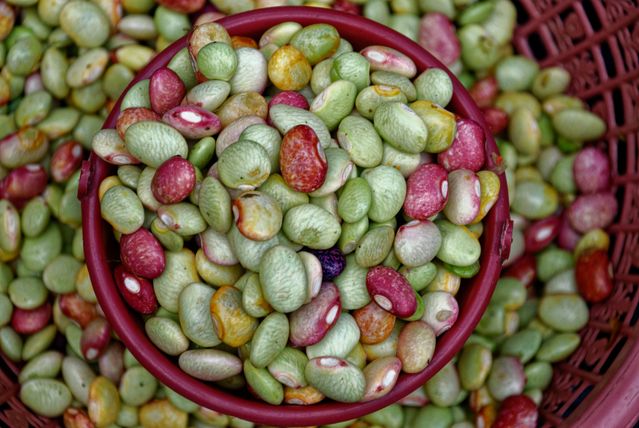
Photo by christian hembert: https://www.pexels.com/photo/colorful-assortment-of-kidney-beans-in-basket-35553032/