
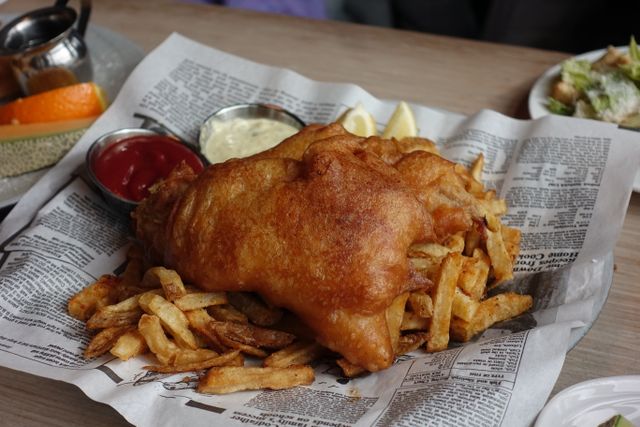
How did fish and chips become a traditional British food? Fish and chips became a traditional British food thanks to fried fish brought from Spain and Portugal, chips brought from Belgium and France, railway networks, improved agriculture, urbanization, entrepreneurs, and wartime thinking.
If you have traveled to Britain, you will undoubtedly have tried fish and chips. It is one of the best known foods there and has been exported to many other countries. If you don’t know it, then it is a piece of deep fried fish (usually cod), with a portion of deep fried chipped potatoes, and the whole lot is covered in salt and vinegar. Traditionally, it was wrapped in newspaper. It took several different things to happen for fish and chips to be possible.
The first was the introduction of fried fish to Britain. Deep frying has been around for thousands of years, but the tradition of deep frying fish appeared to have come from Jewish communities in Portugal and Spain. Jewish people are forbidden from doing anything on the Sabbath, Saturday, so they often coated fish in flour and batter before frying it on the Friday to make it last longer. The batter and oil sealed it and slowed its spoilage so they could eat it on the Saturday. Roman Catholics in Spain and Portugal also ate fried fish during Lent because they weren’t allowed to eat meat. It gradually spread to England as Spanish and Portuguese Jewish people settled there. Incidentally, Japanese tempura also comes from the same route. Portuguese missionaries took it there in the 16th century. One theory says the word tempura comes from the Latin “tempora”, referring to periods when Catholics abstained from meat.
The idea behind chips had arrived at roughly the same time from Belgium and France. Potatoes had been brought to England from the New World in the 16th century and they had quickly become a staple of the British diet. They grew well in the soil and they were filling. The idea of frying them came from Belgium and France, but there, they were generally thinly cut. British potatoes were usually cut into much thicker wedges before frying.
When fried fish and fried chipped potatoes were first put together is anyone’s guess, but there are several reasons why they became popular and the traditional food they are today. There is a fish and chip shop in London, opened by an East European Jewish Immigrant called Joseph Malin, that claims to be the first, but there is also one in Mossley, Lancashire, opened by John Lees, which also claims to be the first. They were both opened in the early 1860s. There is a line in Oliver Twist, written in 1838, that talks about a fried fish warehouse, so they might have existed even before that. However, whichever was first, they took off because of a few changes in society.
The Industrial Revolution had caused mass urbanization, which, for the first time ever, put lots of people in a small area. This was ideal for a fish and chip shop because they had a captive market. One shop could sell to a large number of people. These people also didn’t have a lot of money and fish and chips were cheap.
Fish and chip shops were also helped by improving agriculture. The Industrial Revolution also brought many innovations that were used in the farms. It became easier to grow far more potatoes than before, which brought their price down. Improvements in the fishing industry helped fishermen catch greater numbers of fish. Steam powered trawlers could go further, faster, and carry more fish. And the larger number of potatoes and fish were brought to the cities by the newly emerging railway lines. More than ever before, it was easy and cheap to get fish and potatoes. Add to this an entrepreneurial spirit, and you can see why the number of fish and chip shops grew.
One last thing that helped the fish and chip shop industry to become the most famous food from the UK was rationing during the two world wars. Or rather, lack of rationing. The British government decided to keep fish and chips free from rationing. They realized that the meal was a good source of carbohydrates and proteins for people, it was relatively cheap, and it would keep up morale. Fish and chips weren’t rationed, but that didn’t mean they were always available. Wartime fishing was dangerous and supplies could be scarce, so enormous queues formed whenever a fish-and-chip shop received a delivery. That meant that people were more likely to buy fish and chips than other meals when they went out and it stuck in the national consciousness.
Newspaper was cheap, absorbent and readily available, so it became the standard wrapping. But shops eventually stopped using ordinary newspaper because printing inks and hygiene became concerns. Modern “newspaper” fish-and-chip paper is food-safe paper printed to look like newspaper. And this is what I learned today.
Sources
https://en.wikipedia.org/wiki/Fish_and_chips
https://www.chipshed.co.uk/news/a-history-of-fish-and-chips
https://www.historic-uk.com/CultureUK/Fish-Chips
https://en.wikipedia.org/wiki/Tempura
Photo by casper lin: https://www.pexels.com/photo/crispy-fish-and-chips-with-sauces-in-richmond-30654938/