
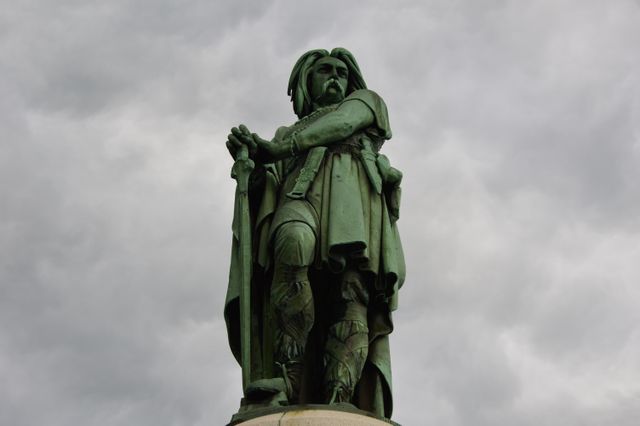
What was Gaul? Gaul was an area of Western Europe that covered modern-day France, Belgium, Luxembourg, and parts of Switzerland, the Netherlands, Germany, and Northern Italy. It was conquered and became part of the Roman Empire between 125 BC and 51 BC.
Gaul was not a country, and Gauls was not the word all of the people who lived there used to describe themselves. Gaul was a collection of tribes spread across the whole area. They left relatively little writing of their own, so it is difficult to know exactly how many tribes there were, but it is thought there could have been as many as one hundred. We know about them through archaeology, coins, inscriptions, and accounts written by Greek and Roman writers. Most of the peoples the Romans called Gauls spoke Celtic languages and shared similar religions and cultures. Caesar wrote that the people in central Gaul called themselves Celtae, while the Romans called them Galli. The Romans didn’t call the region Gaul. They called it Gallia, after the Galli. Greek writers called similar Celtic peoples Galatai. The two names probably came from the same ancient Celtic ethnic name. Confusingly, some Celts later migrated all the way to modern Turkey, where the area they settled became known as Galatia. Our English word Gaul came much later through French Gaule, which was influenced by a Germanic word used for foreign or Romanized peoples, rather than coming directly from the Latin Gallia. The same Germanic root eventually gave us the words Welsh and Wales.
The Gauls were only some of the peoples we call Celts. Celtic-speaking peoples could eventually be found across an enormous area of Europe, from Spain in the west to central Turkey in the east, and as far north as Britain. Their exact origins are uncertain. The Hallstatt culture developed in Central Europe from about 800 BC and has traditionally been associated with the early Celts. From about 450 BC, it was followed by the La Tène culture, named after an archaeological site in Switzerland. La Tène culture spread across large parts of Europe and is strongly associated with the Celtic peoples encountered by the Greeks and Romans. However, modern archaeologists are cautious about assuming that everyone who shared the same material culture belonged to the same ethnic group. The peoples of Gaul were part of this wider Celtic-speaking world.
We mostly know about Gaul because of its relationship with the Roman Empire. As Rome unified and started to expand, it was natural that it was going to come to terms with the Gauls and many other cultures that surrounded it. Rome slowly managed to conquer the Gauls, but what is interesting is that Rome actually lost the very first battle with the Gauls. A tribe called the Senones, led by a Gallic chieftain called Brennos, led an army of Gauls in an attack on Rome in 391 BC. In the Battle of the Allia, Brennos and his army defeated the Roman army and entered Rome, sacking the city. The Romans had to agree to pay 1,000 pounds of gold for Brennos to leave the city. This was the last time the city of Rome would be conquered until the Visigoths in 410 AD. The sack left the Romans with a deep fear of Gallic invasion that lasted for centuries and undoubtedly influenced the way they viewed their northern neighbors.
Gaul was made up of tribes, but they weren’t tribespeople living in small villages. They had cities, road networks, and established economies. In fact, some of them were rather prosperous, which was probably the main reason why Rome set its eyes on them. The first incursion by Rome into Gaul was in 125 BC. Rome wanted a secure land route between Italy and its territories in Spain. They were also interested in the prosperity of the Gallic cities along the Mediterranean. They conquered southern Gaul.
In 58 BC, the Helvetii attempted to migrate westward across Gaul. Caesar intervened, defeated them, and forced them to return home. This began a series of campaigns that eventually resulted in his conquest of almost all of Gaul. In 57 BC he conquered the Belgae and in 56 BC he conquered the rest of Western Gaul. There was a lot of resentment and regular uprisings. In 55 to 54 BC Caesar invaded Britain and built a bridge across the Rhine to demonstrate his power. In 52 BC there was an enormous revolt led by Vercingetorix, who managed to unite many of the Gallic peoples against Rome. Caesar eventually trapped him at Alesia and forced him to surrender. Fighting continued elsewhere, but by 50 BC Caesar had effectively completed his conquest of Gaul. Rome reorganized the captured Gallic territories into provinces and Gaul became one of the most important parts of the Roman Empire. Interestingly, Caesar kept Vercingetorix imprisoned for six years before parading him at a triumph and having him executed. And this is what I learned today.
Sources
https://en.wikipedia.org/wiki/Gaul
https://en.wikipedia.org/wiki/Brennus_(leader_of_the_Senones)
https://www.thoughtco.com/what-is-gaul-116470
https://brewminate.com/roman-gaul-and-the-growth-of-cultures/#google_vignette
https://en.wikipedia.org/wiki/Celts
Photo by Ulrick Trappschuh: https://www.pexels.com/photo/a-statue-under-gray-sky-15407570/