
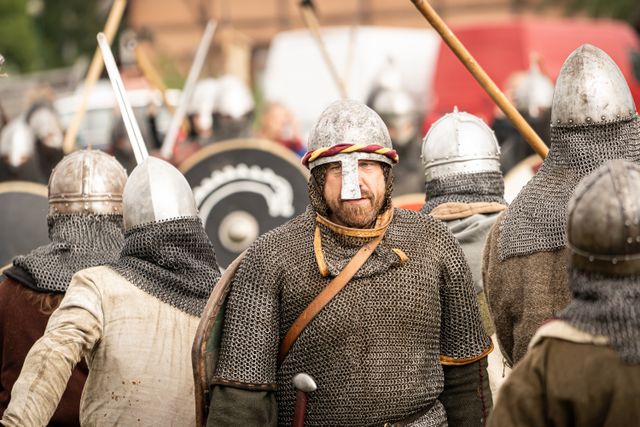
Why did feudal levies stop? Feudal levies were a way that kings could raise a temporary military force through the people who they had given patronage to. They stopped because it became an impractical way of conducting warfare.
Although not the only country to use it, Medieval England is a good example of this system, so let’s use that. In Medieval England, all of the land was owned by the crown. The king would then portion it out to nobles that had helped them in some way. These nobles when then portion out their land to the people that had helped them, and so on. Finally, peasants worked the land and owed their lord rent, labor, or a portion of their produce. The land could be passed down a family line, but ultimately it was held from the king and could return to the Crown under certain circumstances. In return for the land, the king demanded certain things. The promise to fight in defense of the king is the one that we are looking at today.
When a king went to war, he needed to raise an army, and one way he did this was through the feudal levy system. Nobles who owed military service were dutybound to provide it, either by fighting themselves or by providing the required number of knights. Ordinary men could also be raised for armies through other forms of military obligation and local levies, but this was separate from knight service. In England, military service attached to knight tenure was traditionally limited to about forty days a year. However, the feudal levy system had a number of problems that stopped it being practical.
When we lived in relatively small groups, it made sense to be able to rely on the people around you for defense. A whole tribe would have to fight another tribe for survival. Battles would be short and conclusive. They were either won or lost. Once settlements became larger it became less practical and warfare started to change. Battles became less conclusive and conflicts started to stretch from a few hours to months or even years. No matter how much they agreed with their king’s cause, the nobles couldn’t fight for that length of time. Most nobles and knights were only required to serve for 40 days of a year. That meant, as the length of wars increased, the king would often find large parts of his forces would leave when their forty days were up.
Another problem was that warfare was becoming increasingly specialized. Effective archers, men-at-arms and, later, soldiers using gunpowder weapons required training and experience. A king increasingly benefited from soldiers who could train regularly and serve for as long as a campaign required, rather than men whose military obligation was temporary. That meant, rather than relying on his feudal levy, a king would turn to trained soldiers, who were usually mercenaries. And, for this he needed money. It became far more common for a king to demand payment to support his war than it did to demand soldiers to fight.
By the start of the Hundred Years’ War in 1337, kings were relying on paid, contracted armies. Some of these were foreign mercenaries and some of them were paid troops provided by nobles. Nobles realized that by paying troops, they could train them and they became better troops.
This system overtook the feudal levy system because the monarchs also had access to more money than monarchs before them. The population of each country was growing, as was its wealth. Kings and governments were able to tax more than ever before and they finally had the administrations in place to collect that tax money.
It was quite a lot later, but the next natural step was for standing armies. It was good to have a professional army that would turn up and fight your battles if you paid them, but it was far better to have an army that was always ready. And if you had a standing army, you could train and equip them to much higher standards. In England, an important step towards the modern professional army came with the creation of the New Model Army in 1645. Unlike earlier forces raised mainly through local or individual arrangements, it was a centrally organized, nationally recruited and regularly paid army. Permanent standing armies would become increasingly common across Europe during the following centuries. And this is what I learned today.
Sources
https://en.wikipedia.org/wiki/Conscription#Medieval_levies
Photo by Sebastian Dziomba: https://www.pexels.com/photo/historical-viking-reenactment-in-szczecin-34732750/