
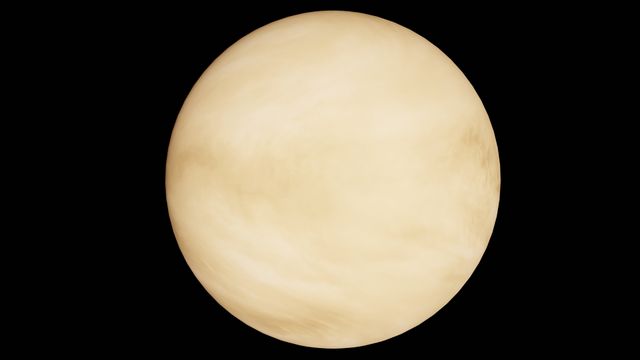
Why doesn’t Venus have a magnetic field? Venus doesn’t have a magnetic field in the same way that we do on Earth, probably because there isn’t enough movement inside its liquid core to produce one. However, that being said, Venus does have a weak induced magnetic field caused by its interaction with the solar wind.
The magnetic field on Earth is produced deep inside the planet. Earth has a solid inner core surrounded by a liquid outer core, made mostly of iron. This liquid iron conducts electricity and is constantly moving. The movement produces electrical currents, and these currents generate a magnetic field. This is known as the dynamo effect. Earth’s magnetic field extends far out into space and protects us from much of the solar wind.
When a rocky planet forms, heavier elements tend to sink toward the center while lighter elements rise toward the surface. Iron is one of the heavier elements, which is why Earth has an iron-rich core. The inside of a young planet is also extremely hot, partly because of the energy released during its formation and differentiation. Over billions of years, this heat gradually escapes from the interior.
This loss of heat is important. Earth’s core is hotter than the mantle surrounding it, so heat flows out of the core. This helps cause convection in the liquid outer core. Hotter, more buoyant material rises while cooler material sinks. Imagine a cup of coffee. If you rotate the cup, the coffee will rotate with it, but that doesn’t necessarily mean the coffee is circulating inside the cup. The dynamo needs this internal circulation.
There is another source of convection as well. Earth’s solid inner core is slowly growing as the planet cools. As iron freezes onto the inner core, lighter elements are left behind in the liquid outer core. These lighter materials are more buoyant and rise. This produces even more movement. Earth’s rotation then helps organize these flows through the Coriolis effect. The moving electrically conducting liquid generates currents, and these currents maintain Earth’s magnetic field.
So, what about Venus? This is where things become difficult because scientists don’t actually know exactly why Venus doesn’t have a magnetic dynamo. Venus is almost the same size as Earth and probably has an iron-rich core, at least some of which may still be liquid. If that is true, simply having a liquid iron core is clearly not enough. Something else is missing.
One possibility is that Venus’s core isn’t losing heat quickly enough. Earth has a very active interior and plate tectonics that help transport heat toward the surface. Venus doesn’t have plate tectonics like Earth does. Its mantle may therefore not be removing enough heat from the core to drive vigorous convection. If the liquid metal isn’t circulating sufficiently, it cannot sustain a dynamo.
Another possibility is that the core of Venus is arranged differently. One theory suggests that the enormous collision that probably created Earth’s Moon also thoroughly mixed Earth’s young core. Venus may never have experienced a similar collision. Its core could therefore be more compositionally layered, with materials of different densities arranged in stable layers. If so, this could make convection more difficult. Another possibility is that Venus doesn’t yet have a solid inner core like Earth. If its inner core isn’t freezing and growing, Venus would also be missing the extra convection produced when lighter elements are released from the freezing iron.
Venus is also unusual because it rotates extremely slowly. Earth rotates once every 24 hours, while Venus takes about 243 Earth days. It might seem obvious that this explains its lack of a magnetic field, but scientists don’t think it is that simple. Computer models suggest that even Venus’s slow rotation could potentially support a dynamo if there were enough convection inside its core. Its slow rotation may affect the dynamo, but it probably isn’t the main reason the dynamo is absent.
However, Venus isn’t completely without a magnetic field. Charged particles are constantly streaming away from the Sun in the solar wind, carrying the Sun’s magnetic field with them. When the solar wind reaches Venus, it interacts with the electrically charged upper atmosphere, or ionosphere. The Sun’s magnetic field becomes draped around the planet, creating what is known as an induced magnetosphere. This deflects some of the solar wind, although Venus still loses atmospheric particles into space.
Venus may have generated its own magnetic field earlier in its history, although scientists don’t yet know whether it did. If it once had a dynamo, changes inside the planet may eventually have reduced the convection in its core until the dynamo shut down. Alternatively, Venus may never have had a long-lasting magnetic dynamo at all. Until we know more about what is happening deep inside Venus, we can’t be certain. And this is what I learned today.
Sources
https://phys.org/news/2017-12-doesnt-venus-magnetosphere.html
https://ui.adsabs.harvard.edu/abs/2002Geo….30..987N/abstract
Photo by Zelch Csaba: https://www.pexels.com/photo/planet-on-black-background-20376407/