
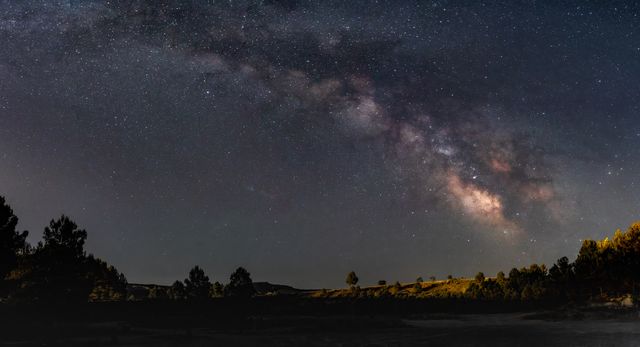
Who discovered that the Milky Way isn’t the only galaxy? Edwin Hubble was the first person to discover that there were other galaxies in space.
When we are at school we learn that our Milky Way Galaxy is one galaxy in a possible infinite number of galaxies. We learn that the closest large galaxy to ours is the Andromeda Galaxy, which is roughly 2.5 million light years away. We learn that it will probably merge with our Milky Way Galaxy some time in the next ten billion years. And, on a clear night, if there is no light pollution, you can even see the Andromeda Galaxy with the naked eye. It looks like a tiny, faint, fuzzy grey smudge. However, we learn all of this because of the discoveries that were made in the early 20th century, and we have to remember that things we know now have not always been known. It is easy to think about galaxies now, knowing what we do, but for early people, there would be no reason to think that the stars weren’t everything. There would be no way for them to know that some of the faint fuzzy objects they could see were actually enormous collections of stars far beyond our galaxy, and they would have had no concept of a galaxy anyway.
Edwin Hubble was the first person to prove that the Milky Way isn’t the only galaxy, but he wasn’t the first person to come up with the idea. In 1750, an astronomer called Thomas Wright came up with a new model of the Milky Way. He reasoned that, because we can see a huge band of stars in the middle of the sky, the Milky Way is actually a flat disk. The band is there because we are looking through much more of the star system, which must be collected into that region. He was followed by Immanuel Kant in 1755 who took up his work and went one step further. He reasoned that if the Milky Way is one enormous collection of stars in a flat disk, then the other fuzzy nebulae he could see were other enormous collections of stars, incredibly far away. This started the Island Universe Theory, but he had no way to prove it because telescopes were not powerful enough.
Over the following centuries, telescopes improved significantly. By the 19th century, astronomers were able to make out the spiral structures inside distant nebulae, but they had no way of knowing if they were relatively small systems within the Milky Way, or enormous systems outside of it. This eventually produced a major argument over the size of the Milky Way and whether the spiral nebulae were other enormous star systems comparable to our own.
In 1920, astronomers, Harlow Shapley and Heber Curtis, took part in what became known as the Great Debate over the size of the Milky Way and the nature of the mysterious spiral nebulae. Shapley argued that the Milky Way was enormous, about 300,000 light-years across, and that the Sun was far from its center. He was broadly right about the Sun’s position but made the galaxy much too large. It is actually about 100,000 light years across. Curtis thought the Milky Way was only about 30,000 light-years across with the Sun near its center, but he believed the spiral nebulae were enormous, distant collections of stars—separate “island universes” like our own galaxy. Both men therefore got important things right and wrong. However, still neither of them could prove their theories.
That proof came from an American astronomer called Edwin Hubble. He was working at the Mount Wilson Observatory at the end of World War 1 and was able to use their 100-inch reflector telescope. That was the most powerful telescope in the world until at least 1940. Hubble wanted to work out how far away the stars in the Andromeda Nebulae were, but he faced a problem. When astronomers look at a star, they don’t know if they are seeing a dim star that is close, or a bright star that is very far away. Fortunately, astronomers already had a way to solve this problem using stars called Cepheid variables. These stars repeatedly expand and contract, causing their brightness to rise and fall in a regular cycle. An astronomer called Henrietta Swan Leavitt had discovered that the longer a Cepheid’s cycle, the greater its true luminosity. Once astronomers had calibrated this relationship, they could measure a Cepheid’s period to work out how luminous it really was, compare this with how bright it appeared from Earth, and calculate its distance. Without Leavitt’s discovery, Hubble would not have been able to make his measurement.
Hubble looked at a Cepheid variable in the Andromeda nebula, and he calculated that it was 900,000 light years away. This was much farther than even the greatest estimates for the size of the Milky Way, which must mean that it was outside the Milky Way. And if it was that large at such a distance, it must be another enormous galaxy. He was out by about 1.6 million light-years, but the main problem wasn’t his telescope. Astronomers didn’t yet fully understand the different types of Cepheid variables, so the period-luminosity relationship they were using was incorrectly calibrated. Later discoveries corrected the distance to roughly 2.5 million light-years. Modern telescopes, the Hubble Space Telescope, for example, are far more powerful and can measure the brightness of the star much more accurately. And once people had heard Hubble’s proof, it opened up many new avenues for research. And this is what I learned today.
Sources
https://www.skyatnightmagazine.com/space-science/edwin-hubble
https://www.skyatnightmagazine.com/space-science/great-debate-1920-curtis-shapley-astronomy
https://airandspace.si.edu/air-and-space-quarterly/issue-15/edwin-hubble-astronomy
https://en.wikipedia.org/wiki/Andromeda_Galaxy
Photo by Rafael Minguet Delgado: https://www.pexels.com/photo/28842660/