
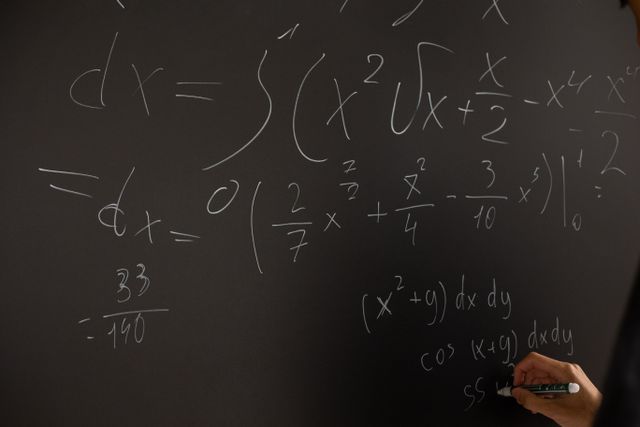
Why did Newton invent calculus? Newton developed calculus because he needed mathematics that could deal with quantities that were continuously changing. This became enormously useful for his work on motion and gravity.
If you want to know how long it will take a car to cover a certain distance, you can use algebra. We know that distance = speed x time, so, as long as you know the distance and the speed you can work out how long it will take. However, what if you are trying to make the same calculation but the car is constantly accelerating? This is where you need calculus and what it is for.
If we continue with our car analogy, it is very easy to work out average speed. If we know it took a car two hours to drive 100 km, we know it had an average speed of 50 km/h. However, that doesn’t mean it was constantly driving at 50 km/h. In some places it would have been going faster and in some slower. If we want to know how fast the car was moving 37 minutes into the journey, we get stuck. That is where calculus comes in. Calculus can be used to study the rate of change of a quantity over time.
To work out the car’s speed at 37 minutes, you can cut the overall time down into smaller and smaller increments. You can average out the time between 36 and 38 minutes. Maybe it’s 60 km/h, but that isn’t close enough. You could average the time between 36.5 minutes and 37.5 minutes. Maybe it’s 66 km/h, but that still isn’t close enough. You could look at 36.999 minutes and 37.001 minutes. Maybe it’s 67.249 km/h, but we are still not exactly at 37 minutes. However, as we keep doing this calculation and making the interval smaller and smaller, the average we calculate gets closer and closer to a particular number. Calculus asks, what number does the average speed approach as the time interval shrinks towards zero. You can’t calculate an average speed over an interval of zero seconds, but you can ask what number the average speed approaches as the interval gets closer and closer to zero. That number is the instantaneous speed at exactly 37 minutes. This was all necessary for the work that Isaac Newton was doing because he was trying to calculate the motions of bodies and their affects on each other through gravity. He needed mathematics capable of dealing with changing position, velocity, acceleration, and forces.
Isaac Newtwon is credited with creating calculus, but he was working with some ideas that had gone before him. Mathematicians in ancient Greece, Egypt, Babylonia, China and India, and later mathematicians in the Islamic world and Europe, had developed ideas that eventually became parts of calculus. However they didn’t go far enough and they didn’t put the ideas together in the way that Newton did.
A common story is that Newton developed Calculus to solve all of his research problems and then went on to write his famous manuscripts. However, things all happened pretty much at the same time. He was studying mathematical problems involving continuously changing quantities, which led him to think about motion and gravity. He developed calculus in bits as he went along to work out different problems. And he didn’t write down his calculus system in one book, but sent it in letters or in parts of manuscripts. In fact, when he finally published his famous work, Principia, he used geometry rather than calculus. Newton was a true genius. In his early twenties he was simultaneously developing revolutionary ideas in mathematics, mechanics, gravity, and optics. And in every field his ideas changed the world.
There was some argument that Newton wasn’t the first person to develop calculus. A German mathematician called Gottfried Wilhelm Leibniz also, independently, came up with a similar system to Newton. He also came up with many of the symbols that are used in calculus today. There was evidence that Newton had discovered it first because it appeared in some of his earlier manuscripts, but Leibniz was the first person to publish his theory of calculus. It became quite a controversy with Newton accusing the other of plagiarism. At the time, “priority”, or who was the first person to discover something, was very important and rigorously fought over. It is most likely that they both developed it independently, but the dispute lasted until Leibniz’s death. Newton was a very powerful person. Newton was president of the Royal Society by this time and used his considerable influence against Leibniz. The Royal Society set up a supposedly impartial committee to investigate who had invented calculus first. The committee decided in Newton’s favor, which is perhaps not surprising because Newton himself secretly wrote much of its final report. Today, historians generally accept that Newton and Leibniz developed calculus independently. And this is what I learned today.
Sources
https://en.wikipedia.org/wiki/Leibniz%E2%80%93Newton_calculus_controversy
https://en.wikipedia.org/wiki/Philosophi%C3%A6_Naturalis_Principia_Mathematica
https://en.wikipedia.org/wiki/History_of_calculus