
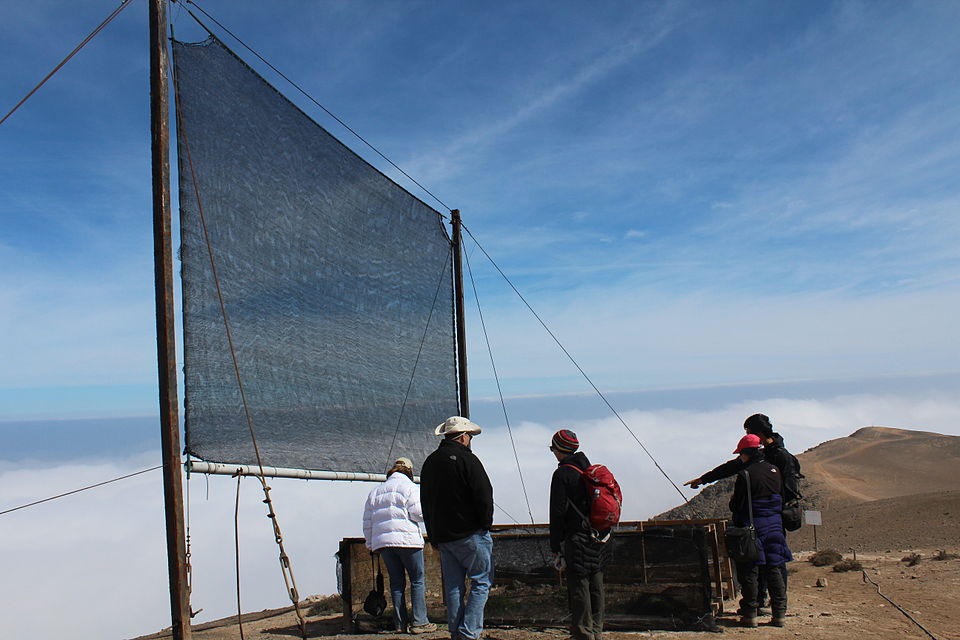
What is a fog net? A fog net is a very fine mesh used for pulling fresh water out of fog.
People get their water from a whole range of sources. They could be reservoirs, aquifers, rivers, desalination plants, or, sometimes, having it shipped in by truck. A lot of places are experiencing water shortages, but the Earth is not running out of water. The Earth is a closed system, and water can be converted into other substances, but generally, the amount of water on Earth stays the same, and it is recycled through the water cycle. Certain places are running out of water because they don’t have the infrastructure to get the water to their people, or because the water source that they rely on has become polluted. A large quantity of the water on Earth is also inaccessible because it is frozen in ice, or not drinkable, such as the water in the oceans. Fog nets are a way of getting fresh water to people in areas that don’t have enough drinking water.
Some places get a lot of rain that they can collect and drink, but many places, such as deserts, don’t have rain. Some of them do, however, have fog. Fog is basically just a cloud that is at ground level. If you are up a mountain, then the fog you see makes more sense because you are up in the clouds, but sometimes clouds can form at ground level, and that is fog. The clouds that make up fog are made of lots of tiny water droplets that are so light they are suspended in the air. If the air is very humid and it cools down, the water in the air condenses into the white water droplets that we can see.
It might sound strange that a hot desert can have fog yet no rain, but it can, and it depends on the location of the desert. To get fog over a desert, you just need air that carries a lot of moisture. In some deserts that are near the ocean, the air above the ocean picks up a lot of moisture before the winds blow it in over the desert. Often, there is another, warmer layer of dry air that sits above the moist air and keeps it pinned down at the surface. Deserts are very hot during the day when they are in direct sunlight, but they get cold at night because they lose their heat quickly. By early morning, the ground has cooled down, and the moist air condenses, forming fog. The hotter layer above it prevents the fog from forming tall clouds that would release their water as rain, so you get fog but no rain.
There are a lot of animals and plants that depend on this fog for their sustaining water. However, it is seasonal and depends on the weather conditions, so sometimes they have to go for long periods without any water at all. Humans can also get at this water, and they do so with a fog net. A fog net is a frame with a very fine mesh fastened onto it. The water droplets in fog are between 1 and 40 micrometers (a human hair is about 100 micrometers), so the mesh has to be extremely fine. Fog is carried with the wind, so the nets have to be placed in the path of the wind. The wind goes through the mesh, and the water droplets cling to it. The layers of the mesh rub together, and the water runs down, heads along gutters at the bottom, and ends up at collection points. Some of these fog nets can get up to 10% of the water out of the moisture in passing fog.
Fog nets are a great idea to get water in a desert, and fog collection has been used for hundreds, and probably thousands, of years by desert communities. They can provide water that is safer and cleaner than groundwater, but they only work for small communities. The water can be used for drinking or to irrigate crops, but the nets don’t produce a huge amount. The fog is also dependent on the wind and the weather conditions, so it isn’t a completely reliable method. The fine mesh will also pick up any dust or pollution that is being carried by the water droplets. If you find yourself stuck in a desert that just happens to be by an ocean, and you have a very fine mesh with you, a fog net could just save your life. And this is what I learned today.
Sources
https://en.wikipedia.org/wiki/Fog_collection
https://www.munichre-foundation.org/en/climate-adaptation/fognets.html
https://www.theguardian.com/news/2018/jun/18/are-we-running-out-of-water
https://education.nationalgeographic.org/resource/desert
https://en.wikipedia.org/wiki/Fog_desert
Image By Pontificia Universidad Católica de Chile – Flickr: Rector Ignacio Sánchez visita Alto Patache, CC BY-SA 2.0, https://commons.wikimedia.org/w/index.php?curid=27302331