
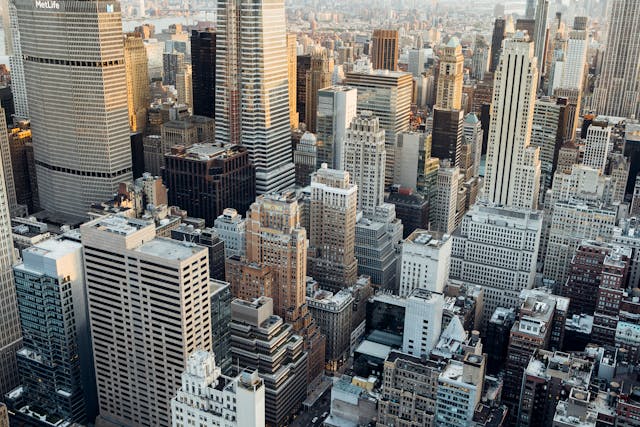
How do you dismantle a skyscraper? There are several ways to dismantle a skyscraper, but none of them are easy. The method depends on where the skyscraper is located, what it is made of, how tall it is, and what is standing around it.
The first skyscrapers were built in the 1880s. They were made possible by several inventions and improvements, including elevators, steel-frame construction, stronger foundations, and better fireproofing. The 42-meter-tall Home Insurance Building, built in Chicago in 1885, is often called the world’s first skyscraper, although historians still argue about the title. Forty-two meters was tall for the time, but these days it probably wouldn’t even qualify as a skyscraper. Since then, buildings have grown taller and taller, and the skylines of most major cities are dominated by them.
Many early skyscrapers have gone, but some famous old ones still remain. The Chrysler Building in New York, for example, was completed in 1930 and is about 319 meters tall. It is a beautiful building, but it also shows one of the problems with skyscrapers. They can last a very long time, but they do not stay modern forever. Elevators, plumbing, wiring, heating systems, windows, offices, and safety systems all age. At some point, an old skyscraper either has to be repaired and modernized, or, if that is not practical, taken down and replaced.
The easiest way to knock down a building is with explosives, but that does not mean it is simple. Controlled demolition is a very complex process. Engineers study the structure, remove parts of the building first, weaken certain columns, and place explosives very carefully. The goal is usually to make the building collapse inward, into its own footprint. It looks fast when it works, but it takes a huge amount of planning.
The problem is that skyscrapers are not ordinary buildings. They are exceedingly tall, they contain enormous amounts of steel, concrete, glass, pipes, wiring, and furniture, and they are often surrounded by other buildings. Even a controlled implosion produces dust, vibration, noise, and flying debris. A short building on an open site might be brought down with explosives, but a tall skyscraper in the middle of a city usually cannot be treated that way. There is too much around it to damage.
To avoid causing damage to nearby buildings, most skyscrapers have to be dismantled rather than simply demolished. There are two main ways this can be done. They can be taken apart from the top down, or, in some special cases, they can be taken apart from the bottom up.
The top-down method is the more straightforward idea. Workers start at the roof and remove the building floor by floor. First, the inside is stripped out. Furniture, walls, wiring, pipes, and non-structural parts are removed. Then machines, cranes, and workers break apart the concrete and steel structure in a carefully planned order. The pieces are lowered to the ground or carried down through the building. This can be slow and expensive, but it is safer than making the whole building fall at once.
There are still many problems. The building has to stay stable while it is being dismantled. Workers cannot accidentally remove a piece that is still supporting something important. They also have to stop debris from falling onto streets, neighboring buildings, cars, or people. Dust and noise have to be controlled as well. On a small building, this is difficult. On a skyscraper, it can take months or years.
The bottom-up method is stranger. In this method, the building is placed on extremely strong, computer-controlled hydraulic jacks. The lowest floor is dismantled, the waste is removed, and then the jacks lower the rest of the building by one floor. Then the next floor is removed. This is repeated again and again, so the building appears to sink into the ground. Kajima Corporation describes its Cut and Take Down method as starting at the bottom, removing one floor, and lowering the building on jacks one floor at a time.
The advantage of this method is that much of the work can be done near ground level. That makes it easier to remove waste and control noise and dust. The disadvantage is that the engineering has to be incredibly precise. The building must remain balanced while its lower structure is being removed. The jacks have to support enormous loads. The temporary supports have to be strong enough to survive wind, earthquakes, and uneven weight. This is not a normal method for every skyscraper. It is a clever solution for particular buildings in particular places.
Older skyscrapers can also be difficult because they were not designed to be taken apart. They were designed to stand. Many were built with huge amounts of steel, concrete, brick, and stone. They may also contain materials that are now considered dangerous, such as asbestos. Before the real demolition begins, workers often have to remove hazardous materials, disconnect utilities, protect nearby streets, and plan how every piece of waste will leave the site.
This raises an interesting problem. Architects and developers are always trying to build taller skyscrapers, but far less attention is given to how those skyscrapers will eventually be dismantled. The Burj Khalifa is 828 meters tall, which makes it the tallest building in the world. One day, it will also be old. It probably won’t be impossible to dismantle, but taking apart something that size would be one of the most difficult demolition projects ever attempted.
And that may be the future of skyscrapers. Building tall is only half of the challenge. The other half is maintaining, repairing, modernizing, and eventually taking those buildings down safely. A skyscraper looks permanent, but no building lasts forever. At some point, even the tallest building becomes a problem that has to be solved from the top down, from the bottom up, or one carefully planned piece at a time. And this is what I learned today.
Sources
Photo by Charles Parker: https://www.pexels.com/photo/residential-and-commerce-buildings-placed-in-downtown-of-megapolis-5847765/