
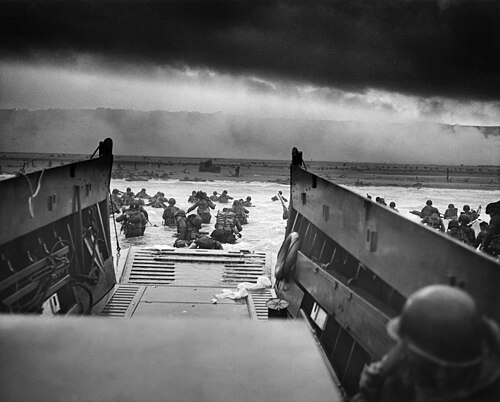
How did the Allies keep D-Day a secret? The Allies kept D-Day secret through a mixture of deception, censorship, and need-to-know security.
D-Day was Tuesday, June 6th, 1944. The landings in Normandy were the beginning of the Allied return to Western Europe. The overall campaign was called Operation Overlord, and the naval invasion itself was called Operation Neptune. However, most people know the day simply as D-Day. On that day, about 156,000 Allied troops landed in Normandy by sea and air. They were supported by thousands of ships and aircraft. By the end of August, more than two million Allied troops had landed in France. Up until then, Germany had controlled much of Western Europe. D-Day was not the end of the war, but it was one of the most important steps toward the end.
“D-Day” has become synonymous with the attack on the beaches of Normandy, but the term itself is not special to that battle. The military uses D-Day for the day when an operation will begin, and H-Hour for the time it will start. This lets planners talk about events before they know the exact date and time. So, D-Day basically means “the day.” It just became attached to June 6th, 1944, because that invasion was so enormous and so important.
One of the many problems the Allies had was how to keep the attack a surprise. They needed overwhelming force, but they also needed the element of surprise. Even with superior numbers, attacking from the sea is extremely difficult. The Germans had built the Atlantic Wall, a long chain of defenses along the coast. They had bunkers, mines, barbed wire, artillery, and machine guns. The beaches had very little shelter, and getting men, vehicles, and equipment out of landing craft took time. If the Germans had known exactly where the Allies were coming, they could have concentrated more troops and weapons there. The invasion might still have happened, but it would have been far more costly.
This is why deception was so important. The overall deception plan was called Operation Bodyguard. Its goal was to hide the real target, Normandy, and make the Germans believe the main invasion would come somewhere else. The most important false target was the Pas-de-Calais, the narrowest point between Britain and France. From the German point of view, Calais made sense. It was close to Britain, it offered a short crossing, and it seemed like the obvious place for an invasion. The Allies wanted Hitler to believe that obvious answer was the correct one.
To convince the Germans, the Allies created a fake army group called the First United States Army Group, or FUSAG. It was supposedly based in southeast England, opposite Calais. It was also supposedly commanded by General George Patton, whom the Germans respected and expected to lead the invasion. This made the fake army more believable. The Allies used dummy tanks, fake aircraft, false landing craft, and fake camps to make it look as if a huge force was gathering there. They also created fake radio traffic between units that did not exist. To German intelligence listening from across the Channel, it sounded like a large army was preparing to move.
The Allies also used double agents. German spies in Britain had mostly been captured or turned, and they were used to send false information back to Germany. These agents leaked information carefully. If they lied too obviously, the Germans might stop trusting them. Instead, they mixed real information, harmless information, and false information together. This made the deception much more convincing. The Germans were led to believe that Normandy might be a diversion and that the real attack would come later at Calais.
This worked extremely well. Hitler and the German command kept many forces near Calais before the invasion, and even after D-Day they hesitated to move them. That delay mattered. Every hour and every day gave the Allies more time to land troops, bring in supplies, and expand the beachhead. The deception did not win the battle by itself, but it made the invasion much more likely to succeed.
The fake army was not the only way they kept D-Day secret. The real plans were known only to a select group of people, and everybody else worked on a need-to-know basis. If people only knew their own small part of the operation, they could not reveal the whole plan if they were captured or if information leaked. Troops were gathered in camps in southern England, but their movement was controlled. Mail was censored. Travel was restricted. Journalists were controlled. Civilians in some coastal areas were kept away from military preparations. It was obviously impossible to hide an entire invasion force completely, but the Allies could hide its exact destination and timing.
The weather also helped and nearly ruined the whole plan at the same time. The invasion was supposed to happen on June 5th, but bad weather forced a delay. The Germans did not expect an invasion in such poor conditions, and some commanders were away from their posts. When the weather improved just enough on June 6th, the Allies took the risk and launched the attack.
So, the Allies did not keep D-Day secret by hiding everything. That would have been impossible. They kept it secret by hiding the most important pieces and making the Germans look in the wrong direction. They made Normandy seem less important than it was. They made Calais seem more important than it was. They controlled information, used double agents, built a fake army, and only told people what they needed to know. The result was one of the most successful deception operations in military history. And this is what I learned today.
Sources
https://en.wikipedia.org/wiki/Operation_Fortitude
https://en.wikipedia.org/wiki/Operation_Overlord
https://www.history.com/articles/why-was-it-called-d-day
By Chief Photographer’s Mate (CPHoM) Robert F. Sargent – This tag does not indicate the copyright status of the attached work. A normal copyright tag is still required. See Commons:Licensing., Public Domain, https://commons.wikimedia.org/w/index.php?curid=17040973