
How can some animals be transparent? Animals can be transparent if their bodies let light pass through them without absorbing, reflecting, or scattering too much of it.
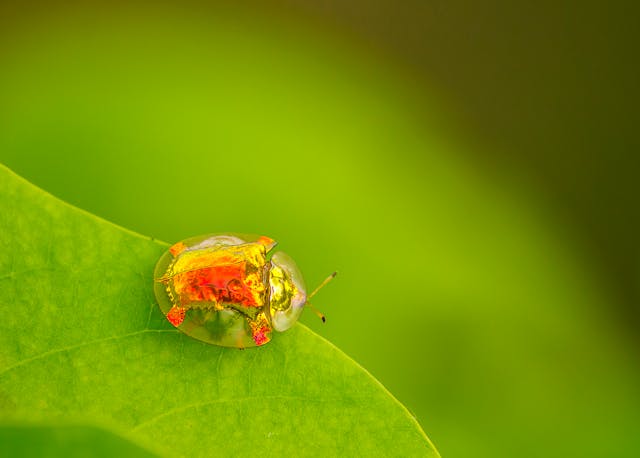
There are not many transparent animals, and most of them are found in water. Some of them are partially transparent and some are almost completely transparent. Even animals that look completely transparent are not invisible, though. It is usually still possible to see their brains, digestive systems, eyes, or other internal organs. The glass octopus, glass shrimp, and jellyfish are three examples of very transparent creatures. The barreleye fish is only partially transparent. It has a transparent forehead, and its real eyes are inside the transparent part of its head. The spots that look like eyes on the front of its face are actually its nostrils. On land, transparent animals are much rarer. The glass frog has transparent skin on its underside, and its internal organs can be seen. The glasswing butterfly has transparent wings, although its body is not transparent. And the tortoise beetle has a transparent outer shell.
For a creature to become transparent, it isn’t just a case of not having pigment in its cells. Individual cells can be fairly clear, which is why scientists often add dye to cells so they can see them properly under a microscope. The problem comes when many cells are packed together. Cells contain membranes, proteins, fats, nuclei, fluids, and many other tiny structures. All of these things bend light slightly differently. This is called their refractive index. When light passes through many tiny structures with different refractive indexes, it scatters in different directions. That scattering makes the tissue look cloudy or white.
That is why snow is white, even though a single piece of ice is clear. A snowflake is made of ice, but snow is made of countless tiny ice crystals with air gaps between them. Light bounces and scatters between all of those surfaces, and the result is white. Something similar happens with white hair. Hair looks white when pigment is lost and light scatters through the structure of the hair. So, to make a body transparent, an animal has to do more than remove color. It has to reduce the things that absorb light and reduce the structures that scatter light.
Transparent animals do this by having watery tissues, very little pigment, and body structures that do not interfere with light too much. Water does not absorb much visible light, and watery tissue can be closer to the refractive index of the water around it. That is the main reason why so many transparent animals live in water. It is much easier to be transparent in water than it is on land. If an animal’s body is mostly water and gel, and it lives in water, light can pass through it with much less bending and scattering. Jellyfish are a good example. They are mostly water, and they do not have bones, blood, or a heart. Their bodies are simple enough that oxygen can move through their thin tissues without needing a red-blood circulatory system.
This is much more difficult for animals on land. Air has a very different refractive index from watery tissue, so even a clear land animal would still bend the light behind it. It might be transparent, but the background seen through it would look slightly distorted. This is like looking through a glass of water. The straw inside the glass appears to bend because light changes direction when it moves between air and water. A transparent land animal would have a similar problem. It would not be as invisible in air as a watery animal can be in water.
Land animals also need to do something about their blood. Blood is full of red blood cells, and red blood cells contain hemoglobin. Hemoglobin absorbs a lot of light, which is why blood is such a strong color. Even if an animal had transparent skin, the blood vessels under the skin would still be visible. That is one reason why fully transparent land animals are so rare.
The glass frog has a remarkable way around this problem. When it is resting or sleeping, it moves most of its red blood cells out of circulation and stores them in its liver. This makes the frog much more transparent. It is not making the blood invisible. It is hiding the blood where it will not spoil the transparency of the rest of the body. Transparent animals in water often have an easier time because many of them either have no blood like ours, or they do not need red, hemoglobin-filled blood moving through every part of the body.
Why have these animals evolved to be transparent? The answer is usually to avoid predators. If an animal is mostly transparent, it is very difficult for a predator to make it out from the background. It is basically a form of camouflage, except the animal is not limited to one color or one kind of background. It can disappear in open water, on a leaf, or against whatever is behind it.
The tortoise beetle has a particularly interesting version of this. Its clear outer shell helps break up its outline, making it harder for predators to recognize it as an insect. Some golden tortoise beetles can also change color because fluid moves through tiny layers in the shell and changes the way light reflects from it. When the shell reflects light like a tiny mirror, the beetle can look golden and shiny. When the structure changes, the beetle can look redder or duller. It is not just pigment. It is structure, fluid, and light working together.
Transparency sounds simple, but it is actually very difficult. A transparent animal has to avoid pigment, hide its blood, reduce scattering, and build its body out of materials that let light pass through. It is not just the absence of color. It is the absence of anything that gets in the way of light. Fascinating. And this is what I learned today.
Sources
https://www.discovermagazine.com/the-funky-physics-of-turning-an-animal-transparent-16981
https://www.utmb.edu/mdnews/podcast/episode/making-animal-skin-transparent
https://www.treehugger.com/intriguing-transparent-animals-4869006
Photo by Pavan Prasad: https://www.pexels.com/photo/golden-tortoise-beetle-on-leaf-close-up-36004488/