
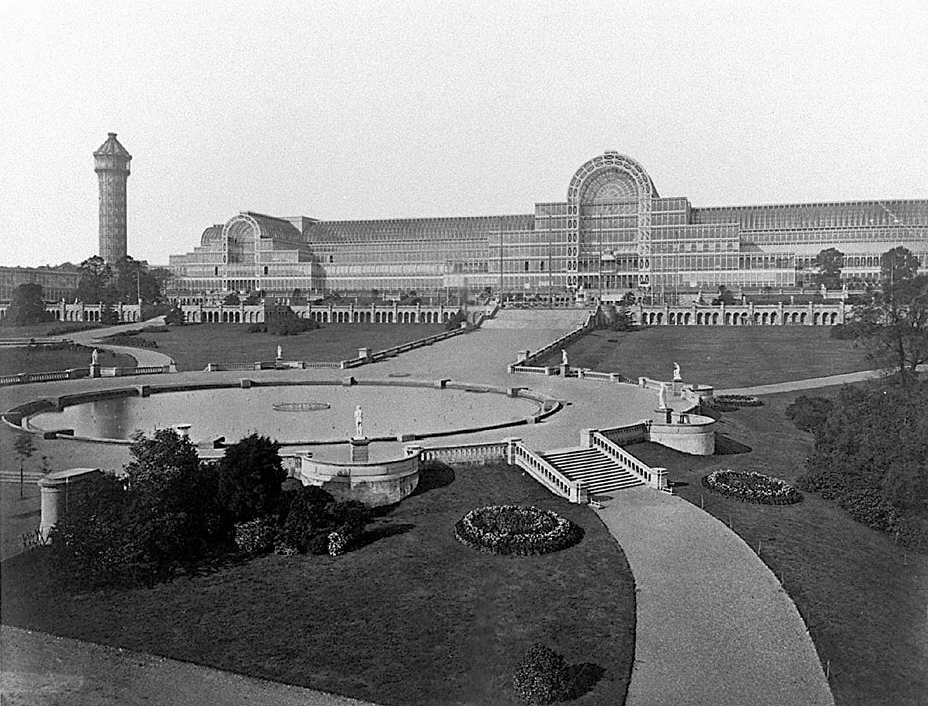
How did a gardener build the Crystal Palace? Joseph Paxton was head gardener for William Cavendish, 6th Duke of Devonshire, and an expert in greenhouses and large glass structures. When all other designs for the Crystal Palace were rejected, he submitted his own, which was chosen.
The Crystal Palace was an enormous cast-iron and plate glass structure built to contain the Great Exhibition of 1851. A building like that had never been seen before and it was designed to showcase the technological advances of the Industrial Revolution. It was built in only 190 days in 1851 and stood until it burned down in 1936. It was 564 m long and 41 m high. It used 4,000 tons of iron and 293,655 panes of glass.
The Crystal Palace was built for the Great Exhibition of 1851, which was Britain’s first international exhibition and an attempt to show the world that it was Britain, not France, that was the technological leader. France had held 11 exhibitions by this point. The exhibition was organized by the Royal Society of the Encouragement of Arts, Manufacturers, and Commerce, with the backing of Prince Albert, husband to Queen Victoria. In fact, without his support, it might not have got off the ground in the first place. The idea was for a place where countries around the world could display their technological innovations, with the emphasis being on Britain. Hyde Park in London was settled on for the location, but it needed a suitably impressive building.
Joesph Paxton was born in England in 1803. He became a garden boy at the age of 15 and slowly improved his skills. He found a job in the Horticultural Society’s Gardens in Chiswick at the age of 20, where he was poached by William Cavendish. Cavendish was taken by Paxton’s knowledge, skill, and eagerness, and he offered him a job as head gardener at his house. Cavendish owned Chatsworth House, which had the finest gardens in Britain at the time. Paxton jumped at the chance.
He rebuilt most of the garden and also made greenhouses for a growing collection of plants, flowers, and trees that were being brought to England from the empire. His early greenhouses used glass and wood, but you can only build to a certain size with wood before the weight of the glass is too much. The collection was growing too big so he designed an enormous greenhouse that was made of iron and glass, the exact materials he would use to design the Crystal Palace. It was made possible because of a new way of mass-producing sheet glass and because of new techniques in making cast iron and wrought iron. This made it possible to make a light, yet strong frame.
The committee in charge of the exhibition put out for designs and they received over 200. They didn’t like any of them. They decided to go with a brick design that they had come up with and published it in the newspapers, but the public hated it. One of the committee knew Paxton and they had a meeting. Paxton’s reputation went before him. He thought it was interesting and went home and sketched out an idea. Within two weeks, he had planned out the whole thing. It was to be a giant glass and iron structure. It would be huge, yet cheap. It would be strong, yet fast to build. It would use new technologies that Britain had and it would look amazing. The committee loved it. Within 190 days it had been built.
The exhibition was a huge success. Six million people visited it, which was a third of the population of Britain. Thomas Cook, a famous British travel agent, got his start by organizing railroad trips, but his trips for people to the exhibition really pushed him onto the map. After the exhibition closed, the building was intended for demolition, but, as with the Eiffel Tower in Paris, it was decided to keep it. The Crystal Palace was moved to a place called Sydenham Hill. The Crystal Palace was used for exhibitions and events but moving it had bankrupted the people involved and the building needed more renovations and repairs than anyone could afford. It started to fall into disrepair. In 1913 it was saved by the 1st Earl of Plymouth, and it was slowly repaired. People started to visit it again, but, in 1936, a fire started in the women’s cloakroom and rapidly spread along the wooden floors. The iron frame softened, buckled, and the glass shattered, until everything collapsed. It was never rebuilt.
An extra interesting piece of information about Paxton. He cultivated the Cavendish banana at Chatsworth, named after the Duke, and the modern Western banana trade is largely descended from that line. Chatsworth says almost every banana consumed in the Western world is descended from a plant grown there. And this is what I learned today.
Sources
Image By Philip Henry Delamotte (1821–1889) – Smithsonian Libraries, Public Domain, https://commons.wikimedia.org/w/index.php?curid=2183219
https://www.bbc.com/news/articles/cy0ll41l9pno
https://en.wikipedia.org/wiki/The_Crystal_Palace
https://en.wikipedia.org/wiki/Great_Exhibition
https://en.wikipedia.org/wiki/Exposition_des_produits_de_l%27industrie_fran%C3%A7aise
https://en.wikipedia.org/wiki/Joseph_Paxton
By Philip Henry Delamotte (1821–1889) – Smithsonian Libraries, Public Domain, https://commons.wikimedia.org/w/index.php?curid=2183219