
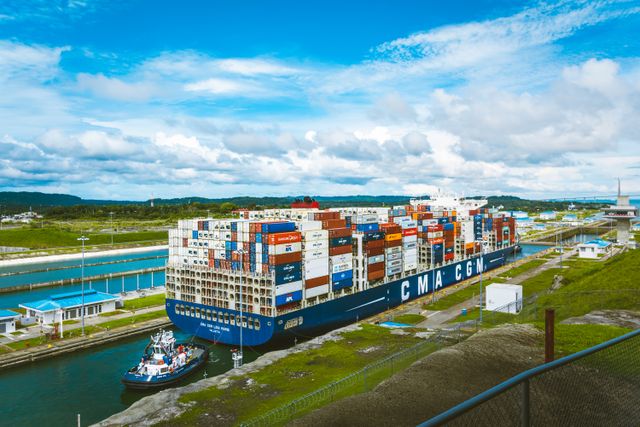
Why doesn’t the US control the Panama Canal anymore? The US doesn’t control the Panama Canal at the moment. It is owned and operated by the country of Panama. The US owned it until 1999.
The Panama Canal is an 82 km long waterway that cuts through the narrowest part of Panama and connects the Caribbean Sea with the Pacific Ocean. That means ships can sail from Europe or Africa, cross the Atlantic, pass through the Panama Canal, and head out into the Pacific Ocean. Without the Panama Canal, ships had to sail all around the bottom of South America, past the very dangerous Cape Horn, and back up the other side. That means it saves a journey of 15,000 km and all of the dangers involved therein. A journey of 15,000 km would take many days, while it only takes 10 hours to go through the Panama Canal. It is not cheap. The price varies on the size and weight of the ship, and it can cost more than $300,000, but that is easily worth it to the shipping companies.
People had long thought about digging a waterway across the Isthmus of Panama. An isthmus is a narrow strip of land bordered by water on both sides. The name comes from the Greek word for neck: isthmos”. The Spanish first thought about doing it after they conquered parts of South America, but they never did. One early attempt to profit from Panama’s geography came, surprisingly, from the Kingdom of Scotland in the 1690s. The Darien Scheme was not a plan to dig a canal, but to establish a trading colony that could control an overland route between the Atlantic and Pacific. It was a disaster. Thousands died, the colony failed, and Scotland lost almost a quarter of all its money. The financial damage helped push Scotland toward the Union with England in 1707.
France was the first country to try in 1881. The program was led by Ferdinand de Lesseps, who had managed to build the Suez Canal. Despite being shorter than the Suez Canal, the Panama Canal turned out to be far more difficult to build. The climate is very hot and humid. The canal had to be built through dense rainforest. De Lesseps tried to build a sea-level canal, like the Suez Canal, but Panama’s mountains, rivers, rain, landslides, and disease made that far harder than expected. There was a lot of corruption and misappropriation of funds. And 22,000 workers died of disease. By 1889, they had only made it 40% of the way through, and the money ran out. They were far behind schedule and it was a far more massive project than anyone had expected.
In 1904, the US bought the French canal company’s remaining assets. This was just after Panama became independent from Colombia in 1903, with US support. The new Panamanian government then accepted the Hay-Bunau-Varilla Treaty, which gave the US control over the Canal Zone. Panama was technically independent, but it was weak, newly created, and dependent on US protection, so it had very little power to negotiate. For the US, control of the Canal Zone meant control over one of the most important shipping routes in the world.
The US began construction on the rest of the canal and finished it in 1914. They succeeded where the French had failed for a number of reasons. Firstly, they had learned that the diseases of yellow fever and malaria were transmitted by mosquitoes, something the French didn’t know. The US put a lot of time and money into eradicating the mosquitoes. Secondly, they realized that a sea level canal would not be possible because there are too many mountains in the way, so they changed it into a system of locks powered by mountain lake water. And they brought in heavy machinery that the French hadn’t had access to.
When the canal opened in 1914, it was wholly American owned and operated. That lasted for about 50 years before resentment in Panama began to grow. Panamanians had never been happy that the US owned the land, and relationships between the two countries had always been difficult. Then, in 1964, a US flag was flown outside a high school instead of a Panamanian flag in the US controlled zone and Panamanians rioted. US troops shot 22 of them and Panama cut off diplomatic relations with the US. The US wanted to restore relations and several presidents looked at ways to return the canal to Panama. In 1977, Jimmy Carter signed a treaty that returned the land to the Panamanians in 1999. And, since then, the land has been owned and operated by Panama.
The US did not return the canal simply as a kind gesture. By the 1960s and 1970s, Panamanian resentment had become a serious political problem, and the Canal Zone looked increasingly like a leftover piece of colonialism. The US still valued the canal, but keeping permanent control of it created diplomatic problems in Latin America and made the canal harder to defend politically. Some larger modern ships and warships were also too big for the old locks, so the canal was no longer the only answer to American naval strategy. Returning it to Panama, while keeping a treaty guaranteeing its neutrality, was a way to reduce conflict while keeping the canal open to world shipping. And this is what I learned today.
Sources
https://en.wikipedia.org/wiki/Panama_Canal
https://en.wikipedia.org/wiki/Darien_scheme
https://www.cfr.org/articles/who-controls-panama-canal
https://www.history.com/articles/panama-canal-return-panama-treaties-carter
Photo by Victor Puente: https://www.pexels.com/photo/cargo-ship-on-docking-area-7629244/