
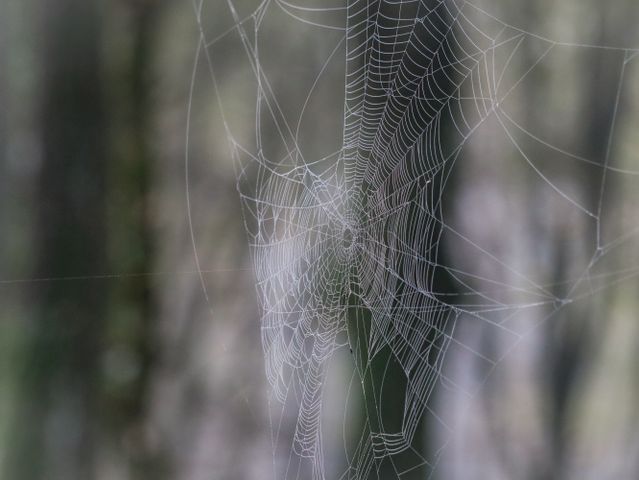
Why don’t spiders get stuck in their own webs? Spiders don’t get stuck because not all of the web is sticky, they know where to put their feet, and their feet are adapted for walking on silk. There may also be chemical help from their legs, but that part is still not completely proven.
Spiders make their webs from silk, which is made from proteins. They have structures in their abdomen called a spinneret, which has a collection of nozzles. The silk starts as a liquid inside the spider. They combine protein chains to make them longer, which makes them stronger. They don’t connect all of the proteins into chains because that would make the web too hard, and it needs to be flexible. The liquid is pushed to the spinneret and out of the nozzles. The spider uses its legs, which have special hairs just for this purpose, to pull the web out and twist it into a fiber. The web hardens as it comes out of the spider’s abdomen. There are several different silk glands, and different silks have different uses. Some silk is strong and used for the frame of the web. Some is stretchy. Some is sticky and used to catch prey. No spider has every possible type of silk, but many spiders can produce several kinds.
Spiders have different ways of starting their webs. Some spiders make a parachute of web and then let the wind blow them somewhere suitable. Others make one thread and swing across a gap. When they have a thread that spans the gap, they start to make their web and different species of spider make different shaped webs.
The stickiness on the web comes from a glue-like substance that spiders produce from a gland in their abdomen called the aggregate gland. The glue is made of moisture absorbing salts and elastic glycoproteins. The spiders don’t spread it all over the web evenly, but they put tiny, evenly spaced droplets on the web. The shape of the droplets allows them to behave like a liquid and spread over any insect that ventures into the web, but also like a solid and hold the insect to the web. The glycoproteins contain sugar molecules that create an enormous number of hydrogen bonds with the prey. Single hydrogen bonds are not very strong, but millions of them will trap an insect. The salts in the glue absorb moisture from the air, keeping the glue liquid, no matter how dry the weather is. Webs will easily hold insects and if you have walked through one, you know how easily they stick to skin as well. Obviously, a large animal has enough strength to break the web and pull the strands off, but the insects spiders hunt don’t have that strength.
So, if the web is so sticky, how do spiders avoid sticking to their own webs? The complete answer to that question is unknown, but there are a lot of theories. The first theory is because of the way that they build their webs. Spiders can produce different types of silk and, as we talked, not all of that silk is sticky. Spiders produce their glue and they stick it at intervals all over the web. The droplets of glue are spaced out so that any insect striking the web will come into contact with several of them, but they are also spaced out enough that the spiders can walk between them. They also use sticky silk for the spiral parts of their webs, but non-sticky silky for the frame that holds the web together. They know which is which and only walk on the non-sticky bits.
Another reason is the shape of their feet. Spiders walk on the very tips of their legs to minimize contact with the glue. Their legs have a lot of hairs on them and the ends of their feet have a lot of hairs that spread out and actually reduce the surface area of their feet that comes into contact with the glue. They have a claw on their feet that they use to grip their webs, but that they also use to peel themselves away if they do stick to the glue.
There is some suggestion that spiders secrete a chemical that they can spread over the hairs on their legs which stops the adhesive sticking to them. There is not much evidence for this though. They also clean their legs constantly to remove any glue that might have stuck there.
Spiders are adapted to their own webs and they don’t get stuck there, but they can very easily get stuck in other spiders’ webs. They might use a different type of adhesive, and the spider won’t know where to put its feet. The exceptions are spiders that invade webs to steal the prey that is trapped there. And this is what I learned today.
Sources
https://www.reconnectwithnature.org/headlines/news/nature-curiosity-why-is-spider-silk-sticky
https://www.nhm.ac.uk/discover/what-are-spider-webs-made-of.html
Photo by Nikola Tomašić: https://www.pexels.com/photo/intricate-spiderweb-in-serene-forest-setting-29264276/