
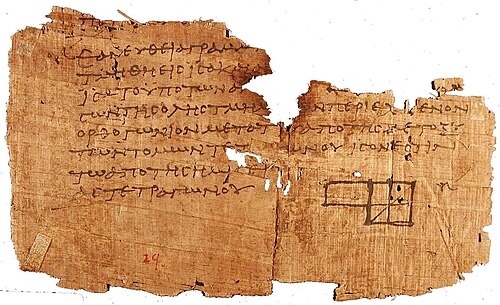
Who discovered prime numbers? The name of the first person to discover prime numbers is lost to history, but the first people to study them formally were Euclid and Eratosthenes, Greek mathematicians.
A prime number is any whole number greater than 1 that can only be divided exactly by 1 and itself. For example, five is a prime number because you can only divide it by one and itself. 5 divided by 5 is 1, and 5 divided by 1 is 5. There are no other numbers you can divide five by. Six, on the other hand, is not a prime number. You can divide six by 6, 3, 2, and 1. Another way of thinking about it is that if a prime number were represented with dots on a piece of paper, the dots could not be arranged into a rectangle, only a line. You could only put 5 dots in a line. If you tried to make a rectangle, you would have 3 and 2. 6 dots could be put in a rectangle of 2×3 or 3×2.
Prime numbers have been known about for a very long time. A piece of bone, called the Ishango Bone, has numerous notches on it. Some of these notches are grouped into the prime numbers between 1 and 20. The bone comes from the Ishango settlement that was located on Lake Edward, near the source of the Nile. The settlement was buried by a volcano 25,000 years ago. Some researchers have suggested that the pattern shows an understanding of prime numbers, although others think the markings had a different purpose. No one really knows what the Ishango Bone was for, although it was possibly a lunar calendar, along with other uses.
Prime numbers were known about for a long time, but it was the Greeks who began to study them in earnest. The Greeks realized that prime numbers were the atoms of mathematics. Every whole number greater than 1 can be broken down into prime numbers, just as any substance can be broken down into its component atoms. 18 is made of 2 x 3 x 3, just as water is made of hydrogen + hydrogen + oxygen. Every number can be made up of prime numbers, but it can only be made in one way. For example, 84 can only be made of 2 x 2 x 3 x 7. Prime numbers are like Lego blocks. You can make any number with them, but when you take it apart, you always end up with the same blocks. This is why mathematicians call prime numbers the building blocks of mathematics.
Euclid, the famous mathematician and father of geometry, was famous for proving that the number of prime numbers is infinite. He did this in his work Elements, written around 300 BC. His proof is quite simple. Take any list of prime numbers. Multiply them together and add one. The new number cannot be divided exactly by any prime in your original list. It must therefore either be a new prime or be divisible by a prime that wasn’t in the list. You can keep adding one infinitely, showing that there is an infinite number of prime numbers.
These days, super computers can calculate enormous prime numbers with millions of digits, yet no one is able to explain the pattern behind prime numbers. When you look at the way they fall over enormous quantities of numbers, they appear to be random, but they are probably not. There are several ideas about why prime numbers behave this way, but they might all be wrong, or it might be a mix of some of them, or maybe all of them. The first is that there is some kind of pattern to the way prime numbers fall, but we just haven’t been able to find it yet. Their distribution must be determined by mathematics, but the challenge is how to uncover it? The second idea is that, although prime numbers are determined by simple rules, their distribution behaves statistically almost as if it were random. Theories one and two can exist at the same time because even if the way prime numbers fall is random, that randomness can be dictated by mathematics. The third idea is that the distribution of prime numbers is deeply connected to the Riemann zeta function. The points where this function equals zero seem to determine how prime numbers are distributed, although nobody fully understands why and nobody can prove it. If you can prove the Riemann Hypothesis, you will win $1 million. Some physicists have noticed that prime numbers behave like quantum physics. The spacing between large prime numbers follows statistical rules that are almost identical to the spacing between quantum energy levels inside atoms. And the last theory is that there is no pattern. It seems like understanding this will give us a whole new insight into the universe around us. And this is what I learned today.
Sources
https://en.wikipedia.org/wiki/Prime_number
https://www.math.buffalo.edu/mad/Ancient-Africa/ishango.html
https://www.math.buffalo.edu/mad/Ancient-Africa/lebombo.html
https://en.wikipedia.org/wiki/Ishango_bone
https://www.gleammath.com/post/why-are-primes-so-fascinating
https://en.wikipedia.org/wiki/Riemann_hypothesis
By Euclid – https://openn.library.upenn.edu/Data/0016/html/e2748.html, Public Domain, https://commons.wikimedia.org/w/index.php?curid=1259734