
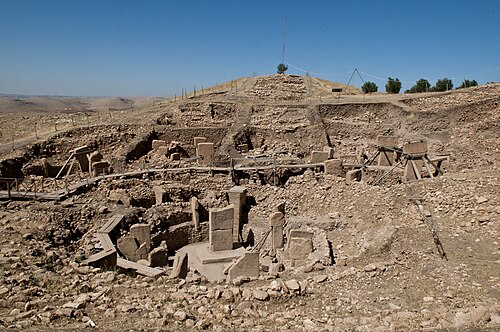
What is Göbekli Tepe? Göbekli Tepe is one of the world’s oldest temples and megalithic sites. It was built in roughly 9500 BC, over eleven thousand years ago. It is in the south of the modern country of Turkey, not far from the border with Syria. It is the first human-built holy place in the world, telling experts a lot about what early people did. The name Göbekli Tepe means belly hill in Turkish because of the shape of the hill the site is built on.
When people think of the most ancient monuments in the world, they probably think of the Great Pyramids, or possibly stone circles like Stonehenge. However, when Stonehenge was built, Göbekli Tepe was already six and a half thousand years old, and when the pyramids were built, it was celebrating its seven thousandth birthday. It is truly ancient, and the remarkable thing is, it was built just as humans were starting to settle down.
The site is located high on the edge of the Germus Mountains, giving it panoramic views across the plains. Today, the area is very dry and brown, but when Göbekli Tepe was built, it was much wetter, and the plains would have been full of grassland, wild cereals, and herds of grazing animals. It was the plentiful food source that kept hunter-gatherers alive.
The whole site hasn’t been completely excavated yet. There are monumental buildings with stone walls and standing stones arranged in circles. On the hillside, there are four more rings of partially excavated pillars. There are two large stone T-shaped pillars in the center of each circle, with a circle of slightly smaller stones around them facing inwards. The tallest pillars are about 5 meters tall. Some of the pillars have no designs, while others are covered in carvings of foxes, lions, scorpions, snakes, boars, birds, leopards, and vultures. Lions might surprise you, but up until fairly recently there were wild lions in Turkey. Ground-penetrating radar surveys have shown that there are at least another 16 stone rings buried around the site. The currently excavated objects only account for about 5% of the whole site.
All of the stones are made from limestone, which is readily available in the surrounding mountains. The builders and stonemasons were working in the Stone Age, and they did not have access to any metal tools. The Bronze Age wouldn’t happen for several thousand years. They built and carved all of the stones using flint tools.
Göbekli Tepe has been called a holy site, but it probably wasn’t used in the same way as modern holy sites. The pillars may have represented human figures and could have been used to honor ancestors, supernatural beings, or other important figures from whatever mythology they believed. They could have made offerings at the pillars. They may have held communal feasts. Large quantities of animal bones have been found, including the tools used to grind cereals. Perhaps it was a place where lots of tribes came together to celebrate. They may have used it as a place to perform ceremonies for the dead. Archaeologists have found skulls with strange marks carved in them, or holes drilled in them. The skulls may have been suspended as part of a ritual. Several burials have also been discovered. Small stone masks and animal carvings have also been found. Archeologists can speculate about what happened and what the site was used for, but it would be very difficult to actually prove anything.
The most interesting thing about the Göbekli Tepe site is what it represents in the shift from hunter-gathering to farming. When the site was first discovered, archeologists thought that hunter-gatherers came together at this location and built the enormous monuments for their ceremonies. More people came, which meant they needed to feed more people, and eventually farming developed as a way to feed these people. However, newer evidence has shown that settling down and building the monument probably came at the same time. Among the monuments, smaller buildings that seem to be houses, evidence of domestic activities, water storage facilities, and human burials have been found. All of this seems to indicate that people were living there while they were building. So, the interesting question is, when did they start to farm?
Were the people at Göbekli Tepe farmers? Surprisingly, there is very little evidence that they were. The people at Göbekli Tepe hunted wild animals and gathered wild cereals. They may have begun experimenting with growing plants, but there is no convincing evidence that they were raising domesticated animals or practicing fully developed agriculture.
This raises an interesting question. Did people begin farming because they had settled down, or did they settle down because they had begun farming? Göbekli Tepe suggests that at least some hunter-gatherers were establishing settlements and building enormous monuments before agriculture became their main source of food. Perhaps settling down, building monuments, and developing farming were all parts of the same gradual process. We still don’t know exactly how it happened, but Göbekli Tepe is helping archaeologists rethink one of the most important changes in human history. And this is what I learned today.
Sources
https://en.wikipedia.org/wiki/G%C3%B6bekli_Tepe
https://www.smithsonianmag.com/history/gobekli-tepe-the-worlds-first-temple-83613665
https://whc.unesco.org/en/list/1572
Image By Teomancimit – Own work, CC BY-SA 3.0, https://commons.wikimedia.org/w/index.php?curid=17377542