
Why do some chemical reactions give off heat and others don’t? The answer depends on the amount of energy absorbed when chemical bonds are broken compared with the amount released when new bonds are formed.
There are two types of chemical reactions: endothermic and exothermic. Endothermic reactions are those that require energy, and exothermic reactions are those that release energy. Both words are made by combining the Greek word “therme”, which means “hot,” with “endon”, meaning “within”, or “exo” meaning “outwards”.
An endothermic reaction is a chemical process that needs energy, so it absorbs heat from the surroundings. This is because a chemical bond is being broken. When two atoms are bonded, they are in a low-energy, stable state. To pull them apart, you have to overcome the electrical attraction that is holding them together. That requires adding energy, and depending on the element, it can take a lot of energy. Endothermic reactions reduce the thermal energy in the surrounding environment because it is being absorbed by the reaction.
An exothermic reaction is the opposite. It is a chemical process that releases energy, so it expels heat into its surroundings. This happens because chemical bonds are forming. When two atoms come together, two hydrogen atoms, for example, they each have one positively charged proton and one negatively charged electron. As the atoms get closer, each electron is attracted to the other atom’s proton, and once they get close enough, the atoms settle into a stable arrangement, sharing electrons. The new bonded atoms have less energy than the two atoms had on their own, and this excess energy is released as heat.
Endothermic and exothermic reactions can be seen in the cold packs and hot packs you can buy in shops. A cold pack is one where you press an activator on it, and it very rapidly becomes cold. You can use it if you are too hot, or if you need to ice a muscle injury. It works because of an endothermic process. Inside the cold pack is usually water and a plastic bag or tube containing a chemical reactant. Usually something like ammonium nitrate, urea, or calcium ammonium nitrate. When you activate the pack, the chemical reactant comes into contact with the water, and the water starts to dissolve it. Ammonium nitrate consists of positively charged ammonium ions and negatively charged nitrate ions held together in a crystal structure. The water molecules surround the ammonium nitrate molecules, and the positive end of the water molecule (the hydrogen) is attracted to the negatively charged nitrate ions, and the negative end of the water molecule (the oxygen) is attracted to the positively charged ammonium ions. These attractions pull the ions away from the crystal structure and keep them separated in the water. Separating the ions requires more energy than is released when the water molecules surround them. This difference in energy is absorbed as heat from the water and its surroundings, and the pack very quickly gets cold. It stays cold until the reaction finishes.
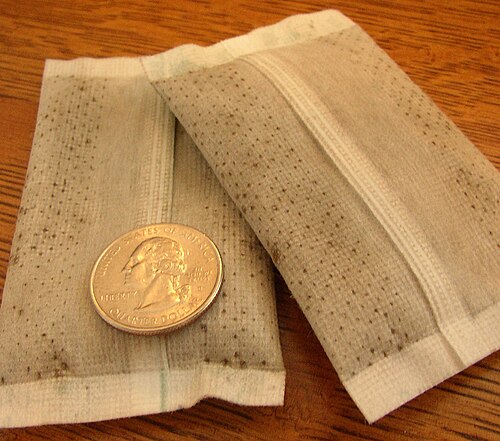
A heat pack works in the opposite way, and it uses an exothermic reaction. There are different kinds of hand warmers, but the cheapest ones are the disposable pouch type. They come in a sealed plastic bag, and they start to get warm as soon as you open the bag. They can stay warm for several hours. They work because they contain iron powder, which reacts with the oxygen in the air. These pouches contain cellulose, iron powder, activated carbon, vermiculite, and salt. When you open them, air enters the pouch through holes in its covering. The oxygen and water in the air react with the iron to produce rust. When you open the packet, oxygen from the air enters through tiny holes in its covering and begins reacting with the iron powder. The salt and water help speed up the process. The iron reacts with oxygen to produce iron oxides, commonly called rust. The products have less chemical energy than the original iron and oxygen, and the difference is released as heat. You might wonder why oxygen reacting with iron to produce rust becomes so hot when your bicycle left in the front garden for six months never warms up. The reason is down to the speed of the reaction. The rust appearing on your bicycle is producing heat, but it is doing it in such small amounts and so slowly that you never notice. A hand warmer reaction is much faster. The iron in a hand warmer is a fine powder, giving it an enormous surface area exposed to oxygen. This allows much more iron to react at once, releasing enough heat for us to feel. And this is what I learned today.
Sources
https://www.bbc.co.uk/bitesize/articles/zb7wwnb#zjynn9q
https://en.wikipedia.org/wiki/Exothermic_process
https://en.wikipedia.org/wiki/Endothermic_process
Image Public Domain, https://commons.wikimedia.org/w/index.php?curid=642519